
Table of Contents
Don't have the time to read the entire post? Our human writers will be sad, but we understand. Summarize the post with your preferred LLM here instead.
MCP (Model Context Protocol) authentication is the foundation of secure, scalable access control for AI agents and agent-driven workflows. It defines how agents authenticate, request access, and act on behalf of users across tools, APIs, and services, ensuring permissions remain tightly scoped as workflows evolve. By brokering identity, context, and authorization through standardized flows, MCP authentication eliminates ad hoc integrations and keeps agent ecosystems consistent and secure.
From early-stage AI products to enterprise-grade agent platforms, MCP authentication is quickly becoming a core requirement for modern application architecture. The right implementation makes it easier to support delegated user consent, fine-grained tool access, and centralized policy enforcement without introducing fragmented logic or hard-coded permissions. For developers, MCP authentication is no longer just an infrastructure concern, but a product capability that directly impacts security, scalability, and the reliability of agent-driven experiences.
In this guide, we explore the top MCP authentication solutions. We break down how each platform approaches agent identity, token exchange, and policy enforcement, highlight key strengths and tradeoffs, and explain which types of teams and products are best suited for each solution.
At a glance
The five MCP auth providers compared here are Descope, Auth0, WorkOS, Stytch, and Scalekit.
Descope offers a complete identity layer for MCP servers, with agents as first-class identities and centralized policy enforcement.
Auth0, WorkOS, Stytch, and Scalekit extend OAuth-based identity to MCP, with varying amounts of custom work for delegation and policy.
The right pick depends on your architecture, agent model, and long-term AI strategy.
What to consider when choosing an MCP authentication solution
Choosing the right MCP authentication solution depends on your application’s architecture, agent model, and long-term AI strategy. While many platforms offer basic OAuth-based authorization, MCP environments require stronger support for agent identities, delegated access, and centralized policy enforcement across tools and workflows.
On a foundational level, MCP auth must support secure agent identity and delegated access across tools and services:
Agent-native authentication architecture: Enable agents to act independently or on behalf of users, with a clear distinction between user and agent contexts.
User-consented authentication flows: Provide mechanisms to capture and enforce user consent when agents act on their behalf.
Scoped token exchange and delegation: Issue OAuth-based tokens with fine-grained permissions for specific tools, endpoints, or actions, without exposing long-lived credentials.
Fine-grained authorization and policy control: Define permissions at the tool, API, or action level, with policies evaluated dynamically by context.
As MCP ecosystems grow, platforms must integrate cleanly with existing identity systems and developer workflows:
Integration with existing identity systems: Ensure compatibility with SAML and OIDC-based enterprise identity providers, such as Okta and Entra ID, to align agent authorization with current SSO infrastructure.
Developer experience: Provide SDKs, APIs, and abstractions that simplify agent authentication flows without complex custom orchestration.
Operational visibility and scalability also become critical as agent usage expands across environments:
Observability and auditing: Maintain logs, tracing, and audit trails to monitor agent activity, token usage, and policy decisions across distributed workflows.
Scalability and ecosystem readiness: Support multiple agents, tools, and workflows while maintaining consistent performance and security.
A strong MCP identity solution balances security, flexibility, and usability, enabling teams to build reliable agent-driven systems while maintaining consistent, policy-driven access control at scale.
MCP authentication solutions at a glance
Here’s how the top 5 MCP auth solutions stack up:
Features | Strengths | Best for | |
|---|---|---|---|
Descope | MCP-native auth, agent identity, policy engine, OAuth token exchange, SSO, MFA, workflows, SDKs | Centralized policy enforcement, agent-native design, agents as first-class identities, fast implementation | AI-native apps, MCP ecosystems, teams needing secure agent orchestration |
Auth0 | OAuth/OIDC, SSO, MFA, RBAC, Actions/Rules, API auth | Mature platform, broad ecosystem, enterprise-ready identity | Enterprises extending existing identity to MCP use cases |
WorkOS | SSO, OAuth, directory sync, APIs, enterprise identity integrations | Developer-first APIs, strong enterprise integrations, fast setup | Teams building custom MCP auth on top of APIs |
Stytch | Passwordless auth, sessions, tokens, APIs, SDKs | Simple implementation, modern auth methods, fast onboarding | Developers experimenting with lightweight MCP auth |
Scalekit | OAuth auth, token exchange, service auth, APIs, MCP patterns | Lightweight, flexible, built for service-to-service auth | Early-stage MCP use cases, custom agent auth implementations |
With these considerations in mind, let’s explore the top MCP auth and identity solutions.
Descope
Overview
Descope is a modern identity platform designed to secure MCP server authentication, agent access, and policy-driven authorization for AI-native applications. It enables teams to authenticate agents, enforce fine-grained permissions, and manage delegated access across tools and services, ensuring interactions remain secure and tightly scoped without custom-built authentication layers or fragmented integrations.
Descope’s MCP-native architecture is built to support agent ecosystems, allowing agents to authenticate and interact with MCP servers through standardized flows while maintaining strict separation between user and agent identity. Access is controlled through centralized policies that define which agents can access specific tools, APIs, and actions, ensuring consistent enforcement as workflows grow in complexity.
Beyond authentication, Descope integrates MCP access with enterprise-ready identity workflows, including OAuth-based token exchange, user-consented access, and policy evaluation across all connected services. With MCP gateway integrations, teams can enforce authentication and authorization for multiple tenants through a single entry point, reducing duplication and ensuring consistent security across every agent interaction.
With visual workflows, SDKs, and native support for agent frameworks, Descope unifies MCP authentication, authorization, and policy orchestration into a single, developer-friendly platform. This enables teams to build secure, scalable agent-driven systems while maintaining centralized control over identity and access across their entire MCP environment. As contributors to multiple MCP authorization working groups, Descope is also aligned with and helps shape evolving MCP standards.
Key capabilities
Agent-native authentication and MCP security
Agent-native authentication flows: Support authentication for agents to securely access services either independently or on behalf of users.
Gateway-agnostic policy enforcement: Integrate with any MCP or PaaS gateway to enforce authentication and authorization for any MCP server.
Fine-grained, tool-level authorization: Define and enforce permissions at the level of individual tools, APIs, and actions, ensuring least-privilege access across agent workflows.
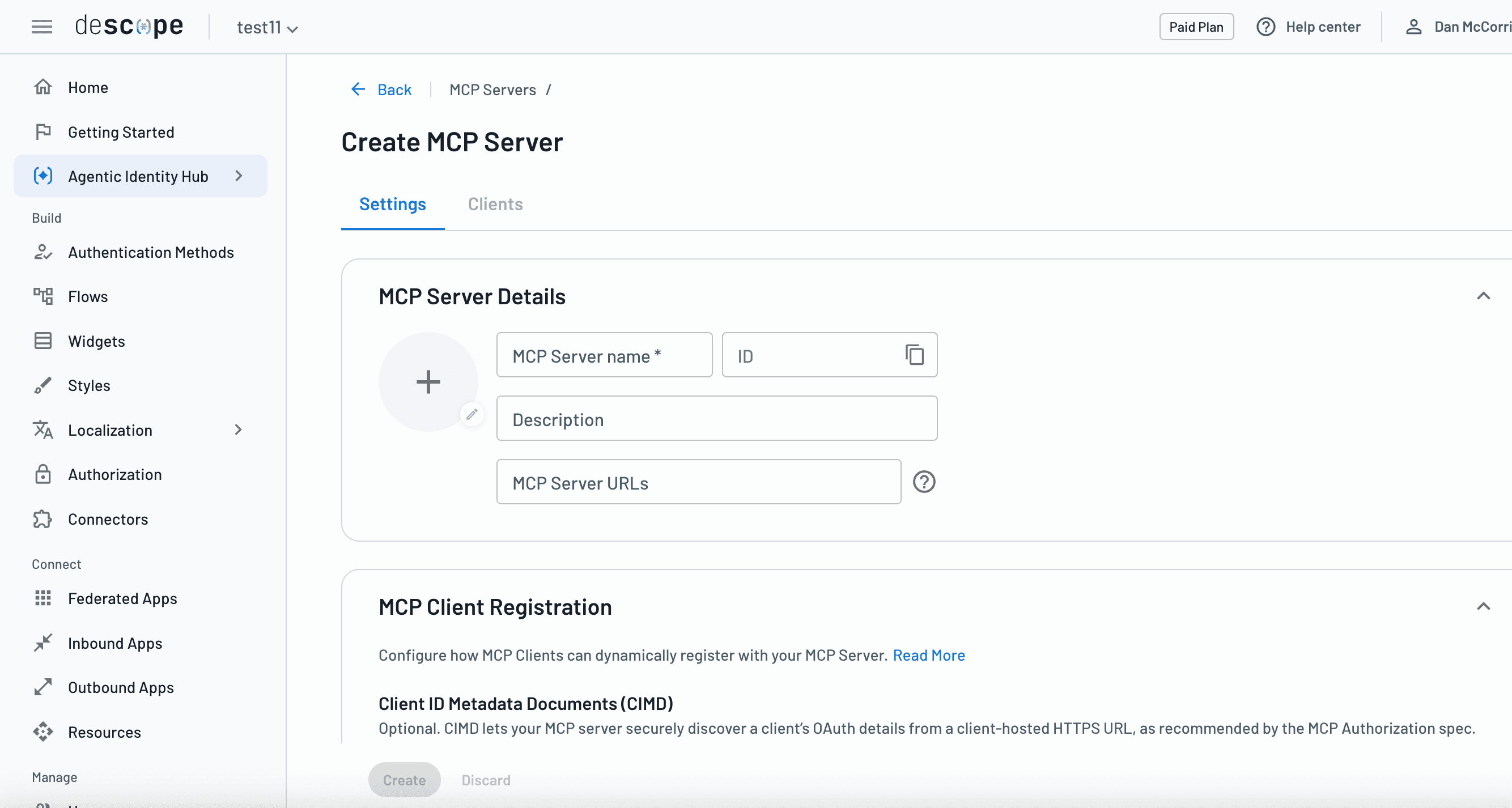
Client registration: Support manual pre-registration, DCR, and CIMD as MCP client registration options.
Enterprise-Managed Authorization (EMA) support: Descope supports both issuing and validating ID-JAG tokens to enable SSO-like experiences for MCP servers. It also has a self-service portal to help customer admins set up EMA with MCP servers using their existing workforce identity provider.
Centralized policy engine: Define, manage, and enforce context-aware policies across all MCP interactions, reducing fragmented authorization logic.
OAuth-based token exchange and delegation: Enable secure, scoped access using standardized token exchange flows, allowing agents to act without exposing long-lived credentials.
Unified identity for users and agents: Manage user and agentic identities within a single platform, ensuring consistent access control across both users and AI agents.
Tenant and user-scoped integration with third-party services: Descope Connections acts as a token vault for storing and refreshing external tokens or API keys to execute MCP tools.
Integration and extensibility
Integrate with existing user IdPs: Plug into existing identity stack using SSO and SCIM to make authorization decisions for internal-facing agents.
Connector ecosystem: Extend authentication flows with third-party services for fraud detection, analytics, compliance, and identity verification.
Enrich JWT claims with webhooks: Route connector responses into Connections to provision user-scoped API keys, storing them in the token vault to be retrieved at tool invocation time.
Developer experience and orchestration
Visual workflow editor: Design authentication, authorization, and agent interaction flows using drag-and-drop tools without writing backend code.
Prebuilt UI widgets: Quickly embed self-service passwordless auth (e.g. adding passkeys and authenticator apps) and account recovery components (e.g. resetting passwords) into any web or mobile app.
SDKs and APIs: Use dedicated SDKs with Python and Express to secure MCP servers with OAuth-compliant auth and identity.
Strengths
MCP-native authentication architecture: Purpose-built support for agent-based authentication enables secure interactions across MCP servers without retrofitting traditional user-centric identity models.
Agents as first-class identities: Manage all agents within a single platform, defined as their own unique identity, and maintain consistent access control across all interaction types.
Centralized policy enforcement by default: Descope’s Agentic Identity Hub policies ensure consistent authentication and authorization across all agents, tools, and services without fragmented logic.
Fine-grained, least-privilege access control: Tool-level and action-level permissions allow teams to tightly scope agent access and reduce the risk of over-permissioned workflows.
Enterprise-ready security and integration: Native support for SSO, auditing, and compliance aligns MCP authentication with existing enterprise identity infrastructure.
Fast implementation for agent workflows: Visual workflows, SDKs, and prebuilt integrations reduce the time and complexity required to deploy secure MCP authentication.
Developer-first platform: Clear APIs, SDKs, and documentation simplify integrating authentication and authorization into modern agent frameworks.
Scales with agent ecosystems: Designed to support growing numbers of agents, tools, and workflows without introducing operational overhead or security gaps.
Ideal for
Descope is ideal for developers and product teams building AI-native applications that require secure MCP server auth and identity, agent access control, and centralized policy enforcement without managing fragmented identity infrastructure. It works well for startups adopting agent workflows early and for enterprises scaling complex MCP ecosystems across tools and services. With Descope, teams can deliver secure, policy-driven agent interactions that scale seamlessly as agents, integrations, and workflows grow.
Descope’s Free Forever tier is $0 and includes 2,000 monthly active consents (MACs) for user consent while accessing MCP servers, while the Pro tier starts at $249/month and includes 5,000 MACs, as listed on the Descope pricing page. You can read this pricing breakdown to understand Descope's pricing for agentic identity.
Auth0
Overview
Auth0, part of Okta, is a well-known enterprise identity platform. If your organization already uses Auth0 for user authentication and single sign-on, it makes sense to start here when adding identity to MCP-based agent workflows. Auth0’s main advantage is its strong support for OAuth 2.0 and OIDC. This gives you a solid and familiar way to issue scoped tokens that agents can use to access APIs and services.
However, Auth0 was not originally built for agentic identity. It does not separate human users from AI agents by default. To support delegated access, agent-specific token flows, or detailed tool-level permissions, you need to add custom logic using Actions or rules. Teams already familiar with Okta and its setup can handle this, but for those starting fresh with MCP, it adds extra work that other platforms are designed to avoid.
Key capabilities
OAuth 2.0 and OIDC-based authentication flows
JWT token issuance for API and agent access
Token-based authorization using claims and scopes
Extensible logic with Actions, rules, and hooks
SAML and OIDC enterprise SSO integrations
Strengths
Battle-tested at enterprise scale: Auth0 has a long production track record for many companies, with proven reliability across large, complex environments.
Existing investment: Organizations already using Auth0 for user auth can extend the same platform to agent workflows without introducing a new identity vendor.
Broad ecosystem and integrations: Deep integrations with identity providers, SDKs, and third-party services reduce integration lift in complex environments.
Ideal for
Auth0 makes sense when your organization already uses it and wants to expand its use to include agent access, instead of switching to a different platform. It works best for teams that have the engineering skills to build custom agent orchestration and policy logic on top of OAuth, and for those who want to keep their tools within the Okta ecosystem.
Also Read: Descope vs Auth0 for AI agent and MCP authentication
WorkOS
Overview
WorkOS is a developer-focused identity platform that helps B2B SaaS products add enterprise features such as SSO, directory sync, and user management via straightforward APIs. Many startups use it to gain enterprise-grade capabilities without building their own identity systems.
Extending WorkOS to MCP authentication is possible, but requires a DIY approach. The platform lacks native agent identity, so delegated access, tool permissions, and agent token exchange need custom work on top of OAuth primitives. For teams wanting to craft their auth layer with solid SSO support, it's a fair tradeoff.
Key capabilities
OAuth-based authentication and token management APIs
Enterprise SSO integrations via SAML and OIDC
Directory sync for user and group management
Developer-first APIs for authentication and identity flow
Strengths
Fast path to enterprise SSO: WorkOS is purpose-built for shipping SAML and OIDC integrations quickly, which is genuinely useful if enterprise customer requirements are your primary driver.
Clean developer experience: Well-documented APIs with minimal abstraction make it easy to understand and compose exactly what you need.
Lightweight footprint: Less opinionated than larger enterprise platforms, which can be an advantage when you want full control over your auth architecture.
Ideal for
WorkOS works well for B2B SaaS teams that need enterprise SSO and want to try MCP authentication without using a more complex platform. It’s a good fit if you have the resources to handle your own agent orchestration and policy logic, and your MCP needs are simple enough that missing agentic features won’t cause much extra work.
Stytch
Overview
Stytch is a modern authentication platform designed for passwordless user experiences. Its primary value lies in developer simplicity, offering clear APIs, reliable SDKs, and robust support for OTP, magic links, and passkeys. These features enable teams to implement authentication quickly without dealing with outdated protocols.
For MCP authentication, Stytch can function as the user identity layer within an agent workflow by issuing tokens that agents use to access downstream services. However, its native support is limited to basic token issuance. Stytch does not provide built-in models for agent identity, delegated access, or tool-level permissions, so any advanced requirements require custom development. This reflects the platform’s focus on authenticating human users rather than agents.
Key capabilities
Passwordless authentication with OTP, magic links, passkeys
Session management and token-based authentication flows
APIs for authentication and user identity management
Basic RBAC-style authorization for application access control
Strengths
Best-in-class passwordless UX: If frictionless user login is a priority alongside MCP, Stytch's passwordless primitives are genuinely strong.
Fraud and bot detection built in: Device fingerprinting and risk signals are native to the platform, not bolted on, which is a real differentiator for consumer-facing agent products.
Clean, approachable APIs:: Well-suited for smaller teams that want to move quickly without deep identity expertise.
Ideal for
Stytch fits teams whose primary auth requirement is a modern, passwordless user login experience, and who need only basic token support to get agents off the ground. If your MCP use cases are simple and you're comfortable building policy and delegation logic yourself, it works fine as a lightweight foundation. It's not a good fit once agent workflows start requiring fine-grained access control or multi-tenant enforcement.
Scalekit
Overview
Scalekit is an authentication platform that is starting to support MCP authentication. It helps secure service-to-service and agent-based access by offering standard ways to authenticate agents and issue scoped tokens. This lets MCP interactions use modern OAuth patterns for security.
Scalekit’s lightweight, flexible approach makes it well-suited for early-stage MCP implementations. However, it provides fewer integrated features for centralized policy enforcement, enterprise workflows, and large-scale agent orchestration than more comprehensive platforms. Among the platforms considered, Scalekit has the smallest user base, which limits its demonstrated reliability for MCP authorization in production environments.
Key capabilities
OAuth-based authentication for MCP and service access
Token exchange for delegated and scoped permissions
API-first model for authentication and integration workflows
Support for service-to-service and agent authentication flows
Strengths
Modern authentication focus: Built around current OAuth and token exchange patterns for secure agent access.
Lightweight and flexible platform: Enables teams to implement MCP authentication without heavy infrastructure.
Designed for service and agent use cases: Supports agentic AI scenarios more directly than traditional platforms.
Ideal for
Scalekit is ideal for teams exploring MCP authentication with a lightweight, flexible approach. It works well for early-stage products or teams that want to build custom agent authentication flows without adopting a fully managed, enterprise-grade identity platform.
Conclusion
Modern MCP authentication is no longer just an extension of API security. It has become a core part of how AI-native applications enable agents to securely access tools, act on behalf of users, and execute workflows across distributed systems. The right MCP authentication solution ensures agent interactions are properly scoped, policies are consistently enforced, and access remains secure as agents, integrations, and use cases evolve. Whether your goal is to enable agent-driven automation, reduce security risk, or standardize access across MCP servers, adopting a purpose-built authentication layer is essential.
Among today’s options, Descope stands out for its native support for MCP authentication, centralized policy enforcement, and agent-aware identity flows, all delivered through a unified, developer-friendly platform. By combining authentication, authorization, and centralized policy enforcement, Descope enables teams to secure agent ecosystems without stitching together multiple tools or building custom infrastructure.
To learn more about implementing MCP authentication with Descope, check out our docs. If you'd like a demo, meet with our auth experts. Also, if you want to try Descope yourself, sign up for a Free Forever Account and start building secure, scalable AI agents and MCP servers today!