

Table of Contents
Don't have the time to read the entire post? Our human writers will be sad, but we understand. Summarize the post with your preferred LLM here instead.
Bots are now a regular part of modern apps, and they often target authentication flows. Login and signup pages face constant pressure from things like credential stuffing, fake account creation, account takeover (ATO) attempts, and spam.
Even though news stories highlight more advanced attacks, most bot traffic is still simple and high in volume. These bots do not try to be smart. They just aim to be quick, reach many targets, and get the job done.
The effects add up fast. Fake signups fill your user database with junk. Automated traffic raises your infrastructure costs. Fraud attempts mean more work for your team. Over time, product and security teams spend more time cleaning up problems instead of building new features.
The good news is that you do not always need complex solutions for bot problems. Often, simple tricks can block a lot of unwanted traffic before it causes issues.
What is a bot trap (aka honeypot)?
A bot trap, often referred to as a honeypot, is one of the simplest and most effective techniques for detecting unsophisticated bots.
The idea is straightforward. You add a hidden field to a form that real users never see. Legitimate users leave it empty because it's invisible to them. Bots, on the other hand, tend to autofill every available field. The moment that hidden field is populated, you know you're dealing with an automated request.
This approach works because it introduces zero friction for real users while requiring almost no implementation overhead. There are no puzzles to solve, no additional steps in the user journey, and no impact on conversion rates.
Bot traps are especially effective at catching "dumb" bots at scale. They won't stop more advanced, human-like automation, but they can quickly filter out a large percentage of low-quality traffic. The value of this early detection is well-documented — Coalition's 2024 Cyber Threat Index found honeypot activity spiked 1,000% more than two weeks before the MOVEit vulnerability advisory was issued, demonstrating how honeypots surface malicious behavior before it ever becomes a headline.
And this is exactly what Descope enables natively inside Flows.
Bot Trap in Descope Flows
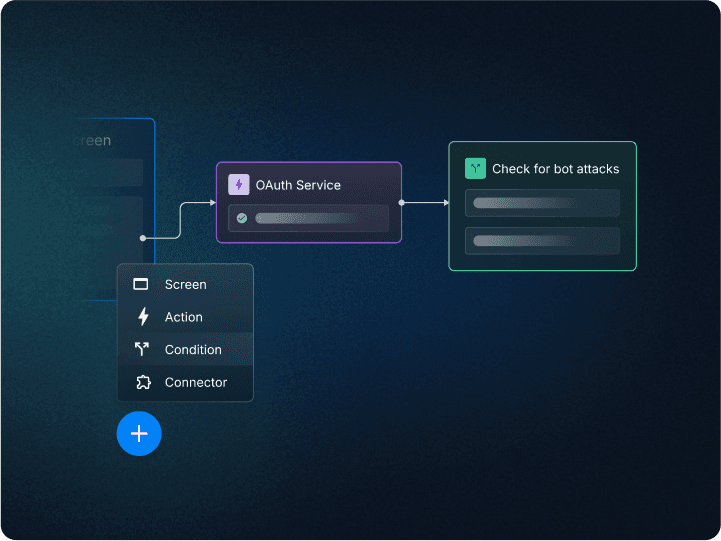
Descope’s Bot Trap brings protection against high-volume bots directly into the authentication process through Flows, allowing you to embed this technique into your identity journeys without additional tooling.
Instead of writing custom frontend logic or managing hidden fields manually, you can simply add a Bot Trap as part of your Flow configuration. It works seamlessly across signup, login, and any custom authentication experience you build.
Because it’s built into the flow itself, bot detection effortlessly becomes part of your identity orchestration rather than an external add-on. There’s no need to stitch together scripts, manage separate services, or maintain custom detection logic.
Use Case: Stopping fake signups before they pollute your app
Imagine you’ve just launched a new product or feature. Within hours, your signup flow starts filling with fake accounts, with bots creating spam users, testing stolen credentials, or preparing for future abuse.
You don’t want to add friction like CAPTCHAs for real users. You just want a lightweight way to filter out low-effort bots instantly.
That’s where a Bot Trap flow comes in.
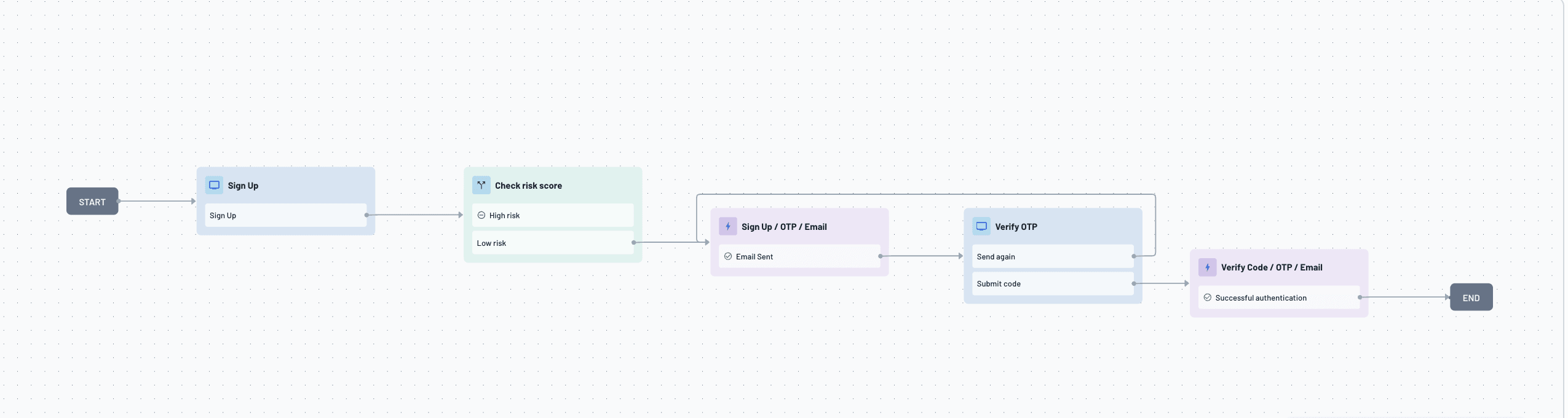
With Descope, you can start with the Sign-Up with Bot Trap Spam Protection in the flow library and have protection in place in minutes. This flow adds a simple, invisible detection layer directly into your signup experience:
Start with a pre-built signup flow that includes bot protection.
The Bot Trap toggle is set to on in your signup screen. No frontend changes are required.
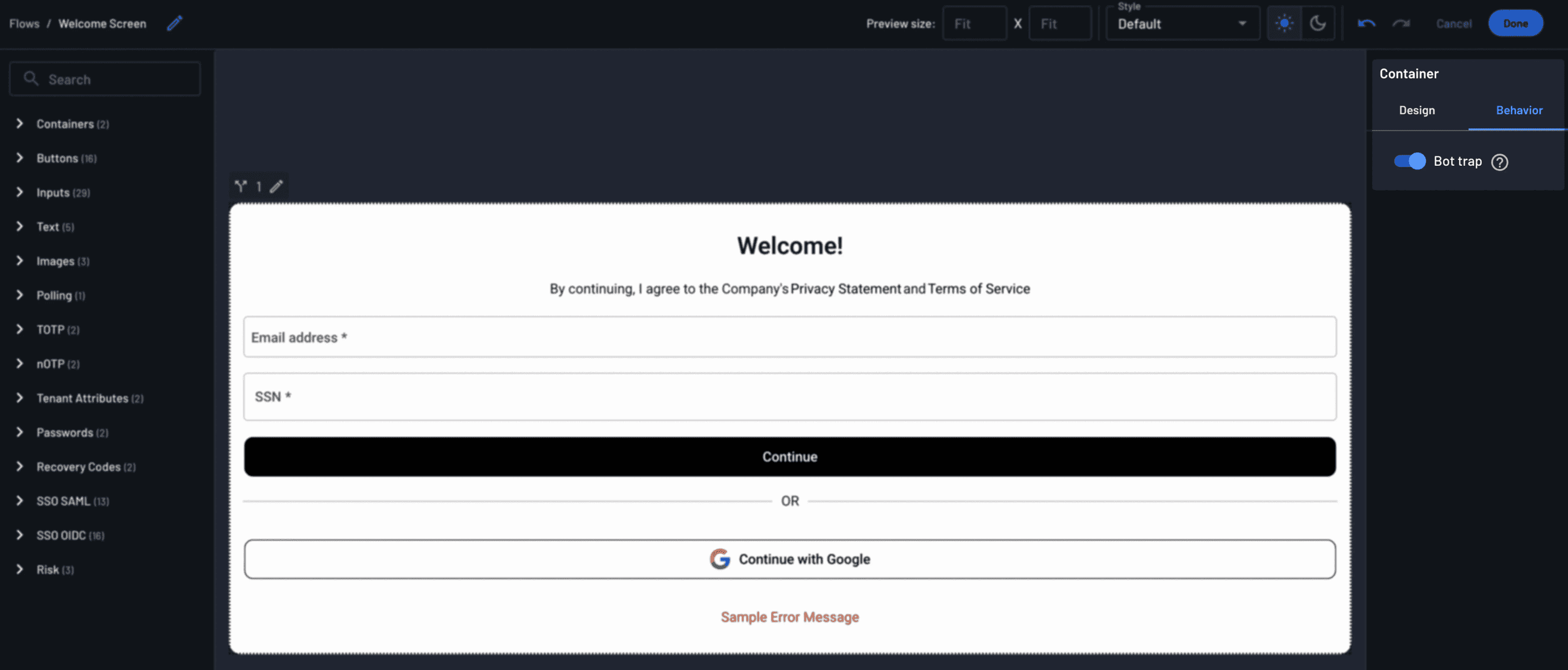
Bots are detected when hidden fields are automatically populated, with the
riskScoreparameter being set to its maximum value.Block or route suspicious requests before account creation.
Extend the flow with email verification, MFA, or risk-based logic as needed
For real users, nothing changes. They complete signup normally, without ever seeing the bot trap.
For basic bots, the outcome is immediate. They autofill hidden fields, get flagged, and can be blocked before an account is created. Your database stays clean, and your infrastructure isn’t wasted on low-quality traffic.
Because bot traps operate silently, they introduce no user friction, require minimal engineering effort, and deliver immediate value. While they won’t stop every advanced attack, they serve as a highly effective first layer that removes a large percentage of unwanted traffic before it becomes a problem.
Layered bot defenses with Descope
Modern bot defense isn’t about a single control. It’s about combining multiple signals and adapting responses based on context. Bot traps serve as an early filter, but more sophisticated attacks require deeper analysis and dynamic responses.
Descope enables this through a layered approach built directly into Flows.
Native Descope capabilities
You can incorporate native risk signals such as IP reputation, velocity patterns, and behavioral anomalies directly into your authentication logic. Based on these signals, you can trigger adaptive or risk-based MFA, ensuring that additional friction is only introduced when necessary.
Because these decisions live inside workflows, you can continuously refine how your system responds to different types of activity.
Plug & play connectors
For more advanced bot and fraud detection, Descope integrates with leading third-party providers.
Arkose Labs adds advanced bot mitigation and interactive challenges for high-risk scenarios.
Forter provides fraud and abuse detection across the entire user journey.
Fingerprint delivers device intelligence and persistent user identification.
Google reCAPTCHA Enterprise offers risk scoring and challenge-based verification when needed.
Within a single Flow, you can combine bot traps as an early filter, risk scoring for deeper context, and MFA / step-up as a response mechanism.
Everything is orchestrated in one place, giving you full control over how your application handles both low-effort and advanced threats.
Why this matters for developers and product teams
Traditionally, bot protection requires stitching together multiple tools, embedding logic across frontend and backend systems, and coordinating between product and security teams.
With Descope, that complexity is reduced significantly.
Security logic lives inside workflows rather than scattered across your codebase. Teams can adjust bot defenses, update authentication logic, and experiment with new approaches without redeploying applications. At the same time, user experience improves. Instead of applying blanket friction like CAPTCHAs, you can challenge users only when signals indicate risk.
The result is a system that is both more secure and more user-friendly.
From simple trap to layered defense
Not every bot problem requires a heavy solution.
Bot traps offer a simple, effective way to eliminate a large portion of low-effort attacks with minimal effort and zero user friction. When built into Descope Flows, they become part of a broader, flexible defense strategy that evolves with your application.
By combining lightweight techniques like bot traps with adaptive authentication and advanced detection signals, you can protect your authentication flows without compromising user experience.
If you want to try Descope yourself, sign up for a Free Forever Account and start building resilient authentication journeys today! If you'd like a demo, meet with our auth experts.