
Table of Contents
Don't have the time to read the entire post? Our human writers will be sad, but we understand. Summarize the post with your preferred LLM here instead.
There’s a moment in every B2B startup’s growth journey where deals can start fizzling for reasons that have nothing to do with your product. Proofs of concept are going great, your champions are bought in… and then you meet with the CISO or CSO. They’ve got a laundry list of security questions:
“Do you support SAML or OIDC single sign-on (SSO), and how long does it take to set up?”
“Can our IT team easily manage our own tenants and provide admin tools on a per-tenant basis?”
“Where and how is user data stored? Do you comply with HIPAA, FedRAMP, and GDPR?”
“Can we easily view audit logs for compliance, or do we have to get them manually exported?”
They’re tough questions, and exactly the kind you should expect when moving upmarket to serve enterprise customers. But what does it take to answer them with confidence, seal the deal, and win enterprise business? This article shines a light on what enterprise identity readiness really means.
We’ll cover what’s at stake when you don’t have it, how companies that hit this wall managed to scale it, and why a managed solution is often the best choice for B2B startups moving into the enterprise market.
Enterprise auth and the problem with plumbing
For most early-stage startups, authentication requirements are treated like plumbing. It’s essential infrastructure that every startup needs, sure, but it’s not a competitive differentiator—at least, not until you’re losing or stalling deals due to identity and security issues. Case in point: SSO (and all the “plumbing” supporting it) is one of the most frequently requested enterprise-grade features, and it can easily render a deal dead in the water if it takes too long to set up, secure, and manage.
The most frustrating part of this challenge is that it arrives precisely when you can least afford it:
You’ve already validated product-market fit with smaller deals
You’re ready to greet your enterprise inflection point with open arms
But the basic infrastructure that got you here won’t get you there
And your team is already stretched thin developing your core product
Unless your product is authentication or digital identity, completely rerolling auth while trying to close Fortune 500 deals is like swapping the engines on a plane mid-flight. Simply put, it’s a non-starter for most enterprises if you take too long to get your ducks in a row.
If you want to win enterprise deals, you have to be ready before you step into the ring. You need to show you’ve met (or can quickly meet) their requirements, not that you’re willing to eventually get there. For most big companies, this starts with SSO.
Your upmarket momentum depends on SSO
Virtually every enterprise deal eventually leads to conversations about SSO. Not whether you support it—that’s table stakes—but how.
IT teams at companies with hundreds, thousands, or even tens of thousands of employees won’t approve tools that create security gaps or administrative overhead. The vast majority of mid-to-enterprise-market companies mandate SSO for vendor procurement, meaning they won’t even consider your product if SSO isn’t already available.
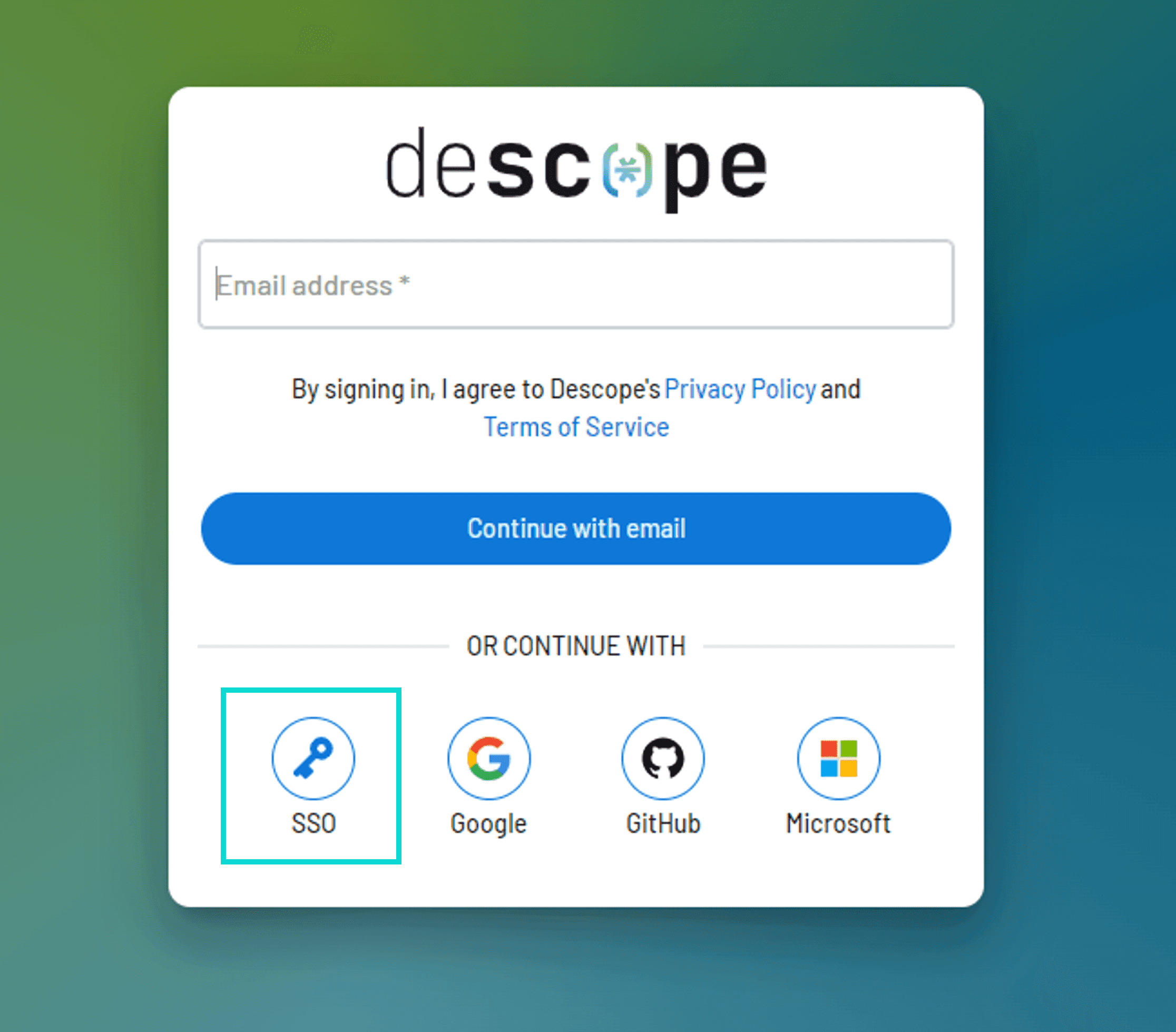
A key characteristic to always remember with enterprise IT or security decision-makers is control. They need to provision (and de-provision) users through their existing identity provider. They need employees logging in with corporate credentials, not creating yet another vulnerable password they’ll forget and reset, or write on a sticky note. They need visibility into their SSO connections and IdPs, and the ability to manage as much of their own security posture through your product as possible.
Specifics are crucial here:
Can you support both identity provider-initiated and service provider-initiated SSO? That matters when different enterprises expect different starting points.
Do you have both SAML and OIDC support? You don’t get to pick which protocol your customers are using.
You need to support multiple identity providers (IdPs) per tenant for larger organizations that might experience acquisitions, those with contractors, or partners running different IdPs.
Also read: IdP vs SP-initiated SSO
Stack Overflow vs. Notch and Cequence Security
Stack Overflow learned just how tough hand-rolling SSO implementation can be when they added it to their Teams product back in 2019. It took a team of three engineers three months and resulted in one of the largest rewrites of their authentication code up to that point. They likely had to solve problems they didn’t anticipate, edge cases that only surface when you’re integrating with many different identity systems.
And that’s what many startups don’t realize until they’re in the thick of it: What works for one enterprise scenario might not work for all enterprise scenarios. Each IdP has its own quirks, every IT team has their own requirements, and the underlying specs (SAML, OIDC, SCIM, etc.) are nuanced enough that not every vendor handles them the same way.
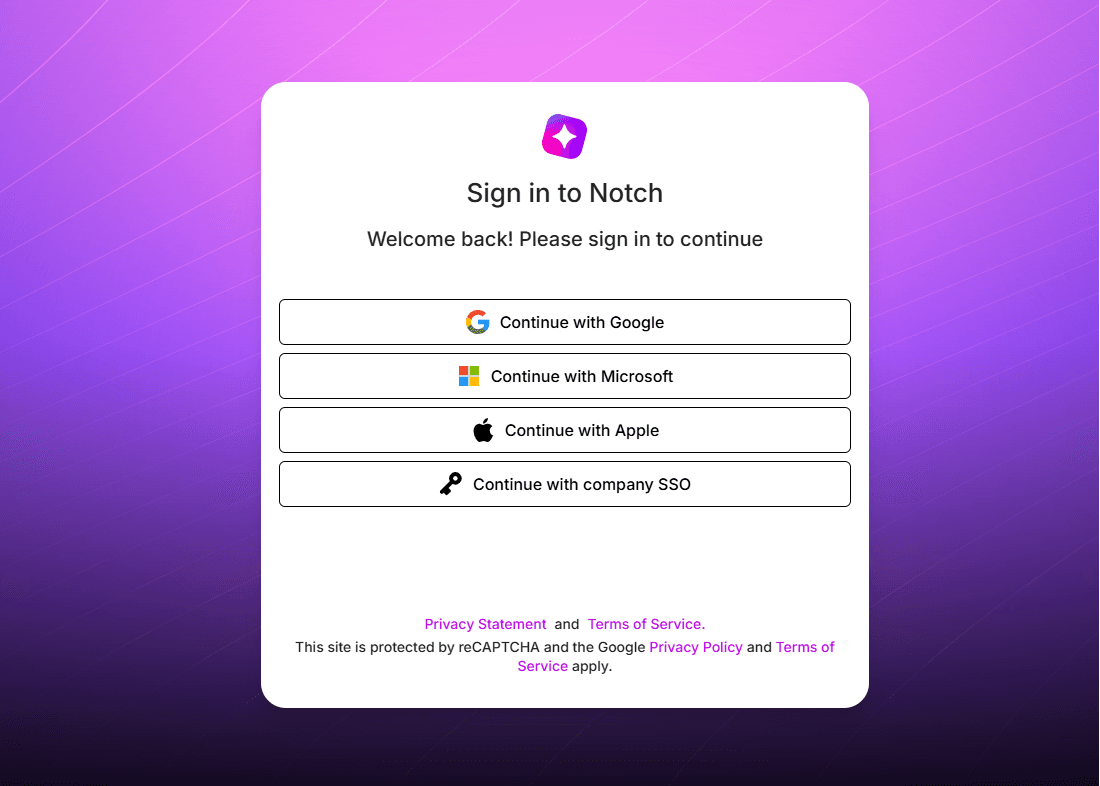
Instead of building everything from scratch, fintech startup Notch chose an identity platform that handles all this complexity: Descope. After deploying their solution, Notch leveraged the Descope SSO Setup Suite (a wizard-like, self-service config tool) to rapidly onboard enterprise customers—one customer even had SSO successfully set up within 24 hours.
Cequence Security, an API security company, saw a 90 percent drop in SSO support tickets (i.e., calls that required hands-on support to onboard customers with SSO) after moving to Descope’s self-service configuration. Before that, every customer SSO setup required their team’s direct involvement. This could take anywhere from days to weeks as delicate variables were dialed in.
The crux of this comparison is simple: If Stack Overflow had been negotiating with an enterprise prospect, that deal would’ve died in the three months it took for SSO to materialize. Notch would’ve had them up and running in a day, without sacrificing a single developer hour to the process. And Cequence Security would have similarly avoided spending unnecessary dev cycles on guiding customers through routine SSO configuration.
Let enterprise customers manage themselves
It’s obvious that out-of-the-box, self-service SSO is a net win for startups moving upmarket. But this begs a broader question: What else can your already-capable enterprise prospects handle without filing a support ticket? What do they want to handle that many providers in your industry don’t usually let them (read: even though there’s no security rationale not to)?
This is where delegated administration comes into play. The idea is to embed admin capabilities directly into your customer’s instance so tenant admins get a native-feeling experience, while you avoid building bespoke admin UIs from scratch.
Many of the capabilities tenant admins want will ultimately save your team time if delegated:
SSO and SCIM connections
User management (creating, editing, and managing user access)
Access key management (machine-to-machine)
Audit logs
Tenant profile (email domains, SSO exclusions, etc.)
You.com, the AI productivity and search company, is managing close to a thousand B2B tenants with minimal engineering lift needed. That’s made possible because their customers are able to handle their own user management, leveraging fine-grained authorization (FGA) to enforce permissions for an increasing number of enterprises.
BalkanID, an identity governance platform, regains countless developer hours previously spent manually exporting logs for customers to audit (which they now handle automatically), troubleshooting account lockouts (which customer admins can resolve), and cleaning up deleted or modified employee identities (which are now addressed by customer admins).
An admin widget approach means you’re not choosing between control and scale. You decide what tenant admins can and can’t do. They get the capabilities they want, and your support team gets their time back.
Multi-tenancy isn’t just a checkbox for enterprise
Enterprises expect a lot more from multi-tenancy than your sales reps saying “each customer gets their own tenant ID.” True multi-tenancy means:
Tenant-aware authentication that routes users to the correct IdP based on email domain or tenant identifier
Per-tenant branding so that login screens match each customer’s brand instead of looking like a generic auth page (that users might mistake for a phishing attempt)
Per-tenant access controls with roles and permissions scoped appropriately based on specific tenant parameters
Tenant-level isolation for security and compliance (i.e., physical separation), ensuring one customer’s data never comes close to leaking into another’s
BalkanID’s experience here is insightful, once again. They originally chose Ory Kratos for authentication, regarding the framework’s apparent open-endedness as the key to providing all the tenant configurability they sought. As they grew, however, maintaining it became increasingly painful. They needed enterprise-grade multi-tenancy with real tenant isolation, but without the engineering overhead that led to stalled deals and stifled development.
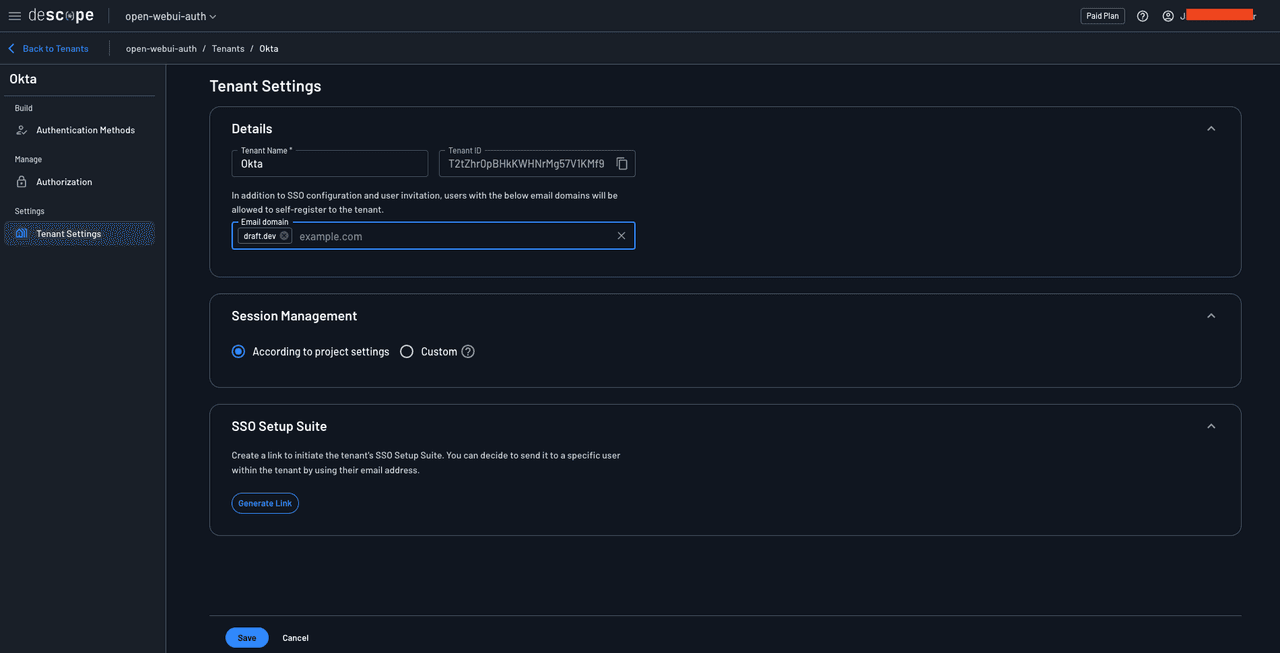
The other piece that can catch startups off guard is multi-tenant users: contractors, consultants, employees who work across multiple customer organizations. If your architecture assumes one user equals one tenant, you’ll spend a lot of time building workarounds. For BalkanID, using Descope offered per-tenant identity linking to handle this and similar edge cases (i.e., boomerang employees) without extra work.
Also read: Multi-tenant vs single-tenant architecture
Data residency and compliance are enterprise essentials
GDPR isn’t optional for enterprises operating in the EU. Some enterprise deals are gated entirely based on where the data lives, or in the case of FedRAMP, whether your organization is vetted for dealing with government entities. It's one of the biggest hurdles to overcome for early startups.
But beyond simple regulatory requirements, this is really about sales velocity. If your prospect’s legal team spends three weeks trying to figure out if your user data storage and processing meets their criteria, you’ve lost vital momentum. Having a clear answer, backed by actual infrastructure commitments, removes a sales blocker that has nothing to do with whether your product solves their problem. Yet it can have everything to do with whether an enterprise can even consider doing business with you.
Multi-region data-residency means EU data stays in the EU, US data stays in the US. User data and instance configurations are stored and processed only in the region of choice, ensuring compliance with local regulations. For companies selling to government agencies, defense contractors, or organizations with federal data requirements, FedRAMP authorization opens an entire market segment. FedRAMP High covers the most sensitive unclassified data, and it’s a legitimate differentiator when competitors can’t check this box.
Echelon AI, a company building AI agents that automate ServiceNow implementations for Fortune 500 companies, specifically cited FedRAMP High and multi-region data residency as requirements for their target customer base. When you’re selling to enterprises with rigorous security and compliance requirements, these aren’t luxury additions. They’re the expectation.
Audit trails for two different audiences
Auditing serves two audiences: your security and compliance team, and your customers’ security and compliance teams. For example, Descope allows your team to stream audit logs to a third-party tool like Datadog or AWS S3 for real-time observability.
What needs to be logged?
Logins, both successful and failed
Attempts made
Methods used
IP address, device fingerprint, and geolocation
User modifications, like role removals
Error events with IDs for debugging
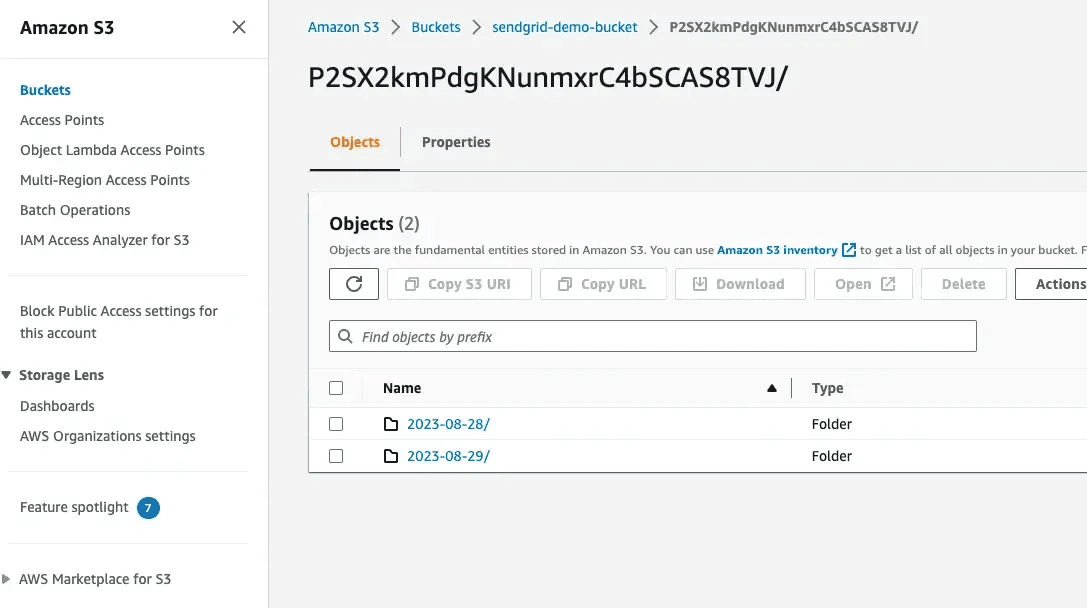
The less obvious requirement is giving your customers access to their own audit data. If their compliance team needs login records for an audit, you don’t want to be fielding manual export requests. Once again, delegated admin for audit management means customers can view their own tenant’s audit logs through an embeddable component.
Treating auth code like product code
Your authentication configuration needs the same dev-staging-prod pipeline as your application code. The best practices that help you define and refine your product, making it attractive to enterprises, are still best practices when applied to identity management.
This means separate projects for each environment, and integrations like GitHub Actions workflows for moving configurations between them. This can extend to Terraform providers that enable managing infrastructure as code, and to export and import capabilities for flow configs, connector setups, and auth method settings.
The alternative is managing changes directly in production, which works until it doesn’t. One misconfigured field, one flow change that breaks the login experience for a subset of users, one accidentally deleted role can be catastrophic. Apply the same discipline you enforce on app deployments for your authentication implementation.
The cost of waiting too long for enterprise auth
Here’s a reasonable argument for delaying enterprise identity work: You’re too early. Your customers are small, engineering time is precious, and the first enterprise deals are months away. Why build for requirements you don’t have (yet)?
But here’s the counterargument: These requirements arrive faster than expected, and building them under the pressure of a looming deal is worse than resolving them proactively. The same moxie and self-starter mentality that brought you to the edge of enterprise awareness isn’t going to propel you further without significant pains.
The inflection point is usually obvious in hindsight. But many startups who built everything else from scratch will find themselves floundering when it comes down to the wire for an enterprise deal.
BalkanID Director Vishesh Bansal wrote in his retrospective post:
“Thousands of lines of code don’t equal control. More to the point, control over your code isn’t the same as control over your outcomes. If I could do it all over again, I might have migrated sooner. Probably the moment we started serving large enterprises with SSO requirements.”
The migration story is worth a read if you’re currently running a roll-your-own solution and feeling the strain.
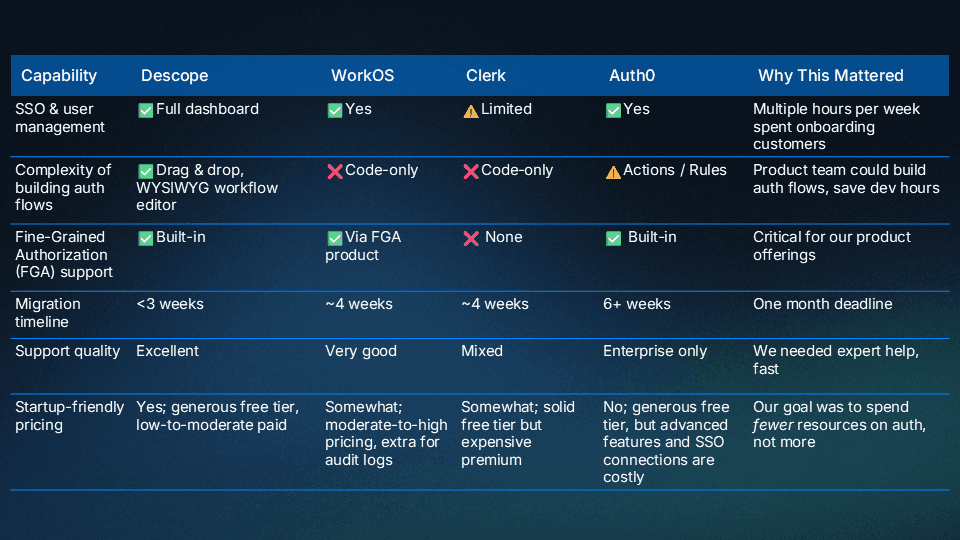
An enterprise team starts spontaneously using your product through self-service, a mid-market customer grows rapidly and starts asking about more multi-tenancy features, your sales team reports that security reviews are stalling momentum—these signals indicate a definitive shift in your market position that can’t be ignored. Your product has proven valuable enough that larger organizations want to standardize on it, but what worked for small orgs simply won’t scale.
The companies that navigate this transition well are the ones that recognize early that they’re moving toward a chokepoint in their growth. They invest in identity infrastructure before it’s an imperative to stay afloat, or prior to losing a deal because of their limitations. The ones that struggle are those that treat essential enterprise auth features as a future problem, messy “plumbing” that isn’t a priority—until it’s the only priority.
Prepare your B2B startup for moving upmarket with modern authentication built to meet demanding enterprise needs. Sign up for a Free Forever Descope account, or book a demo to talk through your enterprise customers’ emerging requirements. It’s never too early to prepare for the next big step.