
Table of Contents
Don't have the time to read the entire post? Our human writers will be sad, but we understand. Summarize the post with your preferred LLM here instead.
Booking a flight used to take me an evening. I'd compare fares across three tabs, check whether my miles were worth using, and then stare at the seat map. Now I can tell a personal agent "find me a nonstop to Denver under $400 for the 18th and check with me before you book," and get on with my night.
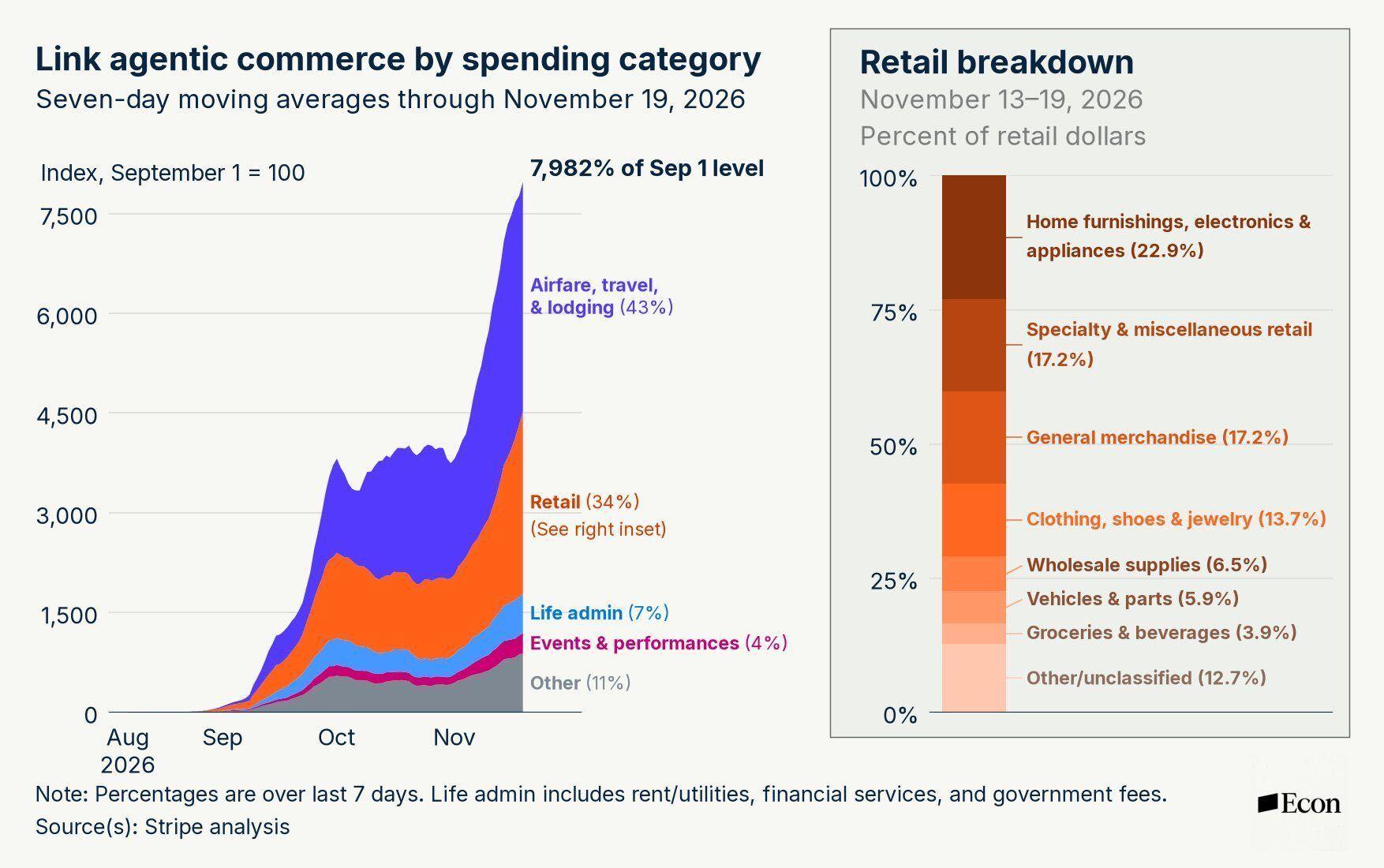
Stripe's latest data suggests plenty of travelers are doing the same, with airfare, travel, and lodging making up 43% of agentic spending on Link in the week ending November 19, more than any other category. Daily agent spend on Link was nearly 80 times higher in mid-November than at the start of September.
For airline digital and loyalty teams, the question has moved from "will agents book flights?" to "what happens when one reaches our sign-in page?" This post covers where airlines stand today, why sign-in is the hard part, and six identity tips for letting agents book without losing control of the account or the sale.
At a glance
Personal agents are spending more on travel than on any other category, and airlines are responding in very different ways.
An agent that signs in with a traveler's password looks the same as an account takeover attempt, which puts bookings, payment details, and miles at risk.
The six tips below cover how to identify agents, scope what they can do, get traveler approval, protect loyalty balances, keep an audit trail, and offer an authorized booking path.
Descope Envoy gives airlines a delegated sign-in path for personal agents that runs alongside their existing customer and loyalty logins.
The different ways airlines are responding to personal agents
At ATPCO's Elevate conference in October, the company reported that 37% of carriers have active AI programs, but only 11% have deployed agentic AI, so most airlines are still deciding how to work with agents.
Airlines that do engage with agents have taken different approaches. For instance, Virgin Atlantic and Southwest let travelers search and price flights through ChatGPT, then send them to the airline's own site to book.
Other airlines are approaching agents carefully, and for good reason. In November, United Airlines announced it would restrict unauthorized third-party AI agents from completing bookings, citing data security and regulatory compliance, while still welcoming AI for trip research. It's a sensible line to draw: a ticket carries a passenger's legal name, payment details, and loyalty balance, and an agent signing in with a customer's password gives an airline no way to know who is really acting.
Some airlines are giving agents a standard-based entry path. For example, Turkish Airlines supports the Personal Agent Protocol (Poppy), where personal agents can check fares, flight status, stopovers, and pull up a booking with a reference number and surname.
Whichever approach an airline takes, the underlying question is: what should an authorized agent look like?
The airline sign-in page is where things get tricky
An airline account holds more than seat assignments and meal preferences. It stores a traveler's legal name and travel document details, saved payment methods, upcoming bookings, and a miles balance that can be worth thousands of dollars.
When an agent signs in using the traveler's password and one-time code, the airline’s systems see an ordinary “human” login…which is also what an account takeover attempt looks like. Loyalty programs are already a common ATO target, with Fingerprint's 2026 travel and hospitality fraud report putting rewards fraud at $1 billion to $3 billion in global losses a year, with more than half of loyalty fraud incidents involving account takeover. Airline miles draw extra attention because a single redemption can cover a flight worth $1,000 to $5,000 or more.
Then there's the support call. A traveler sees a nonrefundable fare on their statement and says "I didn't book that." Maybe their agent booked it as asked. Maybe it misread the request. Maybe it was never their agent. If the agent signed in as the traveler, your logs can't tell these cases apart, and your team has to bear the burden of resolution.
Agentic identity tips for airlines
Know which agent is at the door
Challenge
When an agent uses a traveler's credentials, the airline’s systems can't tell which agent is making a request (or whether an agent is involved at all), so they can't apply different rules for agent traffic.
Solution
Ask agents to identify themselves before issuing a session. Poppy gives agents a standard way to discover your agent-facing endpoints and sign in under their own identity, tied to the traveler they act for.
Publish one discovery file: Agents read it to learn how to sign in and what they can do.
Identify agents by metadata: Client ID Metadata Documents let compliant agents identify themselves without a manual registration step.
Bind sessions to the agent: Tie each session to the agent's cryptographic key with DPoP, so tokens only work for the agent they were issued to.
Also read: What Is the Personal Agent Protocol?
Scope agents to the trip
Challenge
A full account session gives an agent everything the traveler can do, including editing passport details, adding payment methods, and changing the account email. A booking task needs a fraction of that access.
Solution
Define what agents can do on a traveler's account and keep everything else off limits.
Allow the booking tasks: Searching fares, holding seats, and booking within a stated budget.
Protect identity data: Keep travel documents, contact details, and account settings out of an agent’s scope.
Limit duration: Expire elevated access once the task is done.
Ask the traveler before irreversible actions
Challenge
Many fares are nonrefundable, and prices change by the hour. An agent that books flights on its own can leave a traveler with a ticket they can't cancel and a dispute that support teams have to sort out.
Solution
Send high-value or irreversible actions back to the traveler for approval on their own device, outside the agent's session.
Let’s say the traveler's agent spots a fare drop on the Denver nonstop at 11 PM. It should hold the fare and send the flight, times, and total to the traveler's phone. The traveler approves when they wake up, and the booking then goes through with a clear record of who asked, who approved, and who booked.
Use out-of-band approval: Client-Initiated Backchannel Authentication (CIBA) sends the request straight to the traveler's device.
Show the details: Include the route, times, fare rules, and total in the approval request.
Set the triggers: Decide which actions need approval, such as ticket purchases above a certain amount or any nonrefundable fare.
Protect miles separately
Challenge
Travelers can redeem or transfer miles in minutes, often with fewer checks than a card payment. If an agent session can redeem miles as easily as it can search fares, a compromised agent or a bad instruction can accidentally empty out the traveler’s points balance.
Solution
Treat loyalty actions as their own permission, with their own approval.
Separate redemption from booking: An agent allowed to book with a card doesn't automatically get access to miles.
Require approval for transfers: Points transfers and award redemptions should always go back to the traveler.
Revoke without logout: Cut off a single agent's access without signing the traveler out of their account.
Record delegation for disputes and compliance
Challenge
Support teams handle "I didn't book that" calls every week, but not when an AI agent did the booking. Without a record of the agent’s involvement, they have to choose between refunding the charge and trusting the traveler's memory.
Solution
Record the traveler and the agent as separate identities in every token and log entry.
Log both identities: Show which agent acted and which traveler it acted for.
Keep approvals with the booking: Store the approval record with the reservation.
Make records searchable: Let support and fraud teams look up agent activity by booking reference.
Offer an authorized path for agents
Challenge
When agents can't book with an airline directly, they look for another way in: usually through intermediaries or by having travelers hand over their passwords. Booking Holdings' Vayo agent, for example, hands checkout back to the traveler when a supplier doesn't permit agent bookings. Each workaround like this means less visibility for the airline.
Solution
Airlines should give agents a standard, authorized way to book directly, so they keep the customer relationship and stay the merchant of record.
Adopt a standard once: Supporting Poppy lets any compliant agent connect, so airlines don't need a separate integration for each agent.
Set your own rules: The airline’s scopes and approval triggers apply to every agent that connects.
Keep existing sign-in: Add the agent path alongside current customer and loyalty logins.
Also read: Descope Joins the Personal Agent Protocol as a Design Partner
Identity tips for airlines: at a glance
Tip | Challenge | Solution |
|---|---|---|
Know which agent is at the door | Agents using traveler credentials can't be told apart from travelers. | Have agents sign in under their own identity through Poppy, with sessions bound to the agent. |
Scope agents to the trip | A full session gives agents access to travel documents, payment methods, and settings. | Allow search, hold, and booking within a budget. Keep identity data out of scope. |
Ask the traveler before anything irreversible | Nonrefundable fares booked without approval turn into disputes. | Send high-value or irreversible actions to the traveler's device for approval with CIBA. |
Protect miles separately | Miles can be redeemed or transferred quickly by any session with access. | Make loyalty actions a separate permission that always needs traveler approval. |
Record delegation | Support can't tell whether the traveler or an agent made a booking. | Log the traveler and the agent separately and store approvals with each reservation. |
Offer an authorized path | Agents find workarounds when they can't book directly. | Support Poppy so compliant agents can book with you directly on your terms. |
Descope Envoy: delegated agent sign-in for airlines
Descope Envoy gives personal agents a delegated sign-in path to your site and apps. It runs alongside your existing customer and loyalty sign-in, so there's nothing to migrate. Companies such as GoFundMe, GoodRx, Linktree, and Elementor are already working with Envoy.
Poppy support: Accept agents through the Personal Agent Protocol without implementing or maintaining the spec yourself.
Agent identity: Identify agents through client metadata, with sessions bound to each agent's key using DPoP.
Granular permissions: Define what agents can do on a traveler's account with Rich Authorization Requests (RAR), including how long elevated access lasts.
Traveler approval: Send ticket purchases, miles redemptions, and other sensitive actions to the traveler's phone with CIBA.
Delegation records: Keep the traveler and the agent distinct in every token and log entry, and revoke an agent without signing the traveler out.
Also read: Introducing Descope Envoy: Delegated Access for Personal Agents
Get your airline ready for agent bookings
Travelers are already handing flight searches and bookings to personal agents, and that share of agent spending is growing. The airlines best placed for it will be able to answer three questions about every agent booking: which agent placed it, which traveler it acted for, and what it was allowed to do.
If you want to see how Envoy works with your existing sign-in, sign up for Envoy or book a demo with our agent (and human!) auth experts.