
Table of Contents
Don't have the time to read the entire post? Our human writers will be sad, but we understand. Summarize the post with your preferred LLM here instead.
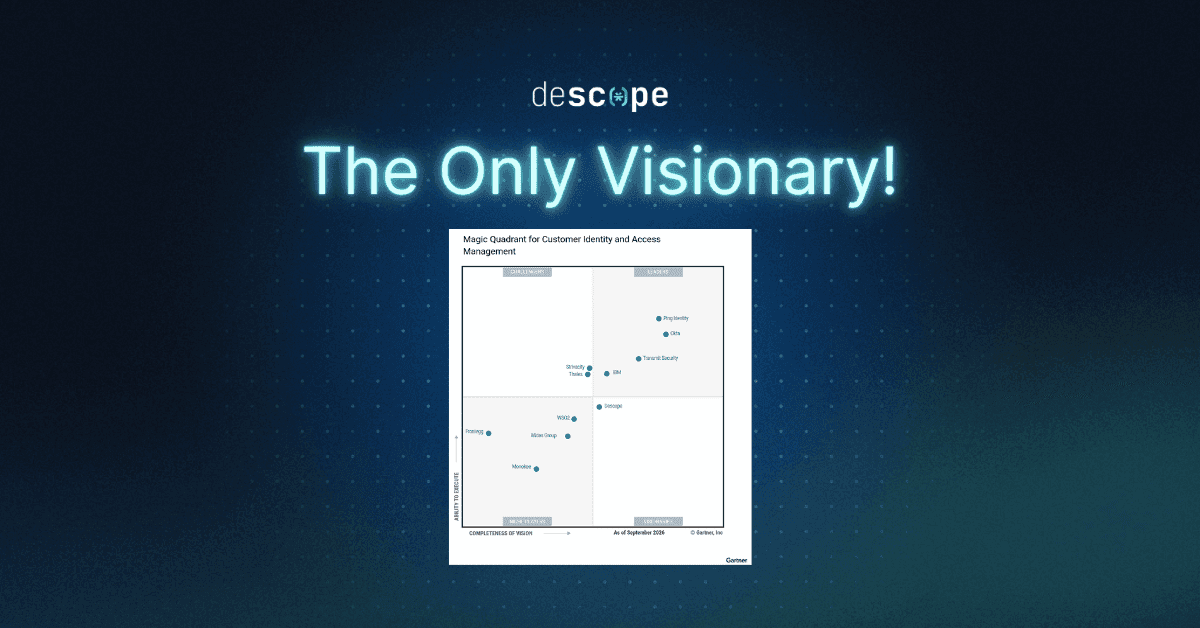
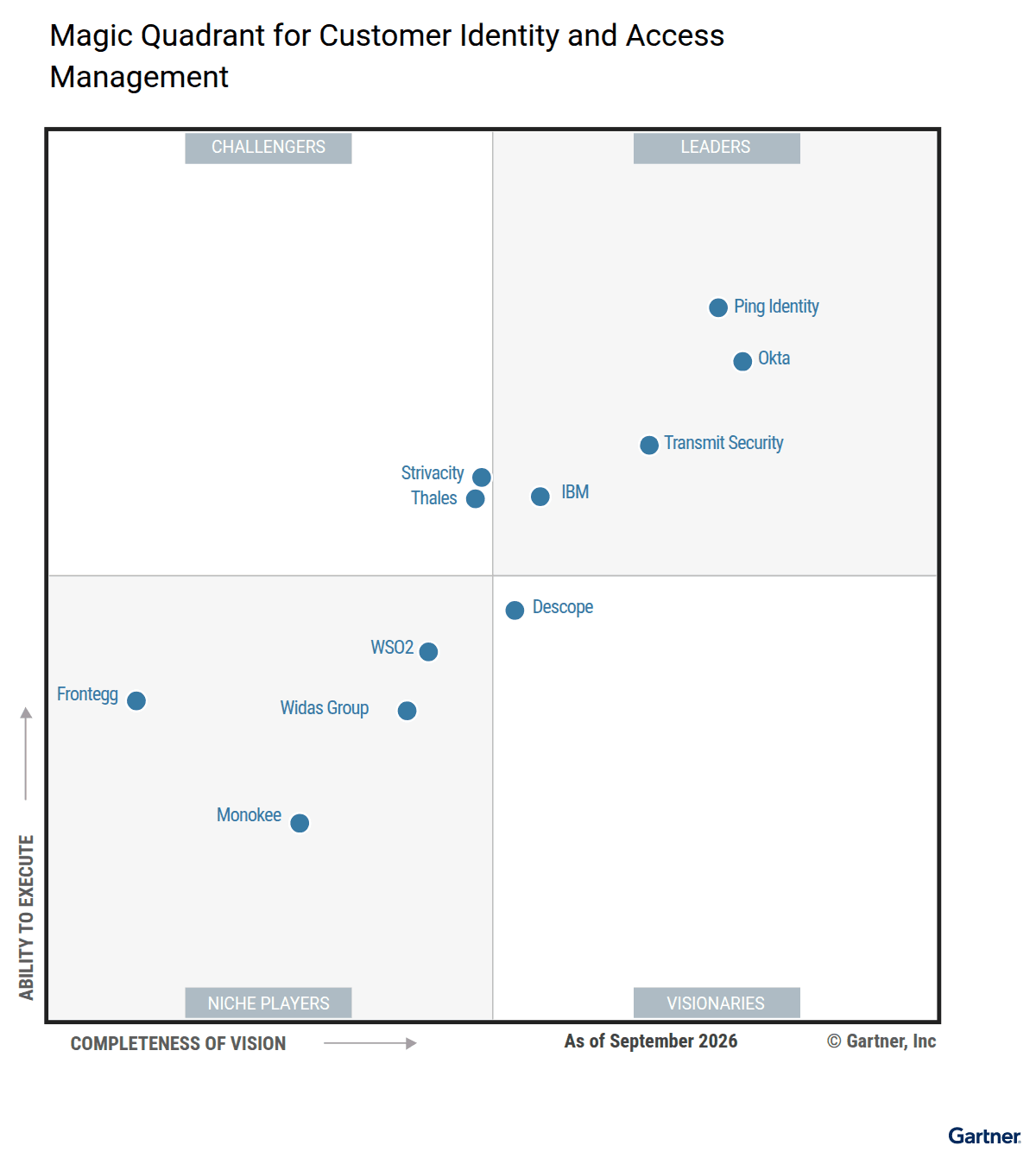
Hello, Descopers! We’re proud to share that Descope has been recognized as the only Visionary in the 2026 Gartner® Magic Quadrant™ for Customer Identity and Access Management (CIAM). This recognition follows Descope’s inclusion as an Honorable Mention in the 2025 Gartner® Magic Quadrant™ for Access Management, published in November 2025.
We believe the new report reflects a change we have already seen in our own customer conversations. Organizations increasingly treat customer identity as its own discipline, with buyers and requirements distinct from workforce access. In this post, we share our reflections on the report, findings from our own CIAM research, and how Descope’s platform maps to the trends shaping the market. You can read a complimentary copy of the full report here.
Our view on why CIAM now has its own Magic Quadrant
In our opinion, previous editions of this research evaluated access management for workforce and customer use cases together, under the Access Management name. The 2026 edition, however, evaluates CIAM on its own.
In our view, Gartner research has pointed in this direction for some time. The April 2025 Innovation Insight for Customer and Partner IAM points to how much of the market is still served by in-house builds. Gartner says:
“Over 50% of organizations are using either a combination of homegrown CIAM solutions or no solution at all (in the case of noncustomer-facing organizations).”
The same report recommends looking past vendors that serve every constituency with one product. Gartner says:
“Be prepared to look beyond traditional multiconstituency AM vendors, particularly for complex CIAM and PIAM use cases.”
We believe a dedicated CIAM evaluation lets buyers compare vendors on the capabilities and outcomes customer-facing teams are measured on. Those include sign-up and login conversion, fraud and account takeover, partner and B2B access, and, increasingly, identity controls for AI agents that act on behalf of customers.
It’s time to stop using workforce tools for CIAM
Plenty of CIAM implementations today rely on solutions that were originally meant to handle workforce audiences, and the regret is showing. Our 2025 State of Customer Identity report, a survey of 416 CIAM decision-makers, found that 51% of organizations use workforce-oriented identity tools for customer authentication, but only 8% would choose that approach if they were starting fresh.

Workforce tools are designed for a known population of employees, often on managed devices and with a higher bar for friction—an employee may be disgruntled with laborious logins, but they are not going to quit because of it. Customer identity, on the other hand, has to serve millions of unknown users across web and mobile apps, collect consent and profile data, and stop fraud at the front door without adding friction that costs sign-ups.
AI agents add another layer of complexity to these rollouts. According to the same report, 88% of organizations plan to adopt AI agents, but only 37% have moved past the pilot stage. As more of those agents act for customers, the identity questions they raise will fall under the purview of teams that own CIAM.
Securing AI agents that act on behalf of customers
We believe that the 2026 CIAM Magic Quadrant covers AI agents and other machine identities alongside customers and partners. At Descope, we treat agent identity as a core part of our platform. AI agents that act on behalf of users are managed on the same platform as those users, with their own distinct identities and while being governed by the same policies and audit trail.
The Agentic Identity Hub registers AI agents and Model Context Protocol (MCP) servers in an agent directory, where each one has an assigned owner and least-privilege access enforced at runtime. Users can approve sensitive agent actions on a separate device through Client-Initiated Backchannel Authentication (CIBA). Enterprises can govern agent access through the identity providers they already use with Cross-App Access (XAA). Today, the Agentic Identity Hub handles authentication and access control for more than 1,000 MCP servers.
In 2026, Gartner also listed Descope as a Sample Vendor for CIAM for AI Agents and Journey-Time Orchestration in two Hype Cycles, the Gartner® Hype Cycle™ for Digital Identity and the Gartner® Hype Cycle™ for Fraud and Financial Crime Prevention.
How Descope aligns with CIAM requirements
The table below maps broader CIAM trends and requirements to the Descope capabilities that, in our view, address them.
CIAM requirement | How Descope aligns |
|---|---|
Visual journey orchestration | Descope Flows, a drag-and-drop editor for registration, login, MFA, and authorization journeys. Connectors to fraud prevention and other third-party services added as steps in the same flow. |
Passwordless and phishing-resistant MFA | Passkeys, magic links, one-time passwords, and authenticator apps. Adaptive MFA and step-up authentication before sensitive actions. Augmentation-friendly MFA implementations. |
Fraud and account takeover prevention | Native risk signals including trusted devices, VPN detection, impossible travel, and bot scores. Connectors to fraud providers such as Forter, reCAPTCHA Enterprise, and Telesign. |
B2B and partner identity | Multi-tenancy with tenant-level SSO and SCIM. Self-service SSO and SCIM setup and delegated administration for customer admins. |
Consumer relationships | Family Accounts, with dependent profiles, independent guardianship, family-scoped roles, and multi-family participation. |
Agentic identity | Agentic Identity Hub with the agent directory, OAuth token exchange, CIBA approvals, XAA, and MCP gateway integrations. |
Global and regulated deployments | Data residency in seven regions. Supplier on the UK government’s G-Cloud 15 framework. FedRAMP High Authorized. |
Developer and admin experience | SDKs, APIs, and an MCP server for developers, alongside a visual console for administrators in the same environment. |
Conclusion
We think a dedicated Gartner Magic Quadrant for CIAM will help organizations evaluate customer identity on its own terms. We expect more teams to move off homegrown systems and workforce tools in the coming years, especially as AI agents start acting on behalf of their users. Being the only Visionary in this report is a proud moment for our team, and we will keep building for the customers, partners, and agents our users depend on.
If you’re interested in trying Descope, sign up for a Free Forever account. Have an active CIAM project for your customers, partners, or AI agents? Book a demo with our auth experts to learn more.
FAQs about the 2026 Gartner Magic Quadrant for CIAM
Gartner, Magic Quadrant for Customer Identity and Access Management, Steve Wessels, Brian Guthrie, Michael Kelley, Gautham Mudra, 28 October 2026.
Gartner, Magic Quadrant for Access Management, Brian Guthrie, Nathan Harris, Yemi Davies, Steve Wessels, 11 November 2025.
Gartner, Innovation Insight for Customer and Partner Identity and Access Management, Michael Kelley, Abhyuday Data, et al., 28 April 2025.
Gartner, Hype Cycle for Digital Identity, Zachary Smith, Nayara Sangiorgio, 6 July 2026.
Gartner, Hype Cycle for Fraud and Financial Crime Prevention, 2026, Vatsal Sharma, 27 July 2026.
Gartner, Magic Quadrant, Hype Cycle are trademarks of Gartner, Inc., and/or its affiliates.
Gartner does not endorse any company, vendor, product or service depicted in its publications, and does not advise technology users to select only those vendors with the highest ratings or other designation. Gartner publications consist of the opinions of Gartner’s business and technology insights organization and should not be construed as statements of fact. Gartner disclaims all warranties, expressed or implied, with respect to this publication, including any warranties of merchantability or fitness for a particular purpose.
This graphic was published by Gartner, Inc. as part of a larger research document and should be evaluated in the context of the entire document. The Gartner document is available upon request from Descope.