
Table of Contents
Don't have the time to read the entire post? Our human writers will be sad, but we understand. Summarize the post with your preferred LLM here instead.
Hey Descopers! We’re thrilled to announce the latest release of the Agentic Identity Hub. This release focuses on some of the most pressing challenges we’ve seen our customers face—securing and governing agents within their organizations.
With Agentic Identity Hub 3.0, Descope continues to act as a dedicated identity provider for AI agents, and organizations are now able to:
Establish agent governance, with every agent being requested, justified, approved, and reviewable
Enforce agent access at runtime across any Policy Enforcement Point (PEP), such as a gateway, MCP server, or API
Secure agents with the latest client authentication methods, including workload identity and Agent SSO (Cross-App Access) issuance
Any developer can start using the Descope Agentic Identity Hub today, including those on our Free Forever tier. Visit the docs and sign up to get started.
Note: The Agent Governance Suite (highlighted later on in this blog) is only available for the Enterprise tier.
Lessons from millions of agents secured
When we announced Agentic Identity Hub 2.0 at the start of the year, we focused largely on the immediate unblocks for agentic AI pilots and experimentation—short-lived credentials and first-class identities that allow agents to begin accessing resources securely.
This worked exceptionally well for our customers building Model Context Protocol (MCP) servers, and we saw that at scale with millions of agents connecting to 1000+ Descope-protected MCP servers, including many on the agent ‘app stores’ such as Claude / ChatGPT. Our Agent SSO (Cross-App Access) release further strengthened our story of securing any agent and MCP server, whether internal or external-facing. Customers like Token Security, You.com, WisdomAI, Daylight Security, and Cequence Security use Descope to securely adopt agentic AI with built-in identity controls.
While secure agent access to resources was the first step, there’s also a visibility storm brewing for CISOs with unfettered AI agent usage inside organizations. Gartner predicts that the average Fortune 500 enterprise will have over 150,000 agents in use by 2028 (up from less than 15 in 2025), but only 13% of organizations think they have the right AI governance in place.
With this release, organizations using the Agentic Identity Hub will now be able to onboard any agent and enforce access across any architecture.
Agent Governance Suite: a “golden path” for agent onboarding
Agents have gone from simple chatbots to core participants in your team’s everyday workflows. At the same time, security teams are faced with securing all types of agents, including those not authorized within their organizations.
Entirely banning or shutting down unauthorized AI at this stage like taking a power drill away from a mechanic. We’ve learned from our customers that the best answer to unauthorized agents is a way to securely onboard them while keeping processes as self-service as possible.
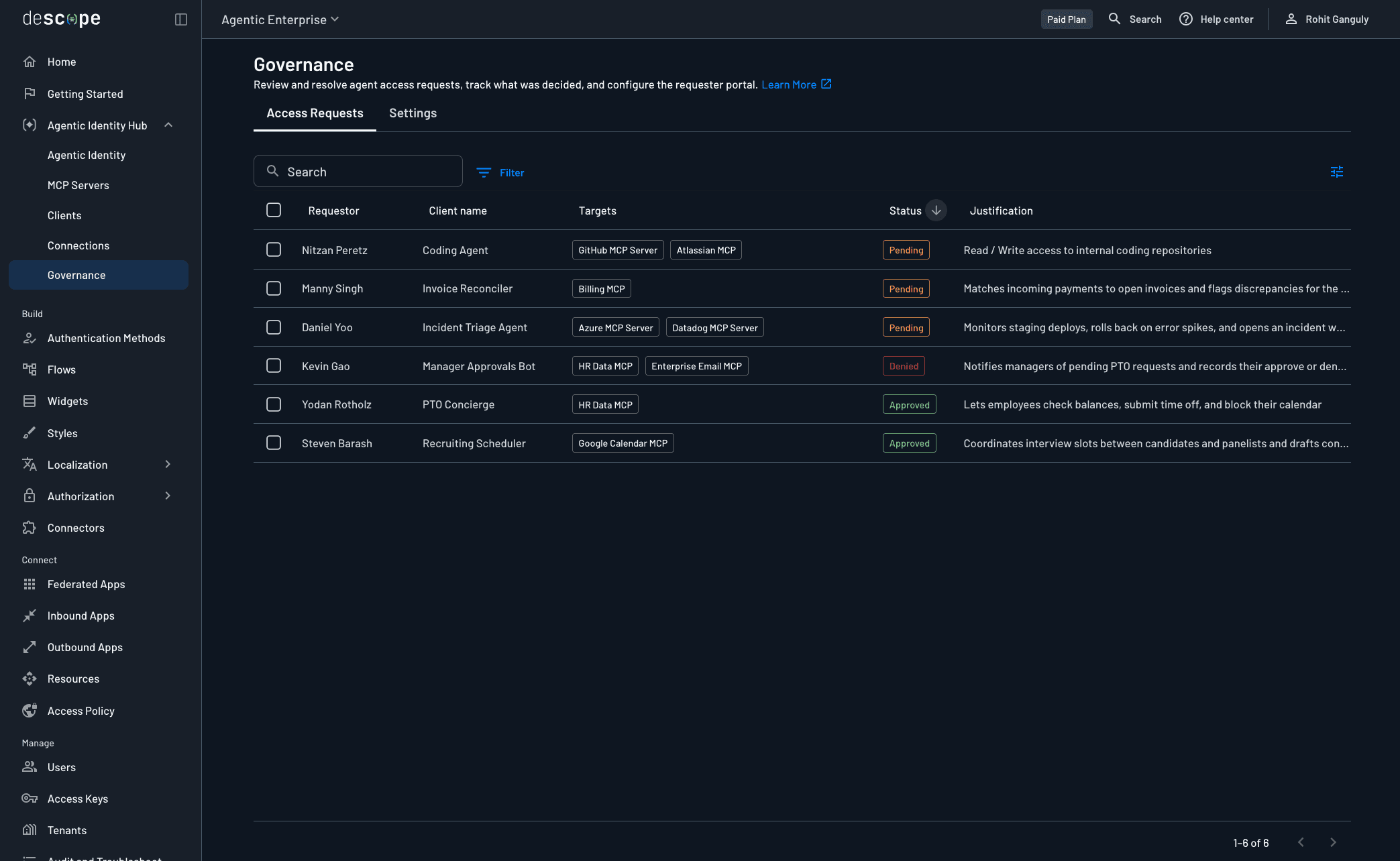
The Agent Governance Suite (AGS) allows your agents and the resources they access to be governed under one unified directory and catalog.
Employees request a new agent along with the resources it needs to connect to. These resources can be anything in your enterprise architecture, including applications, APIs, data sources, and MCP servers.
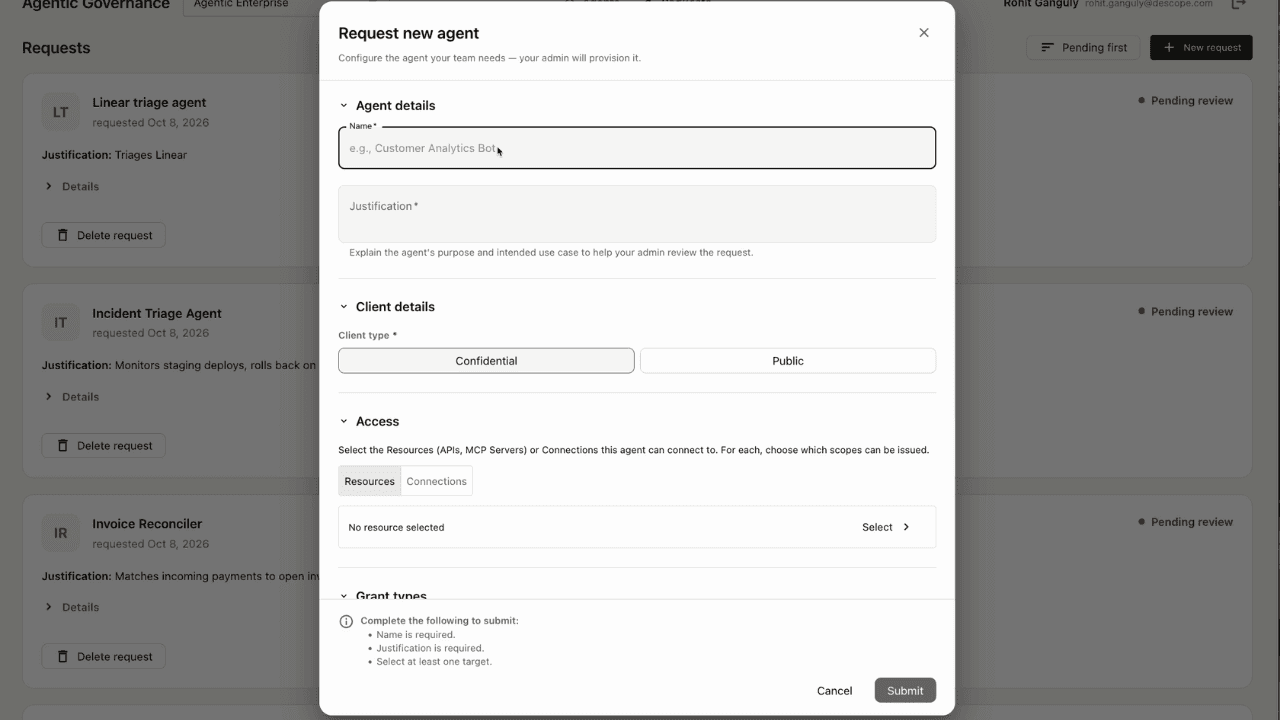
After review and approval, every agent ends up with a documented purpose, an accountable owner, and least-privilege access, through a process fast enough that teams do not route around it.
Enforcing access across any architecture
Once an agent is approved and onboarded to your systems, its access must be continuously verified and enforced. The challenge most organizations face is finding a solution that fits flexibly across often disjoint enterprise resources.
Native gateway integrations
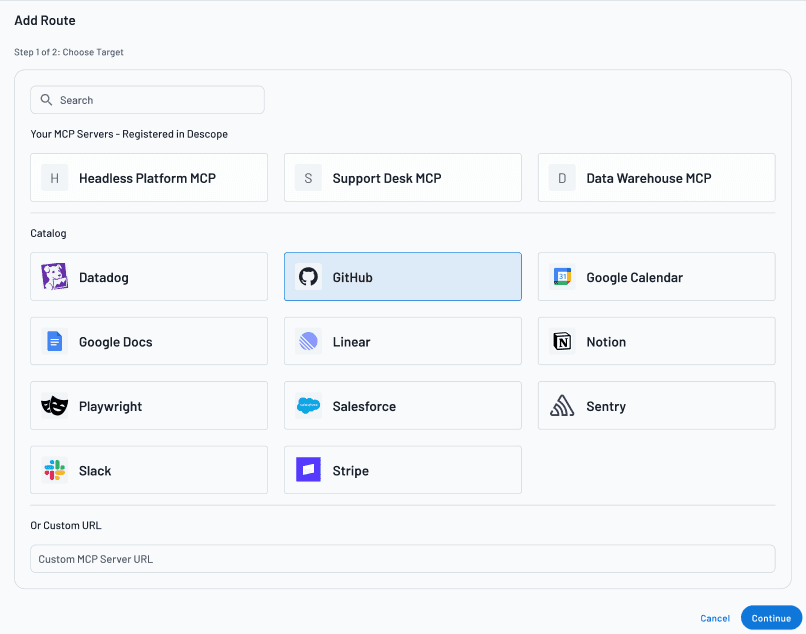
A lot of agent traffic flows through a gateway or proxy solution. The Agentic Identity Hub plugs directly into any Policy Enforcement Point (PEP), including gateways, MCP servers, and APIs. This means that teams can:
Enforce Descope access policies inline through any gateway solution
Validate agent tokens, evaluate per-tool authorization, and enforce access policies for every token issued, exchanged, and brokered.
Keep a single agent policy source of truth in Descope while enforcement runs wherever the agent traffic lives.
Policy engine v2
Descope Policies are an access governance layer that let organizations define and enforce authorization rules for applications or agents attempting to access enterprise resources or downstream connections. Our enhanced policy engine gives security teams finer control over how agent access is decided. Teams can now:
Write explicit Deny policies to block specific agents, tools, scopes, or downstream services, even when another policy would allow them.
Set policy ordering so rules evaluate in a predictable, documented sequence.
Combine allow and deny rules with context from the user, tenant, agent, JWT claims, and resource accessed.
Layer organization-wide guardrails on top of team-level policies without rewriting them.
These changes allow the Agentic Identity Hub to give any agent secure access to any resource, no matter what the underlying architecture looks like.
Agent identity updates
An agent's identity has to hold up wherever it goes: across apps, across clouds, and across the workloads it runs on. Agentic Identity Hub 3.0 adds open standards so every agent is named, owned, scoped, and traceable back to the human and the workload behind it.
Agent SSO (Cross-App Access) issuance and validation
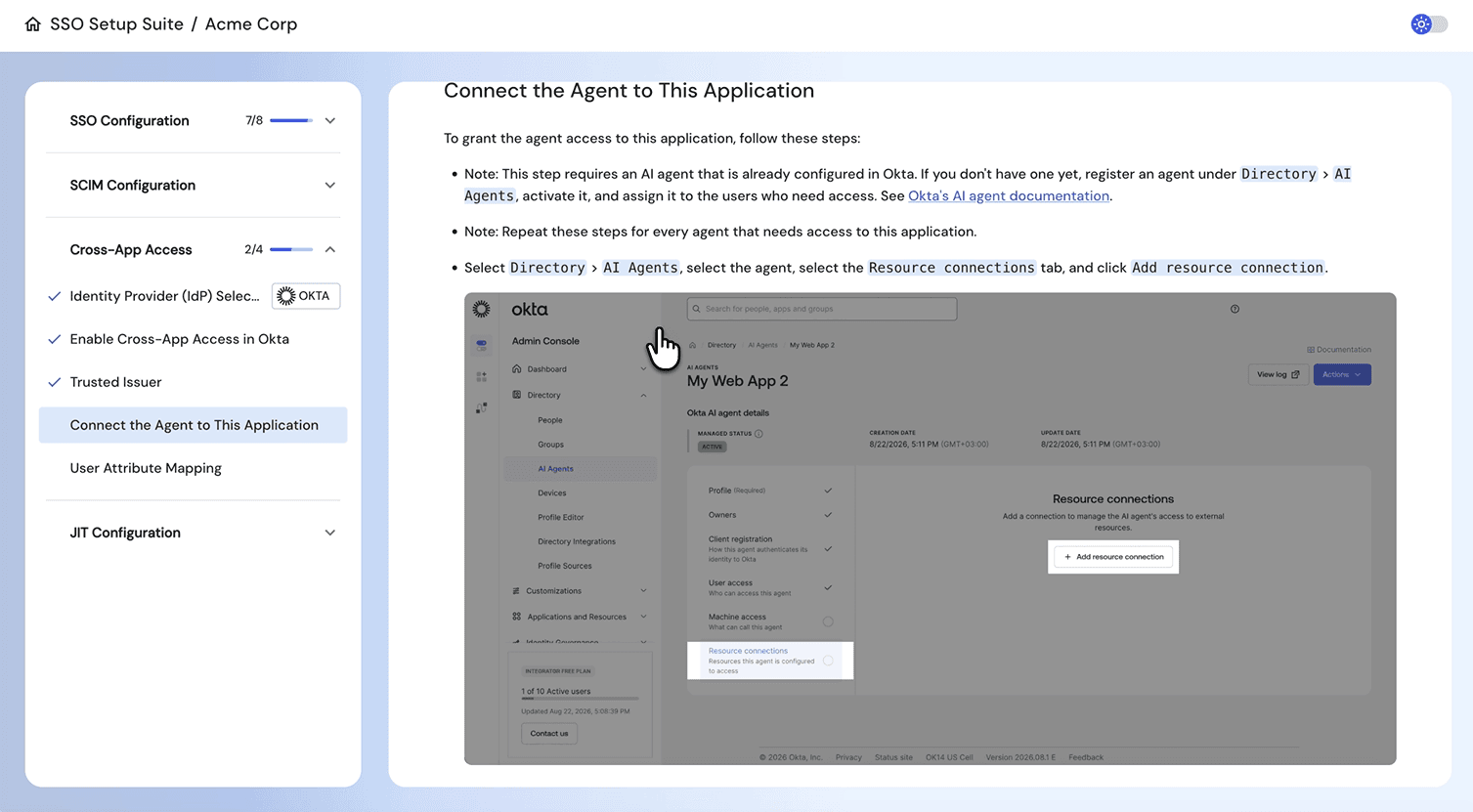
Also known as the Identity Assertion JWT Authorization Grant or ID-JAG standard, Agent SSO is an emerging IETF standard that lets an identity provider vouch for a user when an agent or app requests access to another application.
It is the foundation for enterprise-managed cross-app access for agents. Descope can both issue and validate ID-JAGs. Teams can now:
Issue ID-JAGs so agents can obtain access tokens for other apps on a user's behalf, without a separate consent screen for every connection.
Validate ID-JAGs presented by agents from other identity providers before granting access to their own MCP servers and APIs.
Enable customer admins to set up and test agent SSO configurations in a self-service portal.
Keep the enterprise IdP in control of which agents can reach which apps, with policies applied at grant time.
Preserve the link between agent, user, and tenant in every token exchange for clean attribution.
Descope’s modular architecture plays incredibly nicely in our Agentic Identity Hub, giving organizations currently using IdPs without Agent SSO support an immediate solution to supporting it across all their agents.
Enhanced client authentication
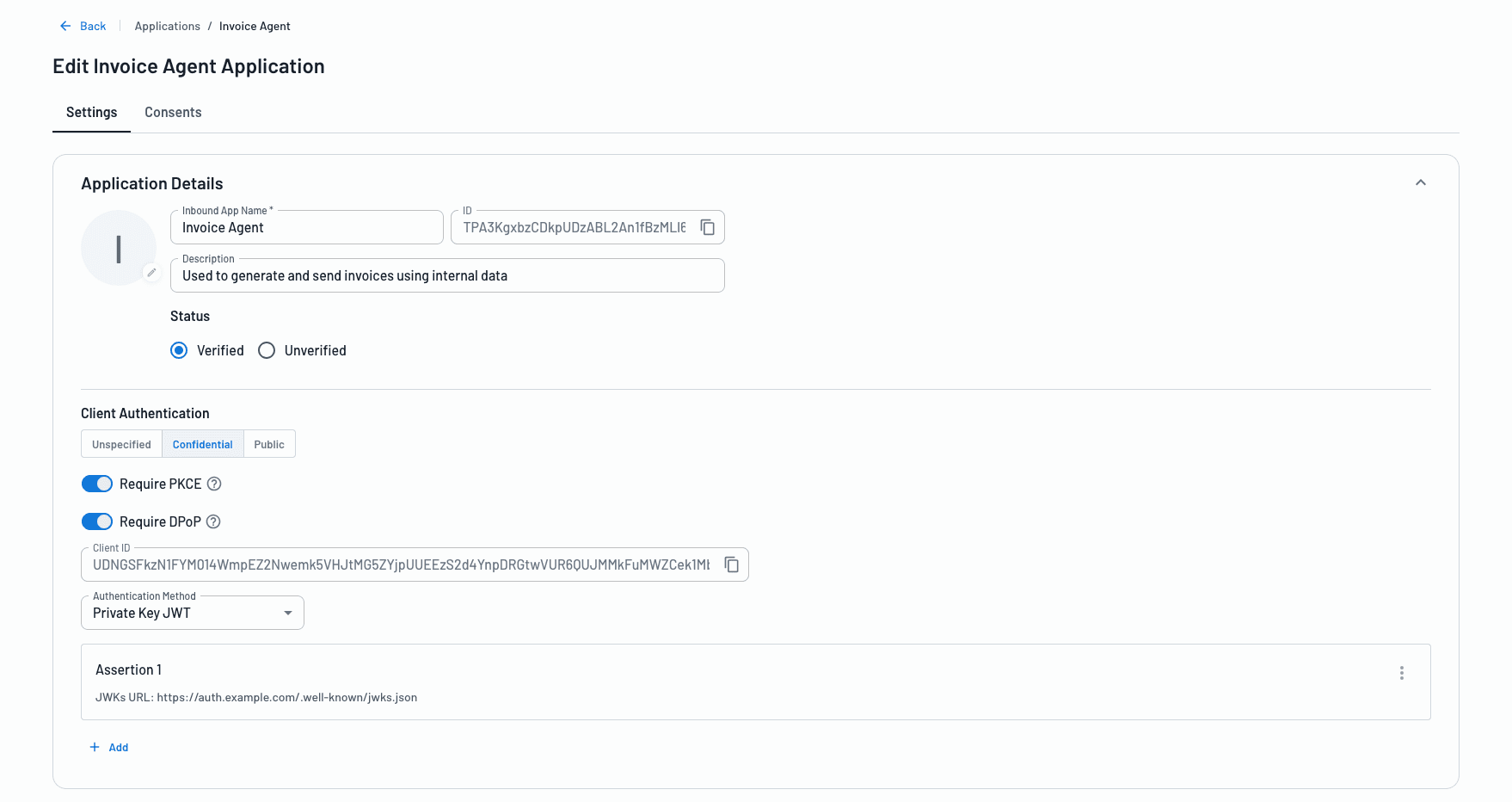
We’re innately familiar with the risk of static secrets, especially when it comes to enterprise AI deployments. The Agentic Identity Hub 3.0 release adds stronger, standards-based ways for agents to prove who they are. Teams can:
Authenticate agents using SPIFFE workload identities (SVIDs), binding an agent identity to the workload it actually runs on.
Use private_key_jwt client authentication so agents sign assertions with a private key instead of sending a shared secret.
Require mutual TLS (mTLS) client authentication and certificate-bound tokens, so a stolen token is useless without the matching certificate.
Choose the right method per agent or per MCP client, based on how and where it runs.
Our existing support for Demonstrating Proof-of-Possession (DPoP) means tokens can also be constrained to the sender, providing a hardened, end-to-end solution for any agent needing to access enterprise resources.
Governance and control for every AI agent
We’re seeing a fundamental shift in how organizations operate with the rise of agentic AI. The question now moves to building the identity and access infrastructure to enable secure AI adoption in your organization. Agentic Identity Hub 3.0 gives teams a fast path to roll out approved agents, and gives security teams the confidence to say yes to AI with confidence.
Visit our docs and sign up to get started with the Agentic Identity Hub. Have questions or a specific project you’d like to discuss? Book a demo with our agent (and human!) auth experts.