
Table of Contents
Don't have the time to read the entire post? Our human writers will be sad, but we understand. Summarize the post with your preferred LLM here instead.
Hello Descopers! We’re excited to share Family Accounts, a new way to model real human relationships—like parent-child, guardian-dependent, and multi-family—right in your authentication layer. If you’re working on a consumer health app, a family banking product, or a household streaming plan, Family Accounts gives you the tools to launch these features without building custom identity middleware or using workarounds for multi-tenancy.
Identity wasn't built for family trees
Most CIAM platforms assume users are independent. Each identity has its own credentials, session, and access rights. This approach works well for enterprise software, where each user needs their own access.
Consumer apps are different. For example, a parent might manage a child’s health records, divorced co-parents may both need access to their teenager’s banking profile, or a grandparent could be added to a household streaming plan. Sometimes, two legal guardians need independent authority over one patient account.
When these situations arise, most teams try one of two solutions, but neither is ideal:
Shared credentials: One login is used by the whole family. This is easy to set up, but it’s hard to know who did what, and it’s risky in regulated settings.
Custom family management middleware: This approach adds a household layer to your existing authentication system. It often takes many weeks of engineering work and can lead to fragile delegation logic. Many setups also log actions under the dependent’s account instead of the guardian who actually did them. Impersonating a user is not the same as acting on their behalf, with audit logs often attributing the action to the wrong person.
Descope’s Family Accounts solves both problems with a purpose-built relational identity framework.
Family Accounts overview
Descope Family Accounts introduces first-class identity primitives that model real-life relationships between users. Here's a look at the core capabilities available today.
Dependent profiles
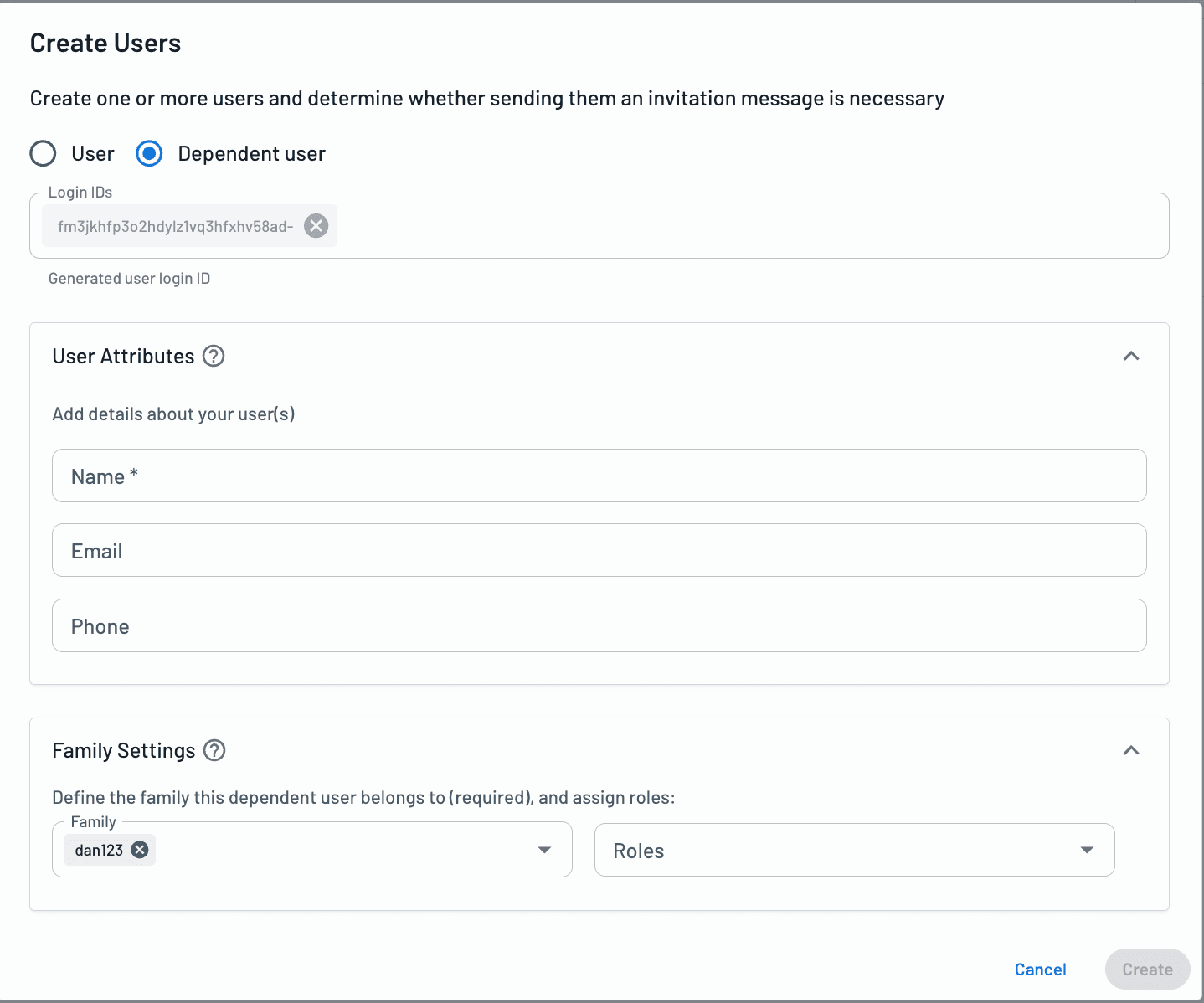
Not every family member can or should have a login. Children, elderly parents, pets, and other dependents often need full identity records—including medical histories, preferences, and entitlements—without the ability or need to authenticate themselves.
Dependent profiles let you provision and manage identity records for these dependents without creating a traditional user account. Instead of holding credentials, a dependent is identified by name and family ID and is accessed only through a guardian's session. Dependent profiles hold custom attributes, link to guardian accounts, and are part of a family’s access policies, all without requiring credentials or a login flow.
Independent guardianship
Family structures are often complex. For example, two parents sharing custody both need equal access to their child’s profile. If one parent removes their own access, it shouldn’t affect the other, and they definitely shouldn’t need to share a password.
Independent guardianship lets you assign multiple unrelated adults as co-guardians for one dependent profile within a family account. Each guardian has their own identity and equal permissions. Guardian roles are set for each family, so someone can be an admin in one family but have no special access in another. Since every guardian acts under their own identity, delegation is clear, and every action is linked to the right person. Every guardian action is written to a dedicated audit log in Descope, giving you a complete record of who did what, when, and on whose behalf.
Family-scoped attributes
A person can have a different role in each family they’re part of, and Family Accounts reflects this in their data. For example, the Parent Type attribute can show someone as a father in one family and a stepfather in another, without needing custom logic to handle the difference.
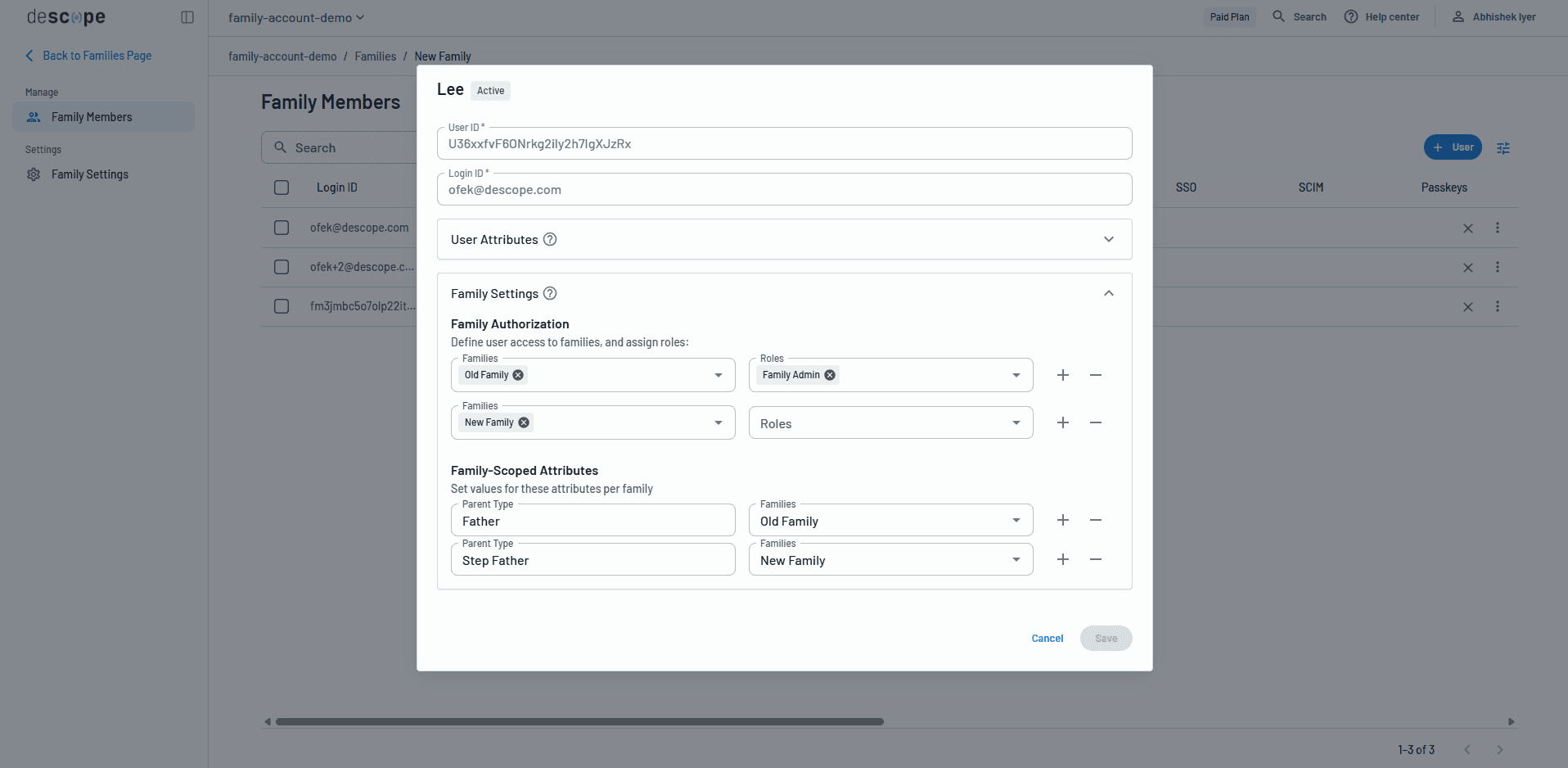
Families can also have their own custom attributes, such as a family address or plan tier, along with their member list. Since a user’s full family membership is available from their session, your app can show them every family they belong to and their role in each one without needing a separate lookup.
Getting Family Accounts into production
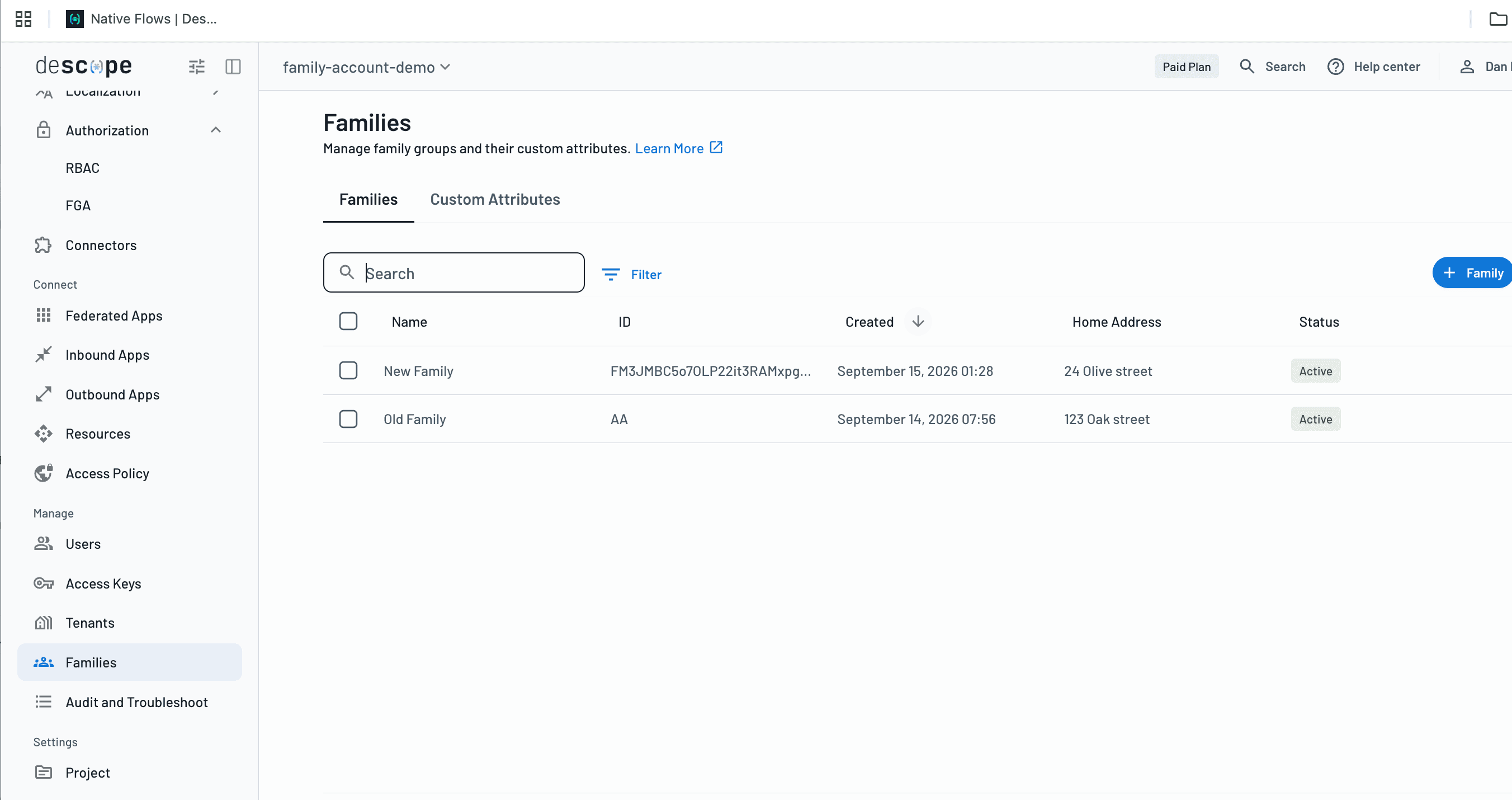
Family Accounts is now available in the Descope console. Once enabled in your Descope Project, creating a family takes just a few seconds. Create a name, add guardian accounts, and add dependents as either new dependent profiles. Each family can have its own custom attributes, and you can configure every member's role and family-scoped attribute values from the same view.
For teams that prefer to work in code, Family Accounts is also fully supported via Descope Management APIs. You can automate family creation as part of your user onboarding flow and query relationship context, including which families a user belongs to and their role in each, directly in your backend access policies.
Family Accounts use cases
Family Accounts help consumer apps manage identities for not just one user, but also parents, guardians, dependents, and other household members. Here are some ways organizations can use relational identity to solve common family needs.
Guardian access for consumer health
Consumer health platforms often need parents and guardians to manage a child’s profile, access health records, or book appointments when the child does not have their own login. Things get more complicated when co-parents or multiple guardians each need their own access to the same child’s account.
With Family Accounts, platforms can create dependent profiles without needing credentials and let multiple guardians connect to the same dependent without sharing accounts. Family roles and attributes give each user the right permissions based on their role in the family. Every guardian action is recorded in an audit log, which is important when platforms need to show who accessed and changed a record.
Family and custodial accounts for fintech
Family banking and fintech products should let parents, guardians, and dependents connect, while making sure each person has the right access. For example, a teenager might need their own account, but a parent should still have wider permissions for the whole family.
Family Accounts offer a model designed to connect these identities, rather than treating everyone as separate users. Family roles and attributes set each member’s permissions, and dependent profiles help family members who need an identity record but do not have credentials.
Household plans for media and streaming
Streaming and media platforms need to support households with multiple profiles, including children and dependents. Blended families can be tricky, since one person might belong to more than one household and have different roles in each.
Family Accounts let platforms set up these households right in the identity layer. Dependent profiles help members without credentials, and multi-family membership with family roles lets users join more than one family with the right access in each.
What’s next in relational identity
Family Accounts is the first release in Descope's broader relational identity framework. Today's launch covers the core capabilities:
Dependent profiles for dependents who cannot or do not need to authenticate
Independent guardianship for co-parents, legal guardians, and dual-custody scenarios
Family-scoped roles and attributes so permissions and data adapt per family, per user
Audit log that records every guardian and dependent action for compliance and review
On the roadmap, we’re working on step-up / dual approval for guardian-gated dependent actions, a context switcher widget to toggle between profiles without logging out and back in, maturity transitions to trigger automatic permission changes when dependents pass an age threshold, and a lot more!
Try Family Accounts on your next consumer build and let us know what you think! If you have questions or want to explore whether relational identity is the right fit for your use case, book a demo with our team.