
Table of Contents
Don't have the time to read the entire post? Our human writers will be sad, but we understand. Summarize the post with your preferred LLM here instead.
Kinde is a developer-focused authentication platform designed to help teams quickly add login, signup, user management, and authentication flows without building identity infrastructure from scratch. Its simplicity, modern developer experience, and fast setup make it appealing for startups and early-stage applications looking to launch quickly.
For many teams, Kinde offers a starting point for basic authentication and user management. However, as applications grow and identity requirements become more complex, developers often encounter limitations around enterprise readiness, customization, extensibility, and long-term scalability.
Modern applications increasingly require flexible authentication orchestration, seamless enterprise onboarding, tenant-aware identity, advanced authorization models, adaptive MFA, and self-service SSO capabilities. Organizations supporting B2B SaaS, enterprise customers, or complex customer identity journeys often need deeper control over authentication flows, federation, provisioning, and integrations than lightweight authentication platforms typically provide.
As teams move upmarket, operational maturity also becomes more important. Enterprise customers frequently expect capabilities like SCIM provisioning, IdP group mapping, delegated administration, advanced SAML/OIDC support, and scalable multi-tenant identity architecture. In these environments, platforms optimized primarily for simplicity and fast implementation can introduce friction as requirements evolve.
Below, we break down the top reasons developers seek Kinde alternatives, followed by a closer look at the leading authentication and user management platforms available today.
This guide will cover:
Why dev teams seek alternatives to Kinde
An overview of the top Kinde alternatives
A deep dive into each platform’s strengths and tradeoffs
A practical guide to choosing the right Kinde alternative for your architecture and growth stage
Why teams seek Kinde alternatives
Many teams evaluate alternatives to Kinde as their applications grow beyond simple authentication use cases and require more enterprise functionality, flexibility, and operational maturity.
On a macro level, two consistent themes emerge - enterprise readiness gaps and limitations scaling from startup auth to mature CIAM requirements:
Growing pains as applications scale: Kinde is optimized for developer simplicity and fast implementation, but as applications evolve, teams often require deeper customization, orchestration, and infrastructure flexibility than the platform currently provides.
Enterprise immaturity and limited CIAM depth: While Kinde covers common authentication basics, many organizations find gaps around enterprise federation, onboarding automation, advanced authorization, and large-scale B2B SaaS requirements.
Teams often run into challenges with enterprise functionality, customization, and operational control:
Limited enterprise federation support: Developers frequently cite gaps around advanced SAML/OIDC functionality, IdP-initiated login, SCIM provisioning, and enterprise-grade federation workflows needed for larger customer deployments.
Limited IdP group and role mapping: Enterprise SaaS applications often require tenant-aware role assignment and mapping IdP groups into authorization policies, which many teams find limited or immature in Kinde.
Limited authentication flow customization: Kinde supports common auth patterns well, but teams with advanced onboarding, progressive profiling, adaptive MFA, or custom user journeys often seek more flexible orchestration capabilities.
Limited self-service SSO onboarding: Supporting enterprise customers at scale requires self-service SSO configuration, metadata management, delegated administration, and SCIM setup workflows that reduce engineering involvement.
B2B and enterprise requirements often introduce additional friction as organizations move upmarket:
Challenges supporting complex multi-tenancy: B2B SaaS applications increasingly require tenant-aware identity models, organization-level RBAC, delegated admin, and customer-specific authentication policies that can become difficult to manage at scale.
Enterprise onboarding scalability issues: Supporting multiple enterprise customers with unique identity providers and provisioning requirements can create operational overhead without mature onboarding workflows and automation.
Advanced MFA and security limitations: Teams implementing adaptive MFA, contextual authentication policies, device trust, or risk-based authentication often look for platforms with more mature security orchestration capabilities.
Developer experience and extensibility are another common source of friction:
Webhook and integration limitations: Some developers report limitations around webhooks, lifecycle event support, and syncing users or tenant data into external systems and databases.
Integration and extensibility gaps: Integrating fraud prevention, analytics, custom business logic, or external orchestration systems may require additional engineering effort due to a smaller integration ecosystem.
Documentation and SDK maturity concerns: As a newer platform, some teams mention incomplete documentation, limited implementation examples, vague guidance in certain areas, and missing SDK support for older frameworks or enterprise environments.
Customization limitations during onboarding: Developers report that signup forms, profile collection, and customer management workflows can feel restrictive for more advanced CIAM use cases.
As applications scale, operational maturity and long-term platform fit become more important:
Roadmap maturity concerns: Some enterprise buyers view portions of Kinde’s roadmap as foundational CIAM capabilities that larger platforms have already delivered and operationalized.
Smaller enterprise footprint and ecosystem maturity: Compared to larger identity vendors, Kinde has a smaller enterprise customer base, fewer large-scale deployments, and a less mature ecosystem across integrations, community resources, and operational tooling.
Scaling beyond basic authentication often requires additional systems: As organizations introduce enterprise SSO, SCIM, authorization, adaptive MFA, delegated administration, and identity orchestration, they frequently evaluate more comprehensive CIAM platforms built for long-term enterprise scalability.
Each alternative below addresses these challenges differently depending on your architecture, ecosystem, and developer workflow requirements.
Kinde alternatives at a glance
Here’s how the top 6 Kinde alternatives stack up:
Features | Strengths | Best for | |
|---|---|---|---|
Descope | Flows, MFA, SSO, SCIM, RBAC/FGA, passwordless auth, adaptive MFA, tenant-aware identity | Flexible orchestration, enterprise-ready CIAM, self-service SSO, strong B2B support | B2C, B2B SaaS, B2B2C, enterprise customer identity |
Auth0 | Authentication, MFA, SSO, RBAC, Actions, federation | Mature platform, broad integrations, strong extensibility | Enterprise and hybrid B2B/B2C applications |
Amazon Cognito | User pools, federation, Lambda triggers, AWS integrations | Deep AWS integration, scalable backend infrastructure | AWS-native applications and cloud-first teams |
Firebase Authentication | Social login, passwordless auth, mobile SDKs, token auth | Easy setup, lightweight implementation, strong mobile support | Mobile apps, startups, frontend-driven products |
Keycloak | SSO, federation, RBAC, LDAP/AD integration, open-source deployment | Full infrastructure control, no vendor lock-in, enterprise federation | Self-hosted enterprise identity and regulated environments |
Ory | API-first authentication, OAuth2/OIDC, fine-grained authorization, modular identity services | Maximum flexibility, composable architecture, backend-first identity | Microservices, distributed systems, custom identity stacks |
Below, we’ll look more closely at what makes each one unique.
Descope
Overview
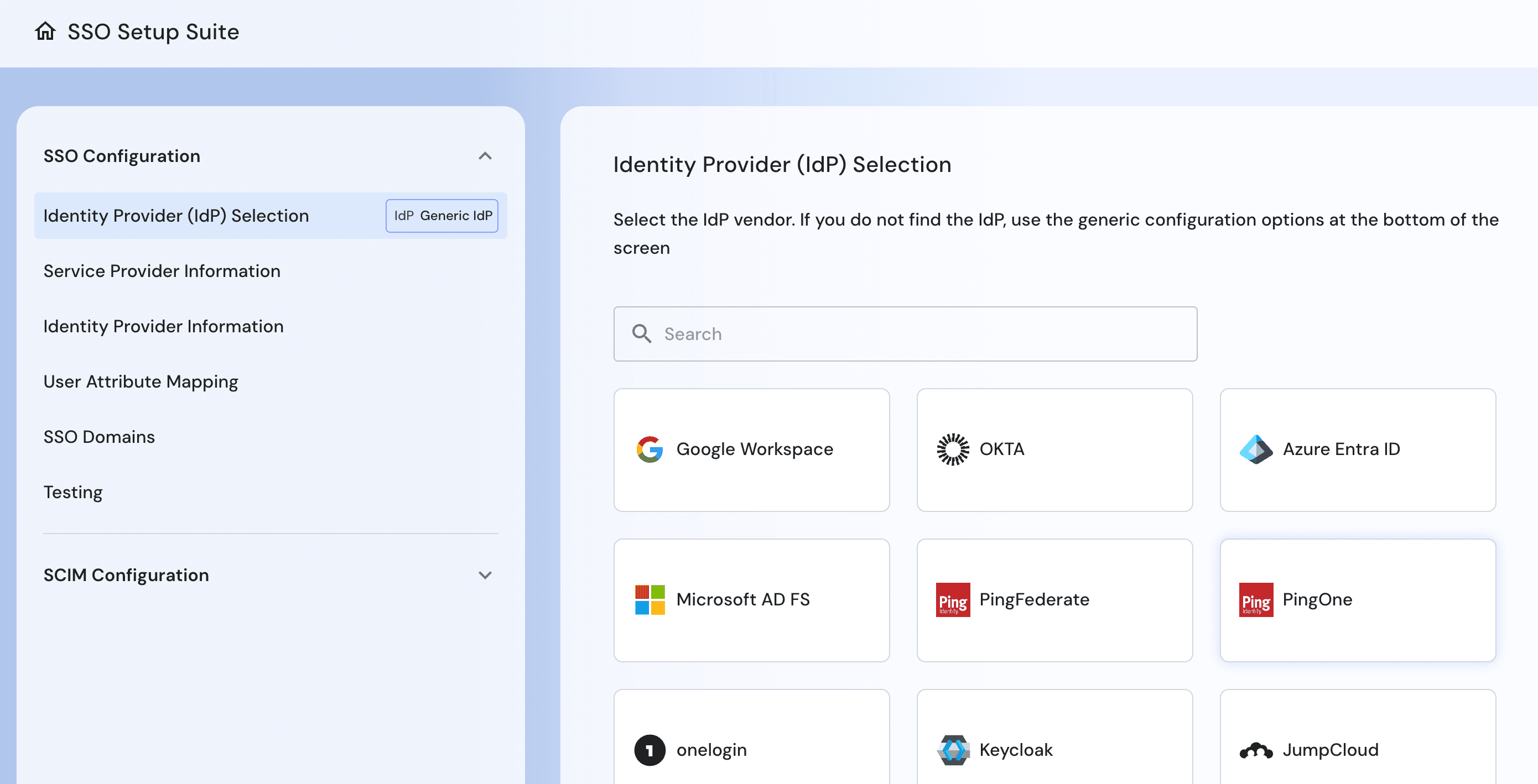
Descope is a modern customer identity platform designed for organizations that need more enterprise flexibility, orchestration, and scalability than lightweight authentication platforms like Kinde. It enables teams to implement authentication, MFA, enterprise SSO, SCIM provisioning, and authorization through configurable workflows, SDKs, and APIs rather than relying on rigid authentication abstractions or limited built-in flows.
Unlike Kinde, which primarily focuses on simplifying authentication for startups and early-stage applications, Descope provides a more comprehensive CIAM platform built for complex B2B, B2C, and enterprise identity requirements. Authentication, authorization, onboarding, MFA, and federation are managed through centralized workflows that can be customized without rebuilding core application logic. This gives teams deeper control over identity experiences across frontend applications, backend services, APIs, and multi-tenant environments while reducing long-term implementation complexity.
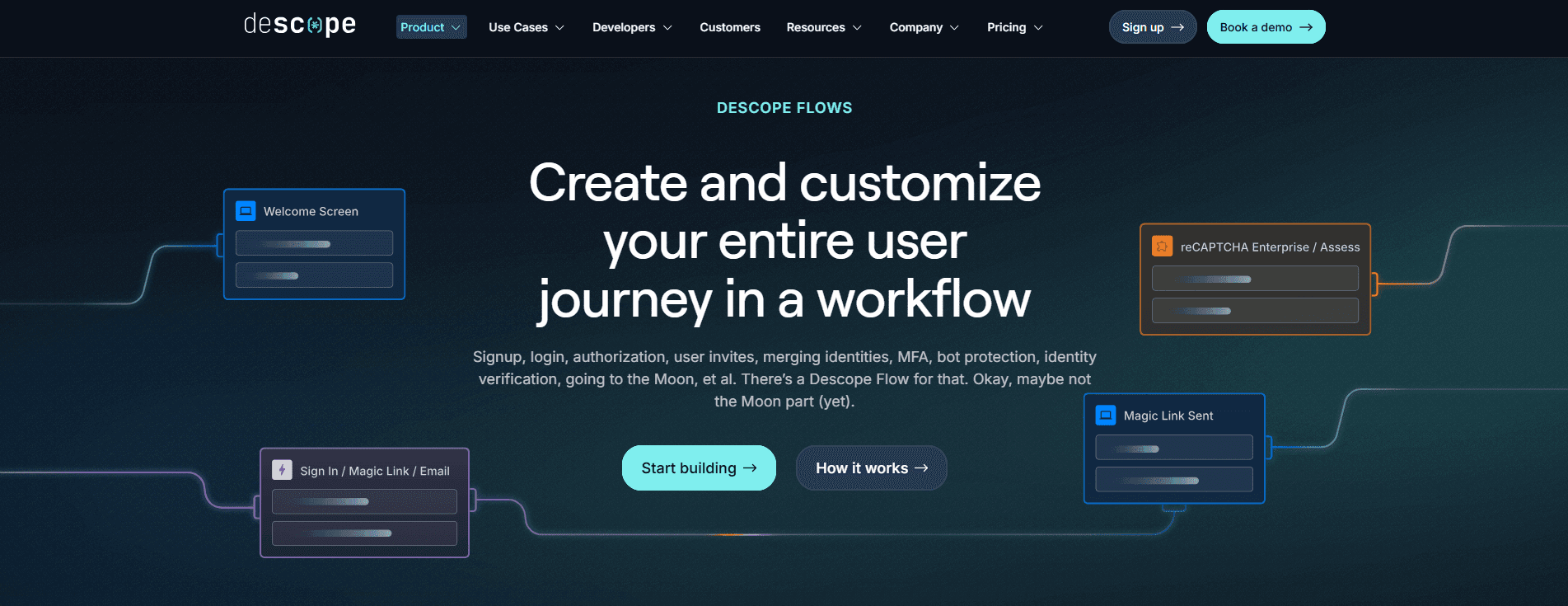
Descope is particularly well suited for B2B SaaS, B2B2C platforms, and applications that require scalable enterprise onboarding, tenant-aware identity, adaptive authentication, and flexible orchestration. Its core differentiator is Descope Flows, a visual no-code and low-code orchestration layer that allows developers to design and modify login, MFA, SSO, onboarding, progressive profiling, and step-up authentication journeys without custom infrastructure or fragmented tooling. This enables organizations to move beyond Kinde’s more limited enterprise capabilities while maintaining fast iteration and centralized identity control.
Key capabilities
Advanced authentication and security features
Support for passkeys, OTP, magic links, and social login, enabling modern passwordless authentication beyond Clerk’s standard frontend flows
Adaptive MFA, session protection, and bot detection using built-in and third-party risk signals, allowing dynamic step-up authentication directly within identity workflows
Streamlined B2B and enterprise identity
Self-service enterprise SSO with guided SAML, OIDC, and SCIM setup, reducing manual configuration and onboarding friction compared to Clerk’s more limited B2B capabilities
Native multi-tenant identity with tenant-aware RBAC and FGA, designed for SaaS use cases without relying on workarounds or external systems
Unified identity orchestration across authentication, authorization, MFA, and risk signals within a single platform, eliminating the need to layer additional services around core auth
Agentic identity support for AI agents and MCP-based ecosystems, extending authentication and authorization infrastructure beyond human users to secure AI systems.
Integration and extensibility support
Extensible integrations ecosystem for fraud detection, analytics, and identity enrichment within authentication workflows rather than requiring external orchestration
Flexible hosted portals and embeddable widgets for delegated identity admin, giving teams control beyond predefined frontend patterns
Powerful, flexible developer tooling
Visual workflow editor for login, signup, MFA, SSO, onboarding, and step-up authentication flows, enabling teams to modify user journeys without rewriting application logic
15+ SDKs and APIs for web, mobile, and backend services, supporting modern API-first, microservices, and distributed architectures
Strengths
Enterprise-ready identity instead of startup-focused auth: Descope supports enterprise SSO, SCIM provisioning, IdP group mapping, delegated administration, and tenant-aware identity capabilities that are limited or unavailable in Kinde
Flexible identity orchestration instead of rigid authentication flows: Authentication, onboarding, MFA, and step-up authentication are managed through configurable workflows rather than fixed abstractions or predefined journeys
Faster enterprise onboarding: Self-service SSO and SCIM setup reduce manual onboarding work and eliminate engineering bottlenecks when adding enterprise customers
Native multi-tenant architecture: Tenant-aware users, organizations, roles, and permissions are built in for B2B SaaS and B2B2C environments without requiring custom workarounds
Unified identity platform: Authentication, authorization, MFA, risk signals, and customer onboarding are managed within one platform instead of stitching together additional tools around core authentication
Adaptive and risk-based MFA built into flows: Dynamic authentication decisions can be enforced directly within workflows using contextual signals and third-party integrations
Greater extensibility and integrations: Supports integrations for fraud prevention, analytics, identity enrichment, and custom business logic through a broader orchestration and connector ecosystem
Passwordless authentication out of the box: Passkeys, magic links, OTP, social login, and modern passwordless experiences are first-class capabilities for web and mobile applications
Reduced long-term complexity: Identity workflows can evolve without rebuilding authentication infrastructure as applications scale and enterprise requirements grow
Built for modern SaaS architectures: Supports B2B, B2C, hybrid applications, APIs, AI agents, and machine identities through flexible identity models and backend-friendly architecture
Broad SDK and API coverage: Integrates cleanly across frontend applications, backend services, mobile apps, and microservices without being tightly coupled to a single frontend framework
Ideal for
Descope is a strong choice for organizations evaluating alternatives to Kinde that need more enterprise readiness, customization, and long-term scalability for customer identity. It is particularly well suited for teams that have outgrown lightweight authentication platforms and require more flexible identity orchestration, enterprise onboarding, and tenant-aware architecture.
It fits SaaS companies and digital product teams that need capabilities such as self-service enterprise SSO, SCIM provisioning, adaptive MFA, IdP group mapping, delegated administration, and customizable authentication journeys without relying on fragmented tooling or extensive custom engineering layered around core authentication.
Descope is also ideal for B2B, B2C, and hybrid platforms that need unified authentication and authorization across customers, partners, administrators, APIs, AI agents, and machine identities. Its workflow-driven architecture supports both frontend and backend identity use cases within a single modern CIAM platform, making it well suited for organizations scaling from startup authentication needs to enterprise-grade identity infrastructure.
Auth0
Overview
Auth0, part of Okta, is a cloud-based customer identity platform frequently evaluated by teams looking for a more mature and enterprise-ready alternative to Kinde. While Kinde focuses on simplifying authentication for startups and early-stage products, Auth0 provides a broader identity platform designed to support complex B2B, B2C, and enterprise identity requirements across a wide range of application architectures.
Auth0 delivers authentication, authorization, MFA, and federation as a managed service with a highly extensible, API-first architecture. Compared to Kinde, Auth0 offers more mature enterprise federation support, broader protocol compatibility, deeper customization capabilities, and a larger integration ecosystem. This makes it a common choice for organizations that have outgrown lightweight authentication tooling and need more flexibility around authentication flows, enterprise onboarding, and identity lifecycle management.
Key capabilities
Enterprise SSO with SAML, OIDC, OAuth2, and broad identity provider support
Built-in MFA including WebAuthn, TOTP, SMS, email, and push authentication
Extensible authentication logic using Actions and Rules for customizing user journeys and business logic
Hosted and embedded login experiences with support for branded and application-specific authentication UX
Strengths
More mature enterprise identity support: Auth0 provides broader support for enterprise federation, SSO, MFA, and extensibility than Kinde’s lighter-weight authentication model
Flexible authentication customization: Authentication flows and identity logic can be customized beyond standard login and signup experiences
Broad identity coverage: Supports B2B, B2C, workforce, and hybrid identity use cases within a single platform
Ideal for
Auth0 is well suited for organizations evaluating Kinde alternatives that need more mature enterprise identity capabilities, broader federation support, and deeper extensibility. It fits teams building B2B, B2C, or hybrid applications that require customizable authentication logic, scalable enterprise onboarding, and flexible identity infrastructure beyond lightweight startup-focused authentication platforms.
Also Read: Descope vs Auth0 For B2B Auth & SSO
Amazon Cognito
Overview
Amazon Cognito is AWS’s native identity and authentication platform, frequently evaluated by teams looking for a more backend-driven and infrastructure-oriented alternative to Kinde. While Kinde focuses on simplifying authentication for modern applications through a lightweight developer experience, Cognito provides deeper integration with AWS services and greater control over backend identity infrastructure.
Cognito delivers authentication, user management, federation, and access control as part of the broader AWS ecosystem. Compared to Kinde, Cognito offers stronger infrastructure-level customization, tighter integration with cloud-native services, and greater flexibility for teams building scalable backend systems. This makes it a common choice for organizations that have outgrown simpler authentication tooling and want identity tightly integrated with APIs, microservices, and cloud infrastructure.
Key capabilities
User pools for authentication, user management, and identity storage
Federation with SAML, OIDC, social identity providers, and enterprise IdPs
AWS Lambda triggers for customizing authentication flows and backend business logic
Deep integration with AWS services such as API Gateway, IAM, AppSync, and Lambda
Strengths
Deep AWS integration: Cognito integrates natively with AWS infrastructure and backend services beyond Kinde’s more application-centric authentication model
Flexible backend customization: Lambda triggers allow teams to customize authentication logic, workflows, and business processes at the infrastructure layer
Scalable cloud-native infrastructure: Designed to support large-scale applications and distributed systems without managing identity infrastructure directly
Ideal for
Amazon Cognito is well suited for organizations evaluating Kinde alternatives that are already invested in AWS and need deeper backend identity control, infrastructure flexibility, and cloud-native scalability. It fits teams building API-first applications, microservices, and distributed systems that require more extensible backend authentication and federation capabilities than lightweight authentication platforms typically provide.
Also Read: Descope vs Amazon Cognito
Firebase Authentication
Overview
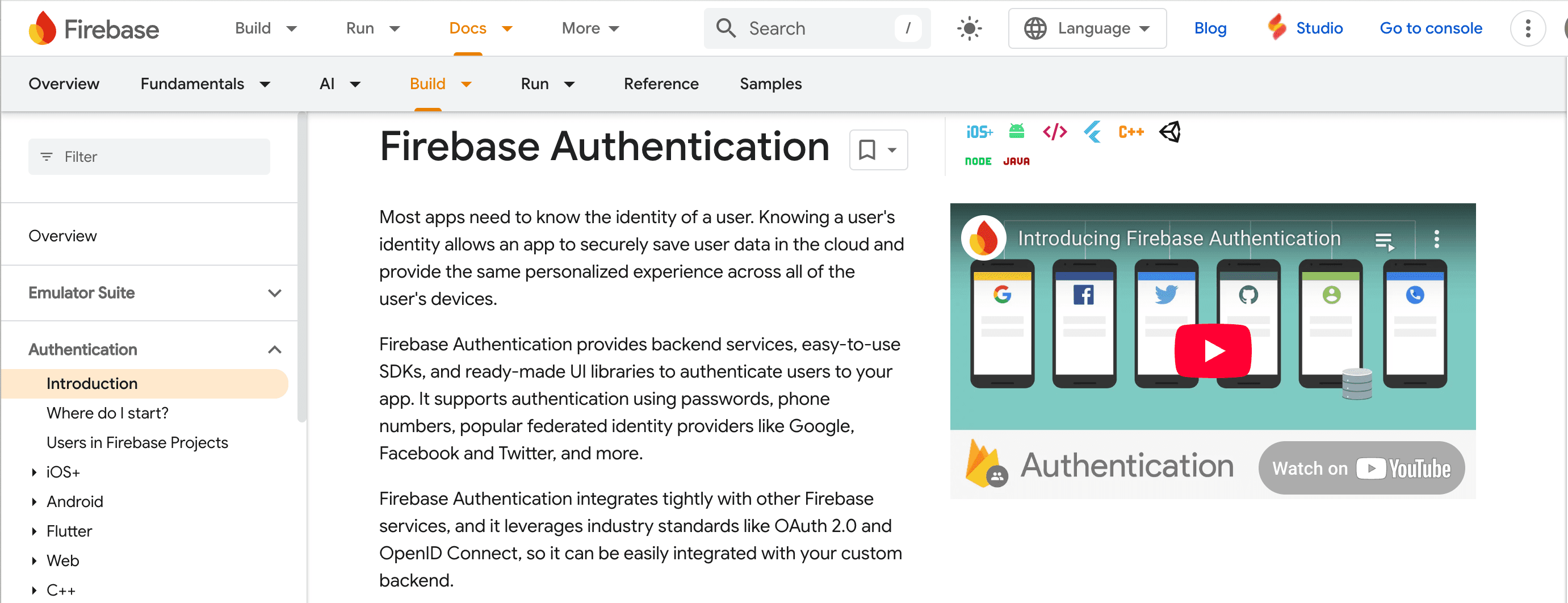
Firebase Authentication is Google’s authentication platform for web and mobile applications, often evaluated by teams looking for a lightweight, developer-friendly alternative to Kinde. While Kinde focuses on modern authentication flows and simplified customer identity experiences, Firebase Authentication emphasizes fast implementation, mobile integration, and tight alignment with the broader Firebase and Google Cloud ecosystem.
Firebase Authentication delivers authentication and user management through SDKs and managed backend services, making it easy for teams to add login and identity features without building infrastructure from scratch. Firebase Authentication is often viewed as simpler and more mobile-centric, but with fewer enterprise CIAM capabilities, customization options, and B2B identity features. This makes it a common choice for startups, mobile apps, and frontend-heavy applications that prioritize speed and ease of development over advanced enterprise identity requirements.
Key capabilities
Support for email/password, social login, phone authentication, anonymous auth, and passwordless authentication
Client and server SDKs for web, iOS, Android, and backend environments
Integration with Firebase services such as Firestore, Functions, Analytics, and Google Cloud
Token-based authentication for APIs, backend services, and mobile applications
Strengths
Fast implementation and onboarding: Firebase Authentication is easy to implement for teams that want lightweight authentication without extensive configuration
Strong mobile and frontend support: Designed for mobile-first and real-time application experiences across web and native platforms
Tight Firebase ecosystem integration: Works seamlessly with Firebase databases, serverless functions, analytics, and Google Cloud infrastructure
Flexible frontend implementation: Allows developers to build custom authentication UX rather than relying entirely on predefined authentication components
Ideal for
Firebase Authentication is well suited for organizations evaluating Kinde alternatives that prioritize simplicity, rapid development, and strong mobile support. It fits startups, mobile applications, and frontend-focused product teams that need lightweight authentication tightly integrated with Firebase and Google Cloud services, but do not require advanced enterprise federation, complex multi-tenancy, or enterprise CIAM functionality.
Keycloak
Overview
Keycloak is an open-source identity and access management platform frequently evaluated by teams looking for a more customizable and self-hosted alternative to Kinde. While Kinde focuses on delivering a managed, developer-friendly authentication experience, Keycloak provides organizations with full control over identity infrastructure, deployment models, and authentication configuration.
Keycloak supports authentication, SSO, federation, and authorization across standard identity protocols, with customization handled through configuration, extensions, and self-managed infrastructure. Compared to Kinde, Keycloak offers greater infrastructure ownership, broader enterprise federation flexibility, and reduced vendor lock-in, but typically requires more operational resources and implementation effort. This makes it a common choice for organizations with strict infrastructure, compliance, or customization requirements that need deeper control over identity systems.
Key capabilities
Support for SAML, OAuth2, and OpenID Connect authentication
Built-in enterprise SSO and identity federation capabilities
User federation with LDAP, Active Directory, and external identity stores
Admin console, user self-service management, and customizable authentication flows
Strengths
Full infrastructure control: Keycloak allows organizations to self-host and fully manage identity infrastructure instead of relying on a managed SaaS platform like Kinde
Strong enterprise federation support: Supports standard enterprise identity protocols, external directories, and complex federation requirements
Open-source flexibility: Organizations can customize and extend the platform without vendor lock-in or dependency on proprietary roadmaps
Ideal for
Keycloak is well suited for organizations evaluating Kinde alternatives that require full infrastructure ownership, extensive customization, or self-hosted identity deployments. It fits enterprises, regulated industries, and engineering teams with the operational resources to manage identity infrastructure while supporting complex federation, compliance, and backend-driven authentication requirements.
Also Read: Top 6 Keycloak Alternatives
Ory
Overview
Ory is a modular, API-first identity platform often evaluated by teams looking for a more flexible and composable alternative to Kinde. While Kinde focuses on simplifying authentication through an integrated developer experience, Ory provides low-level identity building blocks that allow developers to design highly customized authentication and authorization systems from the ground up.
Ory is composed of modular services such as Kratos for authentication, Hydra for OAuth2 and OpenID Connect, and Keto for fine-grained authorization. Compared to Kinde, Ory offers significantly greater backend flexibility, composability, and infrastructure control, making it better suited for organizations building complex distributed systems and API-driven architectures. However, this flexibility also introduces more implementation and operational complexity than lighter-weight managed authentication platforms.
Key capabilities
API-driven authentication with Ory Kratos
OAuth2 and OpenID Connect support through Ory Hydra
Fine-grained authorization and policy enforcement capabilities
Self-hosted and managed deployment options for flexible infrastructure control
Strengths
Maximum identity flexibility: Ory enables teams to build deeply customized authentication and authorization systems instead of relying on predefined authentication abstractions
API-first architecture: Designed for backend services, microservices, APIs, and distributed systems requiring flexible identity orchestration
Modular identity stack: Services can be combined and extended independently based on application and infrastructure requirements
Open-source foundation: Provides transparency, extensibility, and reduced vendor lock-in compared to fully proprietary platforms
Ideal for
Ory is well suited for organizations evaluating Kinde alternatives that need maximum flexibility and backend control over identity architecture. It fits engineering-heavy teams building microservices, distributed systems, API-first platforms, and highly customized authentication environments that require more composability and extensibility than integrated developer-focused authentication platforms typically provide.
Also Read: Why BalkanID Moved From Ory Kratos To Descope
Conclusion
Kinde is a solid starting point for teams that want to quickly add authentication, user management, and modern login experiences to applications without building identity infrastructure from scratch. However, as applications grow and enterprise requirements become more complex, teams often encounter limitations around customization, enterprise federation, multi-tenancy, and long-term CIAM scalability.
Modern applications increasingly require flexible authentication orchestration, seamless enterprise onboarding, adaptive MFA, tenant-aware authorization, and deeper control over identity logic across both frontend and backend systems. In these environments, lightweight authentication platforms can introduce friction as organizations expand into B2B SaaS, enterprise customer onboarding, and more sophisticated identity workflows.
Among the alternatives, Descope stands out for organizations that want a flexible, workflow-driven identity platform that unifies authentication, authorization, enterprise SSO, SCIM, adaptive MFA, and identity orchestration within a single modern CIAM platform. By replacing rigid authentication abstractions with configurable workflows, APIs, and self-service enterprise onboarding capabilities, Descope enables teams to scale identity without adding operational complexity.
If you're evaluating Kinde alternatives and want to explore what a more flexible and enterprise-ready approach looks like, meet with our auth experts. Also, if you want to try Descope yourself, sign up for a Free Forever Account and start dragging & dropping your auth today!