Octave is the agentic go-to-market brain for B2B revenue teams, turning a company’s strategy, ideal customer persona, and messaging into living context that any AI agent, workflow, or tool can weave into its output. Because many of Octave’s customers connect with the product through its MCP server rather than a login screen, the company needed unified authentication regardless of where their users sign in. This is how Descope helped them build it.
About Octave
Octave aims to solve the gap between go-to-market (GTM) strategy and real-world execution. Most GTM knowledge emerges over time, scattered across various decks, docs, and hidden in the heads of individual stakeholders. Octave codifies that knowledge, combining product details, personas, proof points, competitive intelligence, and the unique language that distinguishes a business.
The result is a single source of truth that grounds AI output in real context rather than inference or guesswork. With Octave at their disposal, Large Language Models (LLMS) can reliably support GTM motions without the threat of uncertainty or hallucination.
Julian Tempelsman, Co-Founder and CTO at Octave, said:
“There are nuances that don’t fit into any existing system. It’s in this deck over here, that doc over there. We’re codifying those so they’re machine-readable. We want to be the brain that lets all your tools and workflows actually understand your business.”
Choosing a once-and-done solution
As Octave moved upmarket, its authentication needs grew. The company began with a homegrown wrapper built on Google components, which covered Google Workspace sign-ins. However, as customers started asking for Microsoft-based logins, it was clear that demand for more comprehensive single sign-on (SSO) wouldn’t be far behind.
For a lean team whose business is GTM context, not customer identity, the build-versus-buy decision was straightforward. Every cycle spent retooling auth flows was one that could’ve been spent refining the core Octave offering. Rather than retrofitting auth every time an enterprise requirement came up in a deal, they sought a solution that meant designing their identity layer once, and only once.
Julian Tempelsman, Co-Founder and CTO at Octave, said:
“Authentication is a solved problem, and it’s not what makes Octave special. We didn’t want to spend our team’s time rebuilding logins whenever a customer asked for a new method. We designed it once, and let Descope handle the rest.”
Octave evaluated managed providers and chose Descope for its flexibility, developer experience, documentation, and hands-on support. That last point was especially important to Octave; as a company that, in their words, “bear hugs” their own customers, they prized a provider with a similar philosophy.
The Descope experience
With Descope Flows, Octave rebuilt auth journeys using a drag-and-drop, visual workflow builder. Octave could tweak and extend this authentication layer without touching application code, significantly reducing development overhead. Descope’s multi-tenant architecture ensures enterprise expectations like data isolation are easy to enforce, with each customer receiving its own logically or physically separate tenant.
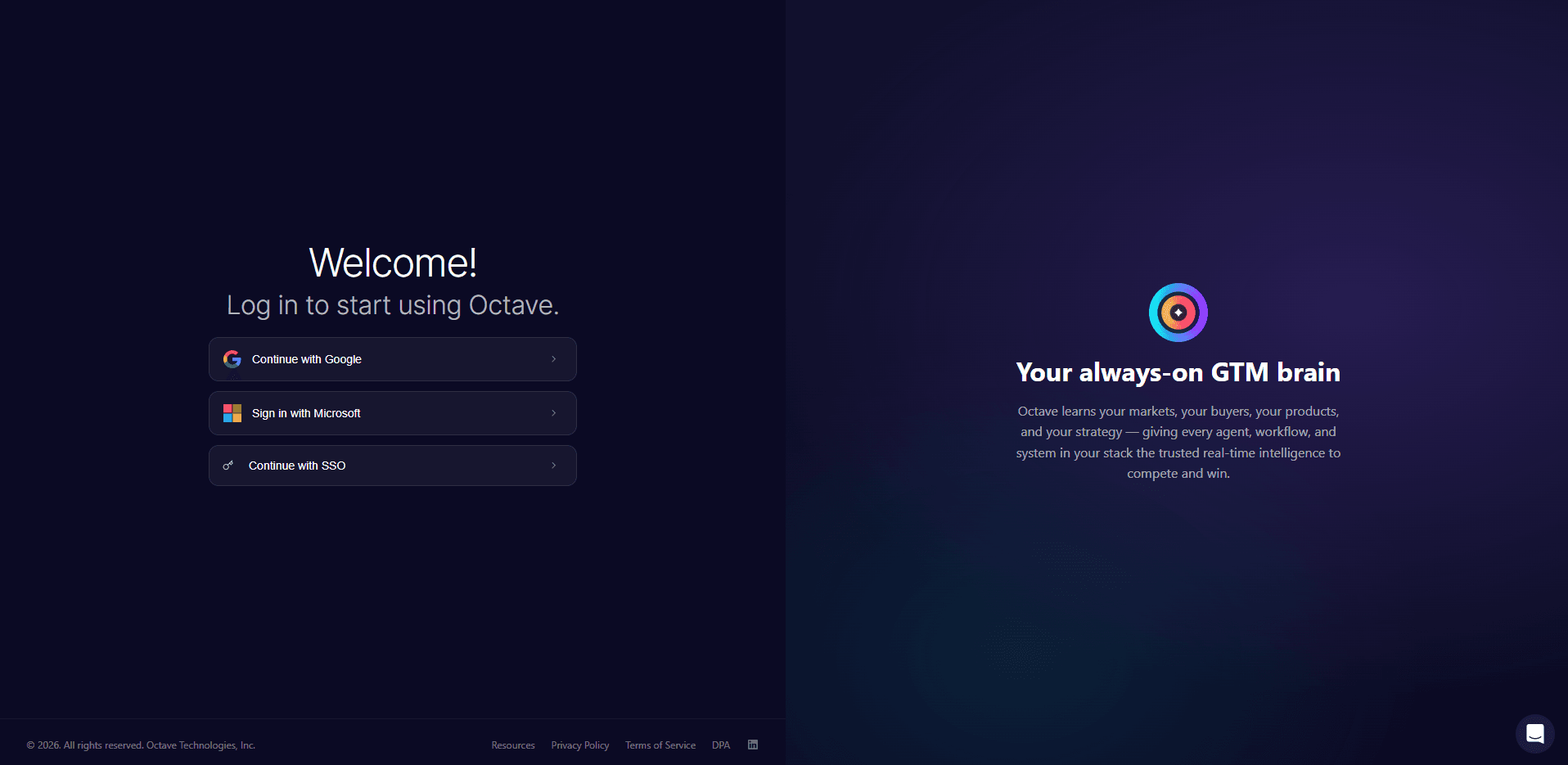
Today, the company uses Descope to support Google Workspace and Microsoft social logins (with custom flow parameters to accept only business email signups) alongside SSO. The migration itself took a couple of weeks, with the Octave team praising Descope’s ability to move a live system with active users onto the new stack without downtime.
One auth experience for every environment
Octave’s Model Context Protocol (MCP) server was a thoughtful extension of the company’s already headless approach. As the team followed the trajectory of Claude and Claude Code, it became clear that users did not want yet another tool to log in to. They wanted the rich context supplied by Octave, delivered where they already worked.
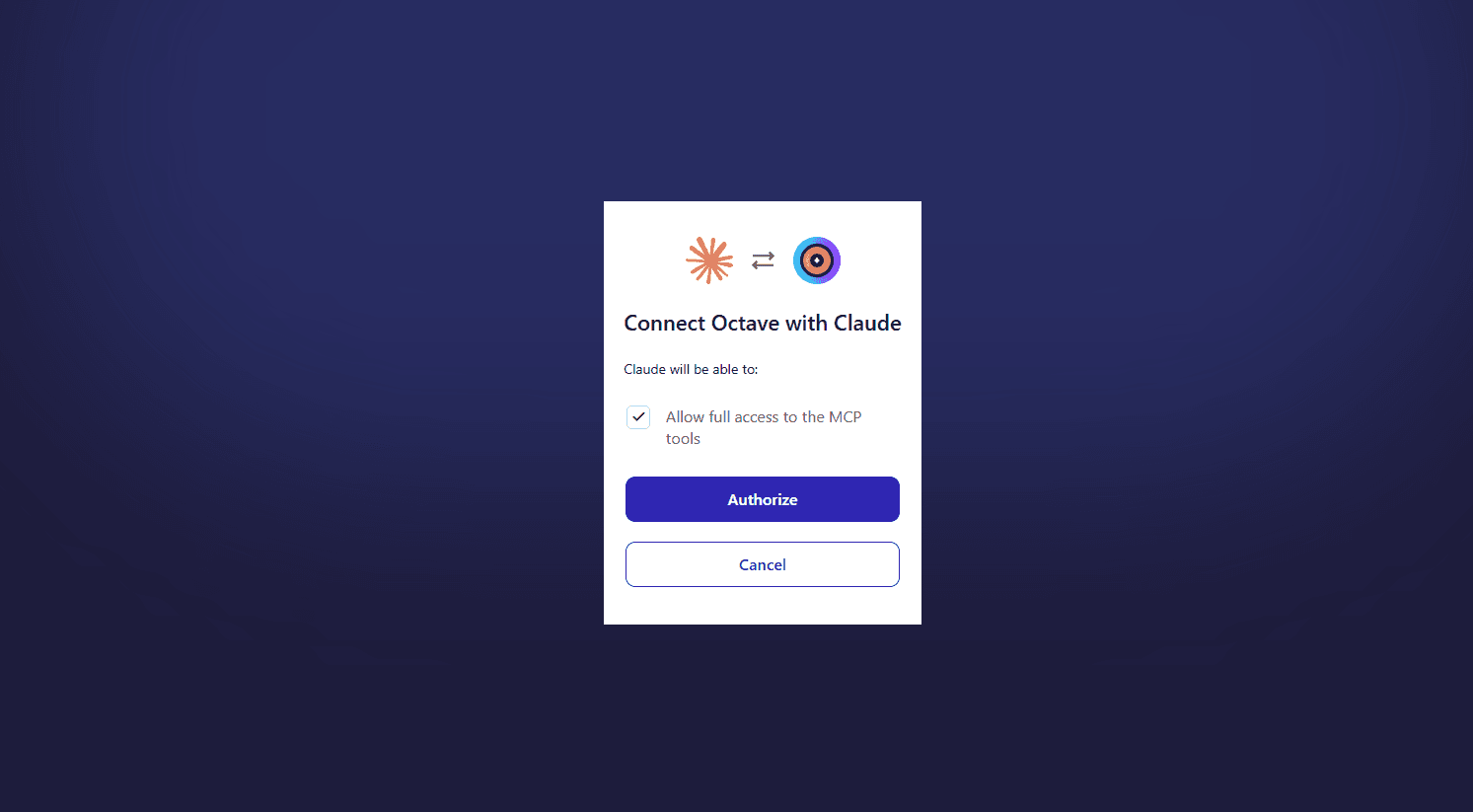
Exposing the product through an MCP server was the smoothest way to achieve this, and because Descope was already handling authentication, the MCP server could use the same sign-in flow.
Julian Tempelsman, Co-Founder and CTO at Octave, said:
“We’re an AI-native, headless product. The majority of our users don’t have to log in to Octave; they connect through our MCP server, which is powered by Descope. Whether someone signs in through the UI or comes in through MCP, the auth runs through Descope Flows.”
The Descope Agentic Identity Hub sits in front of the MCP server as the OAuth-compliant authorization layer, handling the spec-mandated elements like PKCE, Dynamic Client Registration (DCR), and token issuance. Octave uses DCR with an admin approval step: an unregistered client triggers a request, an admin approves or rejects it, and approved clients connect from then on.
Connecting Octave libraries with GTM sources
The context provided by Octave is only as good as the data sources it can reach, and those sources span a wide range of GTM apps: CRMs, conversation intelligence, and the many documents, inboxes, and channels where teams actually work. Traditionally, this would require significant upfront work and ongoing maintenance to ensure Octave could query a customer’s data sources with the proper permissions.
Descope Connections power outbound integrations with several of Octave’s knowledge sources, including Google Drive, Slack, and Notion. Connections handle the secure storage, token refresh, and access control needed to maintain these connections automatically. This allows Octave to ingest the source material, keep it updated, and return results enriched with real context. No complex integration steps, API keys to secure, or tokens to rotate.
Enterprise-grade auth that scales with growth
The most compelling measure of success, according to Octave, is how little they think about authentication now. SSO infrastructure that would have been a major undertaking on their previous system could be built in about a day. As Octave looks to onboard more customers using enterprise SSO, SCIM and the SSO Setup Suite offer self-service options that take even more maintenance off their team’s hands.
Julian Tempelsman, Co-Founder and CTO at Octave, said:
“The best thing I can say about Descope is that we do not have to think about auth. When a customer hears how we handle it, that stops being an objection. And when we do need to extend it, we know it’s easy.”
Looking ahead, Octave plans to connect more GTM knowledge sources to further deepen its already rich context. With Descope, Octave can easily ingest scattered data from new channels, send out requests, and create more bidirectional loops.
And with identity off their plate, those are priorities the Octave team gets to pursue on their own timeline.
Descope is a flexible customer and agentic platform that helps organizations easily add authentication, authorization, and identity management to their apps, AI agents, and MCP servers. Customers use us for initiatives such as passwordless authentication, SSO, identity federation, strong MFA, fraud prevention, and agentic identity.
To get started with Descope, sign up for a Free Forever account. If you have questions about our platform, book time with our auth experts.