
Table of Contents
Don't have the time to read the entire post? Our human writers will be sad, but we understand. Summarize the post with your preferred LLM here instead.
Most modern apps need more than one type of authentication. For example, a single product might require an easy login for individual users, enterprise-level SSO and SCIM for business clients, adaptive MFA to prevent account takeovers, and now, a secure way for AI agents and MCP servers to act for users. Building all of this from scratch is a big responsibility.
Stytch is a popular option for teams looking for developer-focused authentication tools. It provides strong APIs and SDKs for consumer authentication, B2B authentication, and, more recently, OAuth-based Connected Apps. However, Stytch uses a component-based approach. You get building blocks, and your engineering team puts them together, connects them to your authorization logic, and keeps them updated as your needs change.
Descope does things differently. Rather than giving you separate components to connect, Descope offers a no / low-code workflow layer that brings together B2C, B2B, authorization, and agentic identity in one platform. This way, your team can build authentication once and update it through configuration instead of redeploying.
In this post, we will compare Descope and Stytch in the areas that matter most as your product grows: consumer user experience, enterprise readiness, security, pricing, and AI-agent identity.
Also Read: A Complete Comparison of Descope and Stytch
What to look for in a modern customer auth platform
Whether you're serving individual consumers, business tenants, or both, a handful of capabilities separate a platform that scales from one that turns into a maintenance burden:
Support different login form factors - embedded, hosted, and native mobile flows, so login, signup, and MFA can match whatever experience your product needs.
No/low-code workflow orchestration - the ability to change login methods, MFA logic, and onboarding steps through configuration, not a code change and a deploy.
Full passkey support with fallback logic - not just raw WebAuthn, but day-one passkey support with graceful fallback for users or devices that don't support it.
Adaptive, risk-based MFA - step-up authentication driven by real risk signals and pluggable fraud connectors, not just static rules.
Real multi-tenancy for B2B - tenant-aware roles, self-service SSO and SCIM setup, and delegated admin so enterprise customers can manage themselves.
Unified authorization - RBAC, ABAC, or ReBAC living in the same platform as authentication, not a bolt-on service with its own data model.
Predictable pricing - costs that don't spike as MAU, SSO connections, or MFA usage scale.
Agentic and MCP-ready identity - a purpose-built way to authenticate and authorize AI agents, not a repurposed OAuth client model.
Platforms that check these boxes let you spend engineering time on your product instead of your auth stack. Here's how Descope and Stytch stack up against each one.
User experience: Flexible journeys vs. code-heavy components
Descope
Descope puts user journey screens directly in your app, so users stay in one place without being sent to another page or encountering any awkward redirects. Alternatively, teams that prefer a dedicated login page can use Descope's hosted option, so the choice comes down to what best fits your product. On mobile, the same smooth experience works for both iOS and Android using an enhanced web view.
Journeys embedded natively in your app, no redirects
Hosted login option available for teams that prefer a dedicated login page
Native mobile flows for a near-native authentication experience
Fully brandable screens that match your product's look and feel
Also Read: Embedded vs Hosted Login in Descope
Stytch
Stytch provides auth components and SDKs rather than complete user journeys. That gives developers granular control, but without low-code flows or built-in orchestration, every UX iteration (a new step, a design tweak, a conditional path) becomes an engineering task.
Auth components and SDKs, not pre-built journeys
No low-code flow builder for assembling multi-step experiences
UX changes typically require frontend code changes and a deploy
Bottom line: Stytch gives developers the building blocks to create a custom experience. Descope, on the other hand, provides a complete, embedded journey right away and lets you keep improving it without having to redeploy your app.
User journeys & workflows: No / Low code orchestration vs. manual engineering
Descope
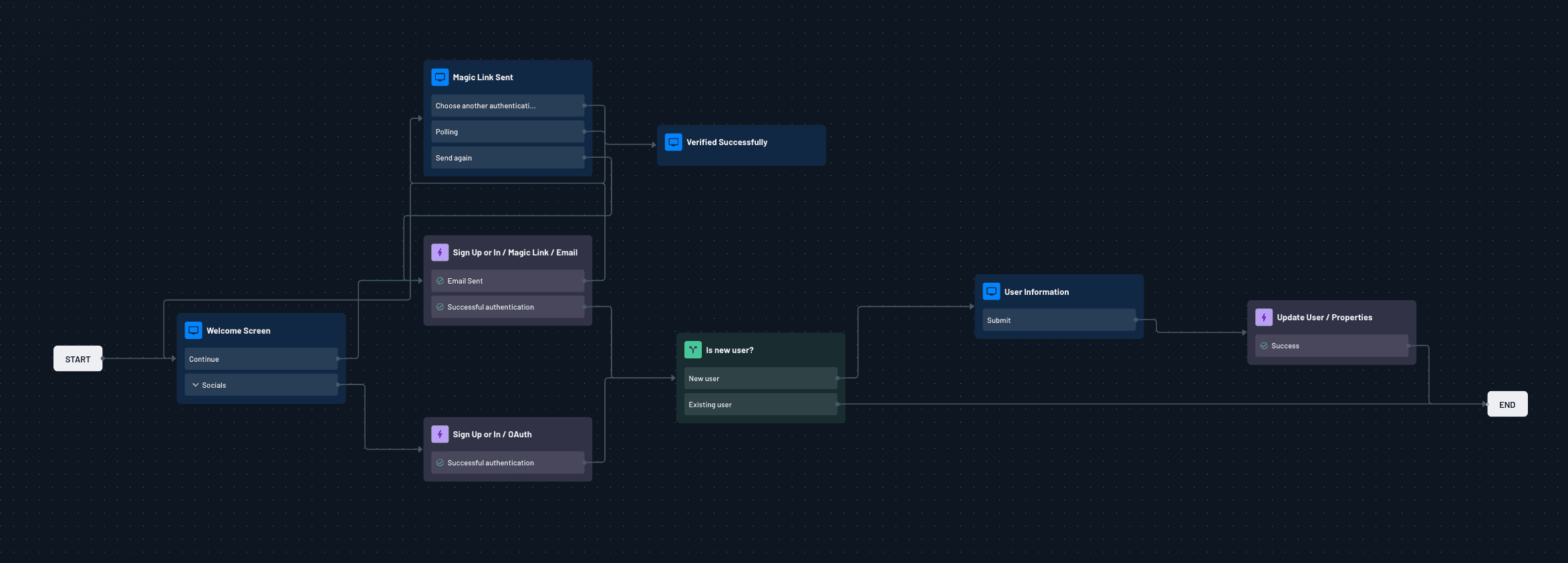
Descope lets you set up authentication as a configurable workflow rather than fixed code. With its visual Flows builder, teams can design, test, and update login, MFA, and onboarding journeys, including A/B tests, without touching backend code.
No-code visual workflows for auth, MFA, and onboarding
A/B test auth methods, onboarding paths, and geo-based logic without custom code
Add conditional branching based on user, device, or risk context
Modify journeys without redeploying your application
Broad SDK and API support for teams that prefer to build and manage auth in code
Stytch
Stytch offers flexible login options through its SDKs and APIs, but it does not have a separate workflow layer. You need to build the full journey in your own application code.
Flexible login patterns via SDK/API
No visual workflow builder or orchestration layer
Multi-step journeys and conditional logic built and maintained in application code
Bottom Line: Stytch enables flexible auth patterns, but teams still hand-build the journey around them. Descope's workflow builder turns that same work into configuration your team can change in minutes.
Passkeys: Day-one native support vs. SDK-based WebAuthn
Descope
Descope has offered passkey support from the start, with features like autofill, fallback logic, and A/B testing for adoption. You can use passkeys as either a first or second factor with any other authentication method.
Passkey support from day one, including autofill
Passkeys as a first or second factor with any other auth method
A/B test passkey rollout across your user base
Automatic fallback to another method if a device isn't passkey-compatible
Stytch
Stytch supports WebAuthn-based passkeys, but its SDK-based setup can be cumbersome and does not include built-in fallback logic. Development teams need to create the full passkey experience themselves, including checking device compatibility and setting up fallback options.
WebAuthn passkey support via SDK
No built-in fallback orchestration for incompatible devices
Full passkey UX and edge-case handling built by the development team
Bottom Line: Both platforms support passkeys, but Descope treats fallback handling and rollout testing as first-class features. With Stytch, that logic is on you to build. Branch is a good example of how much that orchestration matters in practice — more on that below.
MFA & fraud prevention: Adaptive, connector-driven vs. fingerprinting only
Descope
Every Descope plan includes MFA, with phishing-resistant options such as magic links and passkeys. Adaptive MFA relies on risk signals and third-party fraud connectors to determine when extra authentication is needed. All of this is managed in the same workflow builder used for login and onboarding.
MFA available on all plans, including phishing-resistant factors
Risk-based, adaptive MFA driven by real signals
Pluggable fraud connectors, including reCAPTCHA, AbuseIPDB, Forter, and Fingerprint
MFA logic lives in the same workflow as the rest of the auth journey
Stytch
Stytch provides several MFA options and built-in device fingerprinting. However, it does not support adaptive MFA or allow you to use external fraud or risk signals in its authentication flow. To use fraud signals for authentication decisions, you need custom integrations and manual setup.
Multiple MFA factors and device fingerprinting
No adaptive, risk-based MFA out of the box
No native fraud-connector ecosystem; external signals require custom integration
Bottom Line: Stytch gives you MFA factors and fingerprinting signals; turning those into adaptive, risk-based decisions is custom work. Descope ships that logic and the connector ecosystem to power it.
Multi-tenancy & enterprise SSO: One platform vs. a separate product
Descope
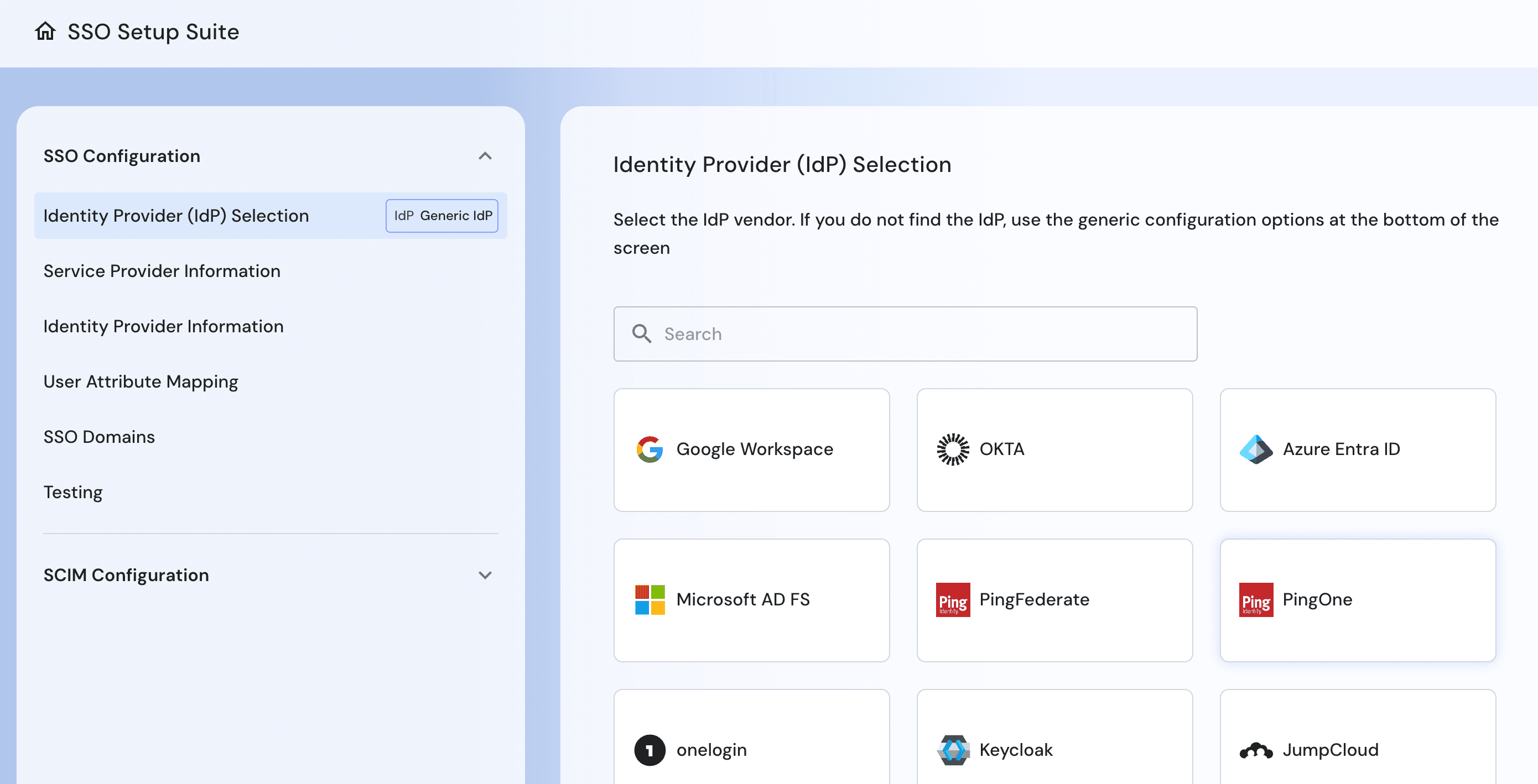
Descope is built tenant-first, so multi-tenancy, roles, SSO, and SCIM are core to the same platform used for consumer auth. The SSO Setup Suite lets tenant admins configure their own SAML/OIDC connections and SCIM provisioning, removing engineering from enterprise onboarding.
Tenant-first architecture built into the same platform as B2C auth
Self-service SSO and SCIM setup for tenant administrators
Tenant-aware roles and delegated admin controls
Tenant-isolated users to support MSSP and white-label reseller models
Support for multiple identity providers per enterprise tenant
Stytch
Stytch's B2B authentication is a distinct product from its Consumer Authentication offering. Teams that need both must implement and maintain each separately, then stitch them together at the application layer.
B2B and Consumer Auth offered as separate products
Enterprise SSO and SCIM available, but as part of a distinct product surface
Teams needing unified B2C/B2B auth must integrate both products themselves
Bottom Line: Stytch requires teams to run two products side by side for B2C and B2B. Descope unifies both in a single platform, so enterprise readiness doesn't mean a second integration.
Also Read: A Primer on B2B Authentication With Descope
Authorization: Unified with auth vs. a separate concern
Descope
Descope unifies authentication and authorization on a single platform. Teams can manage RBAC, ABAC, and ReBAC models, assign roles dynamically within authentication workflows, and enforce permissions using a low-latency FGA cache. No separate authorization service is required.
Built-in RBAC, ABAC, and ReBAC authorization models
Roles and permissions assignable directly from auth workflows
High-performance FGA cache for low-latency authorization checks
Centralized identity and authorization management
Stytch
Stytch supports RBAC, but authorization is not unified with journey orchestration. Assigning roles and permissions to specific authentication flows or conditional logic must be handled in application code.
RBAC available through the platform
Not integrated with a workflow/orchestration layer
Connecting authorization decisions to auth flows requires custom logic
Bottom Line: Stytch offers authorization primitives; Descope ties authorization directly into the same workflows that handle login, onboarding, and MFA.
Agentic identity & MCP auth: Purpose-built hub vs. a separate product surface
Descope
The Agentic Identity Hub provides AI agents and MCP servers with an OAuth-compliant identity layer, so you do not need to rewrite your downstream services. It covers all required features such as PKCE, client registration, consent, and token issuance, and allows agents to use the same sign-in flow as your users.
OAuth 2.1-compliant authorization layer purpose-built for agents and MCP servers
Handles PKCE, client registration, consent, and token issuance out of the box
Layers on top of your existing workforce / customer IdPs–no need to rebuild your identity stack
Unified with the same tenant, role, and authorization model as human users
Stytch
Stytch offers Connected Apps, which allow an application to act as an OAuth/OIDC authorization server for both first- and third-party clients, including AI agents. This is a strong building block, but it is separate from Consumer and B2B Auth. Connected Apps has its own client, scope, and consent model, which you need to integrate separately.
Connected Apps supports OAuth/OIDC-based client and agent access
Implemented as a separate product surface from core auth
Requires its own integration for clients, scopes, and consent flows
Bottom Line: Both platforms support agent-facing OAuth flows, but Descope's Agentic Identity Hub shares the same tenant and authorization model as your human users, while Stytch's Connected Apps is a separate surface to integrate on its own.
Global compliance & enterprise readiness: Broad certifications vs. a narrower baseline
Descope
Descope is built to meet the compliance and deployment requirements of regulated industries and government agencies out of the box, without requiring a separate infrastructure project.
FedRAMP High Authorized, listed on the FedRAMP Marketplace
Multi-region data residency, including dedicated EU, Australia, and Canada data centers
SOC 2 Type 2 and ISO 27001 certified
HIPAA and GDPR compliant, plus CSA STAR Level 2 and PCI DSS certified
Stytch
Stytch covers foundational compliance certifications, but FedRAMP authorization and multi-region data residency aren't part of the platform today.
No FedRAMP authorization
No shipped multi-region data residency
SOC 2 and ISO 27001 certified
HIPAA/BAA available, but only on the Enterprise plan
Bottom Line: Both platforms cover the compliance basics, but Descope's FedRAMP High Authorization and live multi-region data residency matter for regulated industries and government use cases where Stytch doesn't yet have an equivalent.
Future-proofing: One platform vs. multiple products
Descope
Descope brings together B2C authentication, B2B enterprise features, authorization, and AI identity in one platform. When new needs arise, like a new authentication method or tenant type, you usually just adjust workflows instead of adding new integrations.
Unified platform for B2C, B2B, authorization, and AI identity
Workflow-driven architecture makes future changes low-risk
Extend capabilities without introducing new systems
Stytch
Stytch is up-to-date and easy for developers, but its B2C and B2B products are separate. New features like Connected Apps are also managed on their own. As your needs grow, your team may have to integrate and maintain several different products instead of just configuring one.
Strong, modern APIs across distinct product lines
B2C, B2B, and Connected Apps managed as separate products
Expanding identity needs typically mean additional integrations
Bottom Line: Stytch's modular product lineup means your identity stack grows by addition. Descope's unified platform means it grows by configuration.
Descope vs Stytch: At-a-Glance
Descope | Stytch | |
|---|---|---|
User experience | Embedded, native journeys + hosted login | Auth components, redirect-based |
User journeys | No-code visual workflows + A/B testing | Manually engineered flows |
Passkeys | Native, day-one, with fallback logic | SDK-based WebAuthn, no fallback orchestration |
MFA & fraud | Adaptive MFA + fraud connectors, all plans | Device fingerprinting, no adaptive logic |
Multi-tenancy / SSO | Unified platform, self-service SSO + SCIM | Separate B2B product |
Authorization | Unified RBAC/ABAC/ReBAC | Available, not unified with workflows |
Agentic / MCP identity | Agentic Identity Hub, shared tenant model | Connected Apps, separate product surface |
Compliance & data residency | FedRAMP High Authorized, multi-region residency, SOC 2/ISO 27001 | No FedRAMP, no shipped multi-region residency |
Customer stories: Teams that chose Descope over Stytch
Teams tend to move off Stytch when they need one platform to cover consumer UX, enterprise readiness, and increasingly, agent identity instead of three separate integrations.
You.com: B2C, B2B, and MCP auth under one roof
You.com is an AI-powered productivity platform used by individual consumers, developer teams building on its API, and enterprises with strict security requirements. As the company grew, it needed to support consumer-grade sign-in and enterprise SSO without running them as two separate systems. Also, as its MCP server matured, it needed a way to bring AI agents onto the same identity layer.
Descope let You.com unify B2C authentication, self-service enterprise SSO, and fine-grained authorization (ReBAC) in one platform, while migrating 6.5 million users with zero downtime and all user IDs preserved, using a custom migration script that processed 1,000 users every 1.5 seconds.
You.com's MCP server now runs on Descope's Agentic Identity Hub, which handles OAuth 2.1, PKCE, consent, and token issuance so AI agents authenticate through the same sign-in flow as human users without requiring You.com to rewrite its API-key-based backend services.
Branch: Drag-and-drop passkey auth that cut support tickets in half
Branch Insurance, a cloud-native home and auto insurer, wanted to move to phishing-resistant MFA without ripping out its existing auth provider or user store, while meeting strict compliance requirements in a regulated industry.
Descope's workflow-based approach let Branch layer in passkeys alongside its existing authentication, with conditional logic that routed users to passkeys when their device supported it and to fallback MFA when it didn't, all without significant code changes.
The results: 25% passkey adoption, a 50% reduction in auth-related support tickets, and steady login failure rates throughout the rollout.
Fullbay: Enterprise-ready auth for the leading fleet repair platform
Fullbay is the number one heavy-duty truck and trailer repair shop management platform in North America, serving repair shops, private fleets, and heavy-equipment service providers with a cloud-based system for managing service orders, technicians, and parts inventory.
Fullbay moved from Stytch to Descope for its authentication needs because they were seeking a platform that supported multi-tenancy as a first class primitive, had FGA capabilities, and provided native identity infrastructure for AI agents and MCP servers.
Migration: Moving from Stytch without disruption
Migrating authentication infrastructure can feel risky, especially for applications spanning both consumer and enterprise users, where a login interruption or a broken SSO connection has an immediate, visible impact. A well-planned migration prioritizes continuity first, allowing teams to modernize identity without disrupting existing users or enterprise tenants.
Descope supports both full replacement and phased migration for teams transitioning from Stytch. You can switch completely or implement Descope incrementally for features such as passwordless authentication, adaptive MFA, or enterprise SSO, while maintaining existing Stytch flows.
Replace Stytch fully or augment selectively based on your roadmap
Use the AI-powered Stytch-to-Descope migration skill to analyze your codebase, identify which Stytch surfaces are in use, and generate a reviewed migration plan for full or hybrid migrations
Use Session Migration to switch from Stytch without disrupting logged-in users
Use SSO Migration to move existing enterprise SSO connections to Descope without re-onboarding tenants
Use Descope as an OIDC Provider to augment Stytch deployments
By using phased rollouts and standards-based federation, teams can avoid forcing users to re-authenticate or reset credentials during migration. Existing sessions remain stable, and authentication continues to function throughout the transition.
Conclusion
Stytch is a solid choice for teams that want granular, developer-first control and are comfortable assembling auth journeys, tying in authorization, and maintaining separate B2C and B2B products themselves.
However, as products grow, that flexibility can become challenging. Users expect better experiences, enterprise customers want self-service SSO and SCIM, security standards require adaptive MFA, and AI agents need their own identity layer. Combining different Stytch products and custom code to cover all these needs can become complex and time-consuming.
Descope is built to handle all of it from a single platform: B2C auth, B2B enterprise readiness, authorization, and agentic identity, with predictable pricing and a guided path to migrate.
If you're evaluating Stytch or wondering whether your current auth stack can keep up with where your product is headed, now's a good time to take a look at Descope. Book a demo with our auth experts, or sign up for a Free Forever account and start building today.