
Table of Contents
Don't have the time to read the entire post? Our human writers will be sad, but we understand. Summarize the post with your preferred LLM here instead.
Picture a traveler heading to a conference in Austin. Instead of opening five tabs, they tell their personal agent "find me a hotel near the convention center for March 3 to 6, under $250 a night, use my member rate, and check with me before you pay." The agent starts comparing rooms right away.
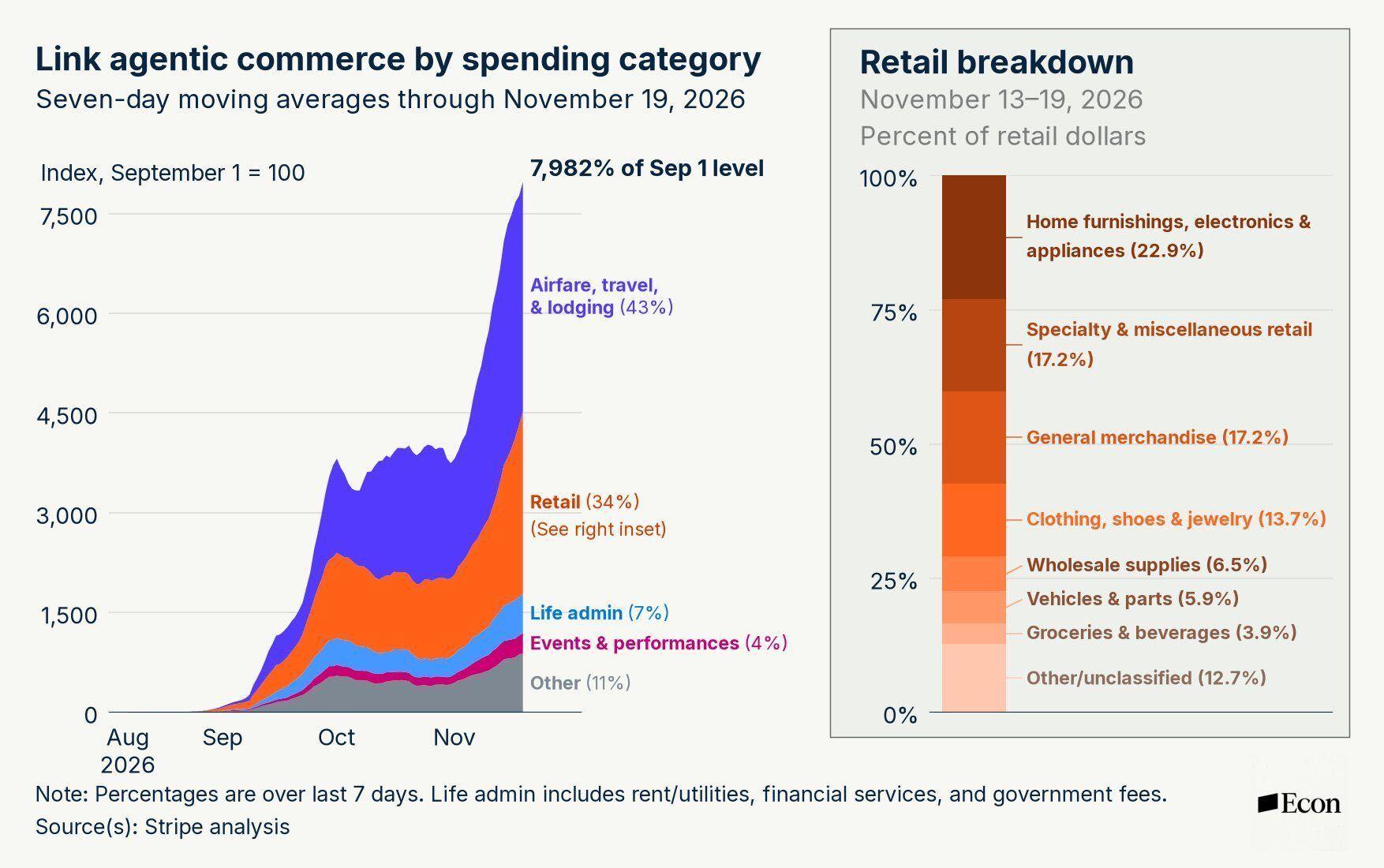
Stripe's latest data suggests travelers are handing off a lot of trips in this manner. Airfare, travel, and lodging made up 43% of agentic spending on Link in the week ending November 19, more than any other category, and daily agent spend on Link was nearly 80 times higher in mid-November than at the start of September.
For hotel distribution and loyalty teams, what matters is whether that agent books with your brand directly or through an online travel agency (OTA). This post covers how hotel brands are responding to agents, why sign-in decides who gets the booking, and six identity tips for turning agent traffic into direct bookings.
At a glance
Personal agents are spending more on travel and lodging than any other category, and the largest hotel brands are already connecting to AI platforms to win direct bookings.
Member rates (the main reason to book direct) sit behind sign-in, and an agent that signs in with a guest's password looks the same as account takeover.
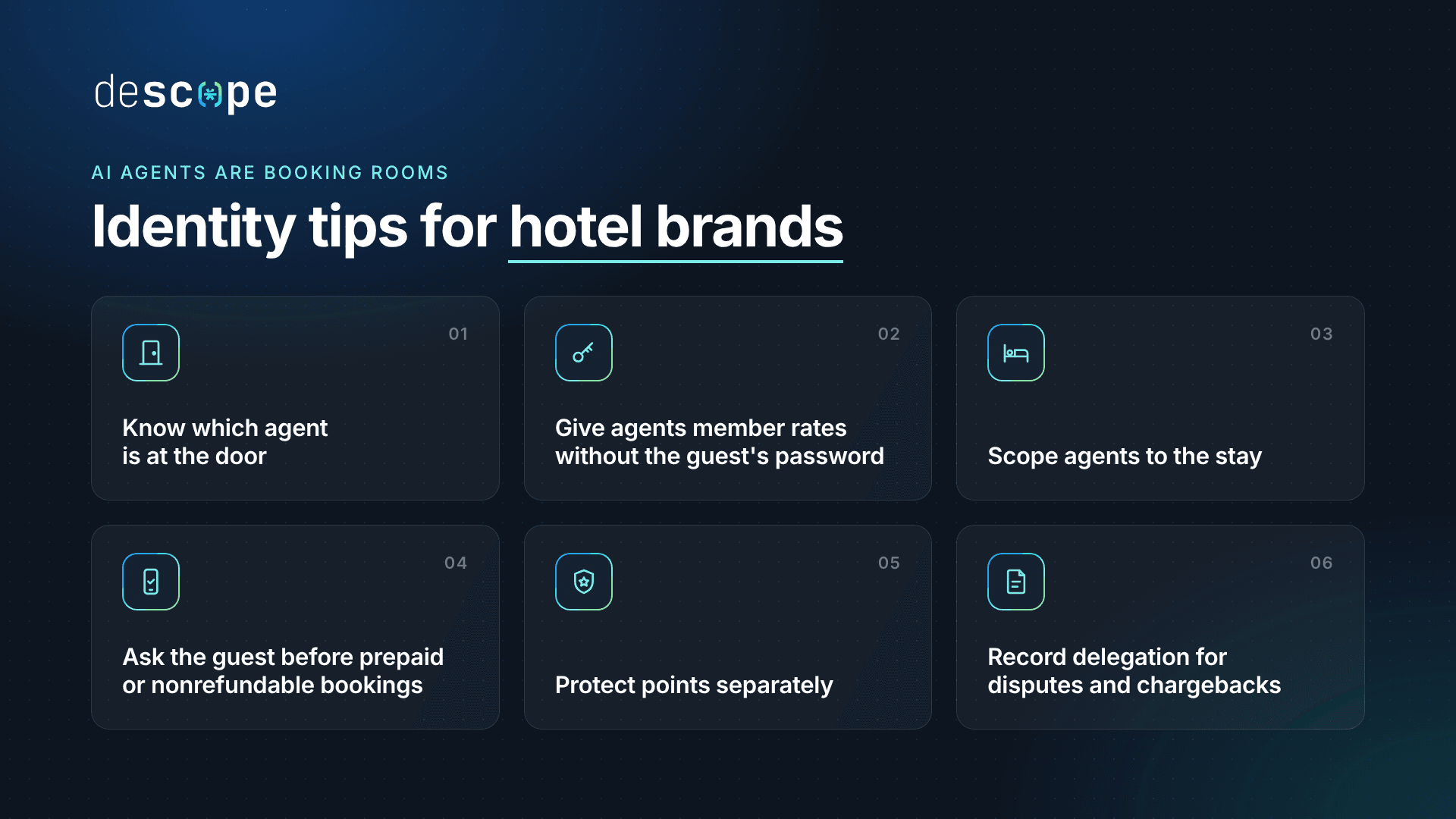
The six tips below cover how to identify agents, unlock member rates safely, scope what agents can do, get guest approval for prepaid rates, protect points, and keep a record for disputes.
Descope Envoy gives hotel brands a delegated sign-in path for personal agents that runs alongside their existing guest and loyalty logins.
How hotel brands are responding to AI agents
Google started letting US travelers book hotels inside AI Mode in August 2026, with Choice, Hilton, IHG, Marriott, and Wyndham among the launch partners alongside the major OTAs. The hotel or OTA stays merchant of record and handles payment, confirmation, and changes. IHG says those bookings are processed as direct bookings, though guests who want member rates can be sent to IHG's own site.
Wyndham has been working with Google and Anthropic on AI bookings since February, and its CEO has been clear about the goal: "The focus is really on driving more direct bookings." In May, Wyndham launched a native ChatGPT app that lets travelers browse about 8,400 hotels and then finish the reservation on WyndhamHotels.com.
OTAs are competing for the same agent bookings, using the same lever hotels rely on. Meta's Muse agent can now search and book Expedia hotels, and when a traveler links their Expedia account, the agent sees Expedia's member pricing. In Skift's test, that lowered one listing by more than $100, so an agent comparing prices can find a better deal on the OTA than on the hotel's own public rate.
That said, agent bookings are still a small share of the market. Booking Holdings said on its Q2 earnings call that AI-referred visits make up less than 1% of total room nights. Hotel brands that set up agent access now will have it in place as that share grows in the months to come.
The sign-in page decides who gets the booking
Agents that don't know a guest's preferred brand tend to end up visiting OTAs. In a study of 176 scripted booking requests, Propellic found that Muse sent 11 of 20 hotel bookings to OTAs and eight directly to hotels. Linking a loyalty account changed that, however—with Marriott or Hilton accounts connected, six of eight direct-booking requests went to a linked brand's property, compared with one of eight without.
This means the guest's loyalty account is the key to a direct booking, but it's also where the risk lies. A hotel account stores the guest's profile and stay history, saved payment methods, upcoming reservations, and a points balance that can cover free nights. When an agent signs in using the guest's password and one-time code, the hotel’s systems see an ordinary login…which is also what account takeover looks like. Fingerprint's 2026 travel and hospitality fraud report found that more than half of loyalty fraud incidents involve account takeover.
Guests are also wary of handing over unfettered access to agents. Among travelers in the Propellic survey who hadn't connected any accounts to their agent, 55% cited privacy or security concerns.
There’s also the question of dispute resolution: when a guest disputes a prepaid stay they say they never booked, the hotel’s support team has to work out whether the guest’s agent booked it as asked, misread the request, or was never their agent in the first place. If the agent signed in as the guest, logs can't tell these cases apart. Fingerprint also reports that hospitality chargebacks are rising about 30% a year, so unclear agent bookings add to a problem that's already growing.
Agent identity tips for hotel brands
Know which agent is at the door
Challenge
When an agent uses a guest's credentials, the hotel’s booking engine and loyalty platform can't tell which agent is making a request, or whether an agent is involved at all. Every agent session gets the same treatment as the guest's own login.
Solution
Ask agents to identify themselves before sessions are issued. The Personal Agent Protocol (Poppy) gives agents a standard way to find agent-facing endpoints and sign in under their own identity, tied to the guest they act for.
Publish one discovery file: Agents read it to learn how to sign in and what they can do on the hotel’s site.
Identify agents by metadata: Client ID Metadata Documents let compliant agents identify themselves without a manual registration step.
Bind sessions to the agent: Tie each session to the agent's cryptographic key with DPoP, so tokens only work for the agent they were issued to.
Also read: What Is the Personal Agent Protocol?
Give agents member rates without the guest's password
Challenge
Member rates and loyalty perks show up only after the guest signs in. An agent that can't sign in sees the hotel’s public rate, which means an OTA with a linked account can show a lower price for the same room. The hotel loses the direct booking over a gap on the sign-in page.
Solution
Let the guest link their loyalty account to their agent through a delegated session. The agent then sees member pricing and the stay earns points without needing the guest’s password.
Link once with consent: The guest approves the connection on the hotel site, and the agent gets its own credentials.
Show member pricing to the agent: Return the same member rates and perks the guest would see when signed in.
Credit the stay: Attach the booking to the member account so points and elite benefits apply.
Scope agents to the stay
Challenge
A full guest session lets an agent do everything the guest can, including changing contact details, adding payment methods, and editing profile preferences. Booking a room certainly doesn’t need all that access.
Solution
Tightly define what agents can do on a guest's account and keep everything else off limits.
Allow the booking tasks: Searching rates, holding rooms, booking within a stated budget, and modifying dates within the cancellation policy.
Protect the guest profile: Keep saved cards, contact details, and account settings out of agent scope.
Limit duration: Expire elevated access after checkout or once the task is done.
Ask the guest before prepaid or nonrefundable bookings
Challenge
Prepaid rates are often the cheapest, but they're also the hardest to roll back. An agent chasing the lowest price can lock a guest into a stay they can't cancel and leave the hotel’s front desk or support team to deal with it.
Solution
Send prepaid bookings, cancellations, and other irreversible actions back to the guest for approval on their own device, outside the agent's session.
Let’s say the guest’s agent finds a prepaid rate for $60 less per night three days before the Austin trip. It holds the room and sends the rate, the cancellation terms, and the new total to the guest's phone, asking whether to swap out the flexible booking. The guest approves between conference sessions, and the change goes through with a record of who asked, who approved, and who booked.
Use out-of-band approval: Client-Initiated Backchannel Authentication (CIBA) sends the request straight to the guest's device.
Show the details: Include the dates, room type, cancellation terms, and total in the approval request.
Set the triggers: Decide which actions need approval, such as prepaid rates, cancellations outside the free window, or stays above a set amount.
Protect points separately
Challenge
Guests can redeem hotel points for free nights or transfer them to airline partners in minutes, often with fewer checks than a card payment. If an agent session can redeem points as easily as it can search rates, a compromised agent or a bad instruction can drain a balance.
Solution
Treat points actions as their own permission, with their own approval.
Separate redemption from booking: An agent allowed to book with a card doesn't automatically get to spend points.
Require approval for redemptions and transfers: Free-night awards and points transfers should always go back to the guest.
Revoke without logout: Cut off a single agent's access without signing the guest out of their account.
Record delegation for disputes and chargebacks
Challenge
When a guest disputes a stay, support and fraud teams need to know whether the guest booked it, their agent booked it, or someone else did. Without a record of agent involvement, the default is often a refund or a lost chargeback.
Solution
Record the guest and the agent as separate identities in every token and log entry.
Log both identities: Show which agent acted and which guest it acted for.
Keep approvals with the reservation: Store the approval record alongside the confirmation number.
Give teams the evidence: Let support and chargeback teams look up agent activity by confirmation number.
Also read: AI Agents Are Booking Flights: Identity Tips for Airlines
Identity tips for hotel brands: at a glance
Tip | Challenge | Solution |
|---|---|---|
Know which agent is at the door | Agents using guest credentials can't be told apart from guests. | Have agents sign in under their own identity through Poppy, with sessions bound to the agent. |
Give agents member rates without the guest's password | Agents that can't sign in see public rates, while OTAs show member pricing. | Let guests link their loyalty account to their agent through a delegated session. |
Scope agents to the stay | A full session exposes saved cards, contact details, and settings. | Allow search, hold, booking, and in-policy changes, and keep the guest profile out of scope. |
Ask the guest before prepaid or nonrefundable rates | Prepaid stays booked without approval turn into disputes. | Send prepaid bookings and cancellations to the guest's device for approval with CIBA. |
Protect points separately | Points can be redeemed or transferred quickly by any session with access. | Make points actions a separate permission that always needs guest approval. |
Record delegation | Support can't tell whether the guest or an agent made a booking. | Log the guest and the agent separately and store approvals with each reservation. |
Descope Envoy: delegated agent sign-in for hotel brands
Descope Envoy gives personal agents a delegated sign-in path to your booking site and apps. It runs alongside existing guest and loyalty sign-in stacks, so there's nothing to migrate. Travel companies already add capabilities to their customer login with Descope this way: Navan added phishing-resistant MFA on top of its existing login in four days, without major changes to its existing CIAM systems.
Poppy support: Accept agents through the Personal Agent Protocol without implementing or maintaining the spec yourself.
Agent identity: Identify agents through client metadata, with sessions bound to each agent's key using DPoP.
Granular permissions: Define what agents can do on a guest's account with Rich Authorization Requests (RAR), including member rate access and how long elevated access lasts.
Guest approval: Send prepaid bookings, points redemptions, and other sensitive actions to the guest's phone with CIBA.
Delegation records: Keep the guest and the agent distinct in every token and log entry, and revoke an agent without signing the guest out.
Envoy launch customers
Consumer brands across fundraising, healthcare, and creator tools are working with Envoy. GoFundMe and GoodRx both implemented Poppy with Envoy and are Poppy design partners. GoFundMe keeps each donor and their agent distinct in every session and asks donors to approve donations from their phone. GoodRx gives agents limited permissions for prescription pricing, and its users stay in control of what their agent does.
Linktree, You.com, Elementor, and Composio are also among Envoy's launch and design partners.
Also read: Descope Joins the Personal Agent Protocol as a Design Partner
Get your hotel brand ready for agent bookings
Travelers are starting to hand hotel searches and bookings to personal agents. The brands that make sign-in easy for those agents are the ones most likely to get the booking directly. Every hotel brand should be able to answer three questions about an agent booking: which agent placed it, which guest it acted for, and what it was allowed to do.
If you want to see how Envoy works with your existing guest sign-in, sign up for Envoy or book a demo with our agent (and human!) auth experts.