
Table of Contents
Don't have the time to read the entire post? Our human writers will be sad, but we understand. Summarize the post with your preferred LLM here instead.
As your consumer app grows, handling authentication gets more complicated.
When you’re just starting out, adding a login is pretty simple. You might use a hosted login page, let people sign in with social accounts, or stick with basic username and password. These choices help you launch fast and start bringing in users. But as your product grows and more people sign up, authentication becomes a key part of the user experience.
Consumer platforms need to keep things secure and easy to use, even as they support millions of users on different devices and browsers. If logging in is too hard, people might not sign up, finish onboarding, or stay engaged. Teams also want to try new signup flows, add passwordless options, include verification steps, or change how authentication works as the product changes.
To keep up with growth, your identity platform needs to do more than just log users in. It should make signups easy, work well on mobile, let teams improve onboarding, and help you adjust authentication as your users’ needs change.
In this blog, we’ll compare Descope and Auth0. We’ll look at how each one improves the user experience, makes authentication easier for your team, and helps you scale. If you’re building or growing a consumer app, knowing these differences can help you pick the right identity platform for great user experiences and long-term growth.
Also Read: A Complete Comparison of Descope and Auth0
Requirements for B2C CIAM
According to the 2025 Gartner® Innovation Insight for Customer & Partner IAM, supporting consumer applications involves more than just adding login and signup features. It means creating an identity system that can handle millions of users while keeping security, user experience, and business growth in balance.
Frictionless user experience at scale - Consumer identity systems should make every interaction as smooth as possible. Signup and login should be quick, easy to use, and work the same way on any device. Even small issues, like extra steps or redirects, can cause users to leave and lower conversion rates.
Mobile-first and omnichannel access - Identity flows need to work smoothly on every channel and feel natural to users, no matter how they interact with the application.
Composable and flexible user journeys - Modern CIAM needs to adapt authentication and onboarding flows as business needs change. Teams should be able to add new verification steps, support different user paths, and update authentication logic without needing long engineering projects.
Passwordless and adaptive security controls - Top CIAM platforms focus on passwordless authentication methods like passkeys, magic links, and one-time codes. Adaptive MFA improves security by using extra authentication only when there are risk signals, which keeps things easy for trusted users.
Continuous iteration and experimentation - Consumer applications are always working to improve onboarding and engagement. Identity systems should let teams quickly test and adjust authentication journeys without slowing down product development.
Unified identity across user types - Modern applications often serve consumers, partners, and business users together. Identity platforms should support all these user types in one system instead of using separate identity stacks. This approach creates a consistent user experience, shared security policies, and a simpler setup as products grow into B2B2C and partner-driven models.
These requirements highlight why the underlying architecture of your identity platform matters. The differences become clear when comparing how platforms handle core areas like mobile authentication, user journeys, flexibility, and long-term adaptability.
The following sections will compare Auth0 and Descope on the aforementioned evaluation criteria and more.
Also Read: Authentication in Ecommerce: Best Methods & CIAM Tips
Mobile authentication: Native flows vs redirect-based login
Descope
Descope is designed to support authentication experiences that feel native to the application. Instead of redirecting users to external login pages, authentication flows can be embedded directly into mobile apps and web applications. This approach helps maintain a consistent product experience and reduces friction during signup and login.
Authentication flows embedded directly inside the application
No redirect-based login required
Authentication screens feel native within the app experience
Improved UX for mobile signup and authentication journeys
By keeping authentication inside the product experience, Descope helps consumer apps maintain smooth onboarding flows and reduce user drop-off during login.
Also Read: Add Authentication to Kotlin With Descope Native Flows
Auth0
Auth0 commonly relies on its Universal Login feature, which uses redirect-based authentication. While this simplifies implementation in some scenarios, it means users are redirected to a hosted login page before returning to the application. In mobile environments, these redirects can introduce friction and complicate the authentication experience.
Universal Login relies on redirect-based authentication
Users are redirected to hosted login pages during login
Mobile webviews can introduce UX inconsistencies
Session handling across redirects can add complexity
Redirect flows may increase drop-off in signup funnels
Auth0’s approach works well for quickly adding authentication, but redirect-based login can become more noticeable as teams optimize user experience for consumer applications.
Bottom Line: Auth0 login commonly relies on redirect-based authentication flows. Descope keeps authentication embedded inside the application for a more seamless mobile experience.
User journeys: Workflow builder vs hard-coded logic
Descope
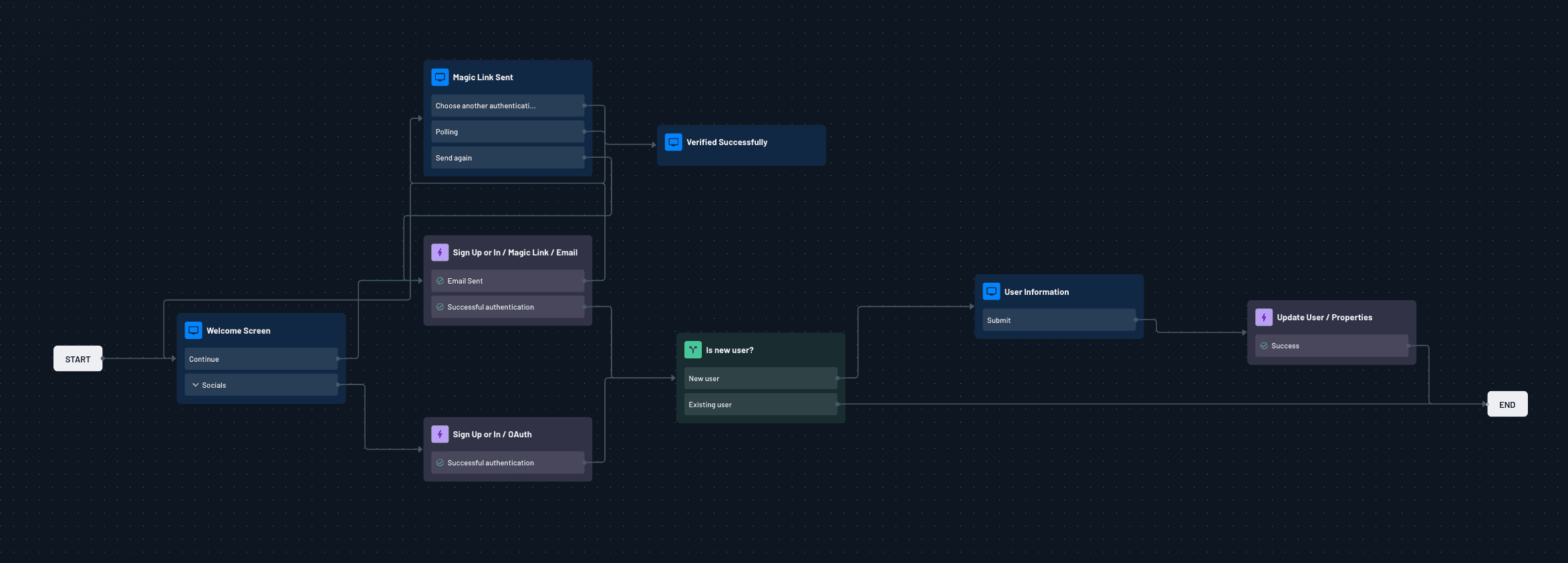
Descope approaches authentication as configurable infrastructure rather than fixed application logic. Its visual workflow builder allows teams to design and modify signup, login, MFA, and verification journeys without embedding that complexity into application code. This makes it easier to adapt authentication flows as consumer products evolve and user experience requirements change.
Visual workflows define authentication journeys
Modify signup, login, and MFA flows without redeploying applications
Add branching logic and conditional paths easily
Integrate Connectors, like fraud detection and verification, directly into flows
By keeping identity logic in configurable workflows, Descope enables teams to iterate on authentication experiences without turning every change into an engineering project.
Auth0
Auth0 allows customization through Universal Login and Actions, but advanced user journey logic typically requires writing and maintaining code. As authentication flows become more sophisticated, the logic for onboarding, verification, and security policies often shifts into application code or custom middleware.
Advanced authentication flows require Actions and custom code
Customization often implemented through application logic
Many changes require code updates and redeployment
Authentication journeys can become tightly coupled to backend systems
Auth0 supports customization, but as flows grow more complex, identity logic often becomes code-driven rather than configuration-driven.
Bottom Line: Descope keeps authentication journeys configurable through workflows. Auth0 customization often requires deeper engineering involvement as user flows evolve.
Authentication and MFA methods: Flexible passwordless vs limited combinations
Descope
Descope is designed to support modern authentication methods that prioritize both security and user convenience. Instead of forcing teams into a single authentication model, Descope allows developers to combine multiple methods within the same user journey. This flexibility helps consumer applications support different user preferences and device capabilities while maintaining a smooth login experience.
Passkeys supported from day one
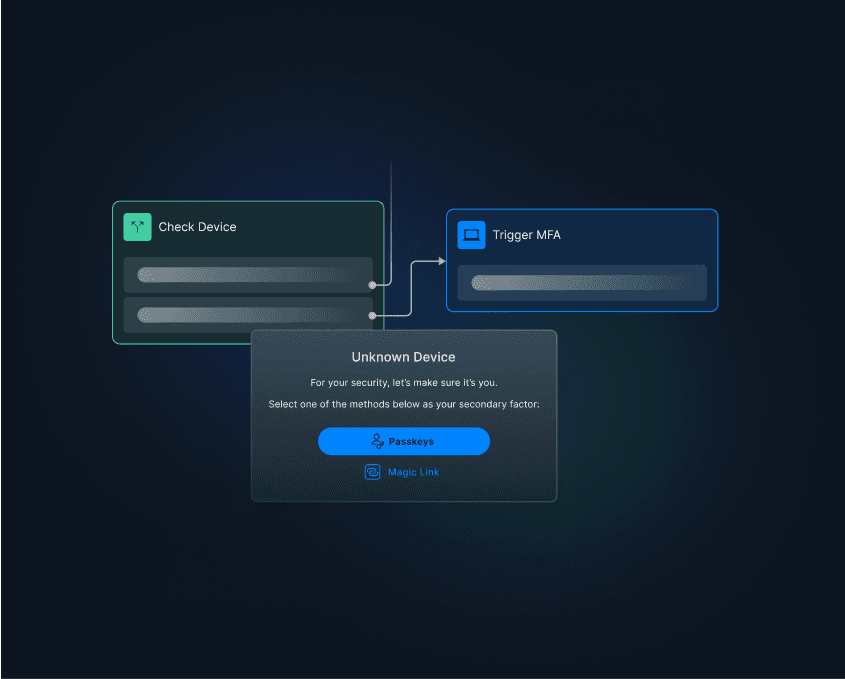
Magic links, one-time passwords, and social login integrated natively into flows
Multiple authentication methods combined within the same journey with configurable fallback options
Conditional workflow logic enables risk-based MFA and step-up authentication when needed
Augmentation-friendly MFA allows teams to layer additional security controls without rebuilding authentication
By allowing authentication methods to be combined, adapted, and triggered dynamically through workflows, Descope helps teams deliver secure login experiences without adding unnecessary friction for users.
Also Read: How Navan Augmented Auth0 With Descope Magic Link MFA
Auth0
Auth0 supports passwordless authentication and MFA, but configuring flexible authentication journeys can require additional setup and engineering work. As teams attempt to combine multiple authentication methods or introduce fallback options, the implementation can become more complex.
Passwordless authentication supported but often configuration-heavy
Passkey implementations can be more restrictive
Some MFA methods depend on plan tiers
Combining authentication methods may require custom logic
Changes to authentication journeys often require engineering updates
Auth0 provides strong authentication capabilities, but implementing flexible combinations of authentication methods can require more configuration and development effort.
Bottom Line: Descope allows teams to combine authentication methods flexibly across user journeys. Auth0 implementations can become more rigid as authentication flows grow more complex.
Authentication customization: Flexible workflows vs hosted login constraints
Descope
Descope treats authentication as a configurable layer of your application rather than a fixed login system. Through its workflow builder, teams can customize onboarding, login, and verification experiences without embedding identity logic directly into application code. This makes it easier to evolve authentication as product requirements and user expectations change.
Authentication logic controlled through configurable workflows
Customize onboarding and login journeys visually, including A/B testing different user flows
Support both natively embedded login experiences (no redirects) and hosted login when needed
Add onboarding steps, verification logic, and integrate fraud or analytics services within flows
Modify authentication logic without rebuilding underlying infrastructure
By keeping authentication customization inside workflows, Descope enables teams to evolve user journeys quickly while maintaining a consistent and flexible architecture.
Auth0
Auth0 customization is typically centered around Universal Login and Actions. While these tools allow developers to extend authentication functionality, advanced user experiences often require additional code and supporting infrastructure. As customization needs grow, teams may end up building layers of logic around Auth0 to support product requirements.
Customization largely centered around Universal Login
Hosted login UI can limit UX flexibility
Advanced flows require Actions or custom development
Many teams build additional orchestration layers around Auth0
Customization can increase operational complexity over time
Auth0 provides tools for customization, but implementing more advanced authentication experiences often shifts complexity into application code and supporting services.
Bottom Line: Auth0 customization frequently requires building additional logic around the platform. Descope provides built-in orchestration that makes authentication easier to adapt.
Developer overhead: Identity orchestration vs custom engineering
Descope
Descope is designed to reduce the amount of engineering work required to manage authentication infrastructure. Its workflow builder acts as an orchestration layer for authentication, allowing teams to connect authentication logic, verification steps, and third-party services without writing extensive custom code. This approach helps teams spend less time maintaining identity systems and more time building product features.
Built-in orchestration for authentication journeys
Workflow engine manages authentication and security logic
Third-party connectors integrated directly through workflows
Reduced need for custom authentication infrastructure
Teams focus on product development instead of auth plumbing
By centralizing identity orchestration inside the platform, Descope simplifies authentication architecture and reduces the operational overhead required to maintain it.
Auth0
Auth0 provides powerful authentication capabilities, but advanced authentication flows often require additional engineering work. As authentication requirements grow, teams frequently introduce custom middleware, APIs, or orchestration layers to coordinate login flows, verification steps, and integrations with external services.
Advanced authentication flows often require additional code
Teams frequently implement custom middleware or APIs
External orchestration logic becomes common
Managing custom auth layers increases maintenance burden
Engineering teams maintain identity infrastructure over time
Auth0 can support complex authentication architectures, but the responsibility for orchestrating those systems often shifts to the development team.
Bottom Line: Auth0 implementations often rely on custom orchestration layers maintained by engineering teams. Descope provides built-in orchestration that helps reduce long-term development overhead.
Adaptability: Designed for evolving user journeys vs slower iteration
Descope
Descope is designed to support applications that continuously evolve their user experience. Because authentication logic lives inside configurable workflows, teams can update signup flows, verification steps, and authentication methods without needing to modify application code. This makes it easier to experiment with onboarding journeys and improve conversion as consumer products grow.
Authentication flows easily modified through workflows
Teams can experiment with onboarding and signup journeys
Rapid iteration without redeploying applications
Authentication evolves alongside product requirements
Supports experimentation for growth-stage consumer apps
By keeping authentication logic configurable rather than code-driven, Descope enables product teams to iterate quickly while maintaining a stable identity architecture.
Auth0
Auth0 allows customization, but authentication changes often require updates to application code or Actions. As authentication flows grow more complex, implementing changes can involve testing cycles, redeployment, and coordination across engineering teams. Over time, this can make user journeys harder to modify.
Authentication changes often require code updates
Testing and redeployment cycles can slow iteration
User journeys become harder to modify as complexity grows
Teams may delay improvements due to engineering effort
Identity logic can become increasingly difficult to evolve
Auth0 supports flexible authentication capabilities, but modifying authentication experiences may require deeper engineering involvement as products scale.
Bottom Line: Auth0 implementations can become more rigid as authentication flows grow more complex. Descope is designed to keep authentication adaptable as user journeys evolve.
Descope vs Auth0 for B2C apps: At-a-glance
Category | Descope | Auth0 |
|---|---|---|
Mobile authentication | Embedded authentication flows inside the application; hosted login supported as well | Redirect-based Universal Login |
User journeys | Visual workflow engine for authentication logic; SDKs and APIs supported as well | Actions and custom code required |
Authentication methods | Flexible passwordless authentication options | More restricted authentication combinations |
Authentication customization | Workflow-based authentication orchestration | Hosted login customization with code |
Developer overhead | Built-in orchestration reduces custom infrastructure | Custom middleware and orchestration |
Adaptability | Modify authentication journeys quickly | Slower iteration with code updates |
Customer stories: Consumer platforms that needed flexible authentication
GoodRx
GoodRx helps millions of consumers find affordable prescription pricing and healthcare savings across pharmacies in the United States. Because the platform serves a large consumer audience, authentication must balance strong security with a smooth user experience across devices.
As GoodRx continued to scale, they needed an identity solution that could support secure authentication for healthcare-related user data while keeping login friction low. Users access the platform from multiple devices and channels, so authentication had to be reliable, scalable, and easy to use.
With Descope, GoodRx implemented a flexible authentication system that improves login experiences while maintaining strong security and scalability for a large consumer user base.
Read more: GoodRx: Agile, Omnichannel Auth for Tens of Millions of Users
Linktree
Linktree powers one of the world’s largest creator platforms, helping millions of users manage their online presence through a single link. With high signup volume and a global user base, authentication plays a critical role in onboarding and ongoing engagement.
As Linktree scaled, they needed a customer identity solution that could handle rapid user growth without restrictive rate limits. Their authentication flows also needed to evolve continuously to support new features, user behaviors, and growth initiatives without becoming engineering backlogs every time.
With Descope, Linktree implemented a flexible customer identity stack that allowed authentication journeys to adapt alongside the product, improving onboarding experiences while saving engineering time.
Migration: Moving from Auth0 without disruption
Migrating authentication infrastructure can feel risky, especially for consumer applications serving large user bases where login interruptions directly impact user experience. A well-planned migration prioritizes continuity first, allowing teams to modernize identity without disrupting existing users.
Descope supports both full replacement and phased migration strategies. Teams can transition entirely off Auth0 or introduce Descope incrementally for specific use cases such as passwordless authentication or adaptive MFA while maintaining existing login flows.
Replace Auth0 fully or augment selectively based on your roadmap
Use a dedicated Auth0 migration guide for full and hybrid migration walkthroughs
Use Session Migration to switch from Auth0 without disrupting logged in users
Use Descope as an OIDC Provider to augment Auth0 deployments
By using phased rollouts and standards-based federation, teams can avoid forcing users to re-authenticate or reset credentials during migration. Existing sessions remain stable, and authentication continues to function throughout the transition.
Built for hosted login vs built for adaptable authentication
Auth0 helped popularize developer-friendly authentication and remains a strong option for teams getting started with login and user management. But as consumer applications grow, authentication becomes more than just a feature. It becomes a core part of the user experience.
Consumer platforms must continuously optimize onboarding, reduce friction, and adapt authentication flows to changing user behavior. A redirect-based model combined with increasing reliance on custom code can make it harder to evolve these experiences over time, especially as products scale and requirements become more dynamic.
Descope takes a different approach by embedding authentication directly into the application and enabling teams to design complete user journeys through workflows. This makes it easier to reduce login friction, iterate on onboarding flows, adopt mobile-friendly and passwordless authentication, and scale authentication as user bases grow.
If you are building a modern consumer application, it is worth evaluating whether your identity platform can keep up with how quickly your product evolves. If you'd like a demo, meet with our auth experts. Also, if you want to try Descope yourself, sign up for a Free Forever Account and start improving the user auth experience on your app today!