
Table of Contents
Don't have the time to read the entire post? Our human writers will be sad, but we understand. Summarize the post with your preferred LLM here instead.
AI agents are giving a new meaning to the concept of authentication and identity.
Traditional identity platforms work simply: the user logs in, verifies their identity, and gains access to the app. Auth0 has spent over ten years improving this method and remains one of the most trusted platforms for application authentication and authorization.
Autonomous AI agents challenge this model in ways most identity platforms were not designed to handle. These agents act on behalf of users, sometimes without any human involvement. Instead of using others' credentials, they need their own identities. They connect to MCP servers that must be secured and control which clients can register. Instead of broad and continuous access, they request specific, limited permissions with delegated consent. The third-party credentials they use must be stored securely and not appear in prompts or logs. Their access should be verified by context-aware policies, not just fixed roles. For the most sensitive actions, a human must still be able to intervene and approve.
To secure agentic applications, identity must extend beyond simple human user authentication. The Descope Agentic Identity Hub offers a unified identity layer designed for agents, MCP servers, credentials, policies, and users.
This blog post compares how Descope and Auth0 handle authentication of AI agents and MCPs to help you choose the right platform for your next project.
Also Read: A Complete Comparison of Descope and Auth0
AI agent and MCP authentication requirements
Agentic identity is not just about adding OAuth to an AI agent. It is about building an identity layer that scales with how agents actually operate.
First-class agent identities - Every AI agent needs an identity of its own instead of a shared service account or a borrowed user token. Agents that act independently, retrieve their own credentials, and get revoked individually require a dedicated identity model built for non-human actors.
Secure MCP server authentication - Each MCP server should have its own authorization boundary so that only registered agents and clients can connect and access can be controlled separately from the rest of the application.
OAuth-based delegated authorization - Agents should act with permission delegated by a user or an organization rather than having universal access. The agentic identity system should link each action an agent takes to the specific scope granted to it, ensuring access can be audited and revoked.
Granular scopes and delegated consent - Agents should receive only the narrow, task-specific scopes that a job demands, and users should have a clear opportunity to consent to that level of access. Broad, standing scopes turn one compromised agent into a much greater exposure surface.
Secure credential storage and retrieval - Agents frequently need third-party credentials, such as OAuth tokens or API keys, to complete a task. Those credentials must stay vaulted and scoped, retrieved only at the moment of use rather than embedded in prompts, code, or logs.
Context-aware authorization policies - Static roles are not enough once agents start chaining tool calls together. Authorization needs to evaluate context–such as which MCP server, which credential, and which user relationship is involved–before granting access.
Human-in-the-loop approval - Some agent actions carry enough risk that a human should confirm them before execution. Sensitive actions need a built-in approval step that uses authentication methods people already use and trust.
Support for emerging agent identity standards - The agent identity ecosystem is still being developed, with specifications such as MCP, OAuth, CIMD, Dynamic Client Registration, and Enterprise-Managed Authorization/Cross-App Access changing rapidly. Platforms must keep up with these standards so agentic applications remain interoperable as they develop.
When these capabilities are foundational, agentic expansion becomes predictable. Without them, every new agent, MCP server, or credential becomes a manual security review instead of a repeatable pattern.
Agent identity: First-class agent identities vs emerging agent principals
Descope
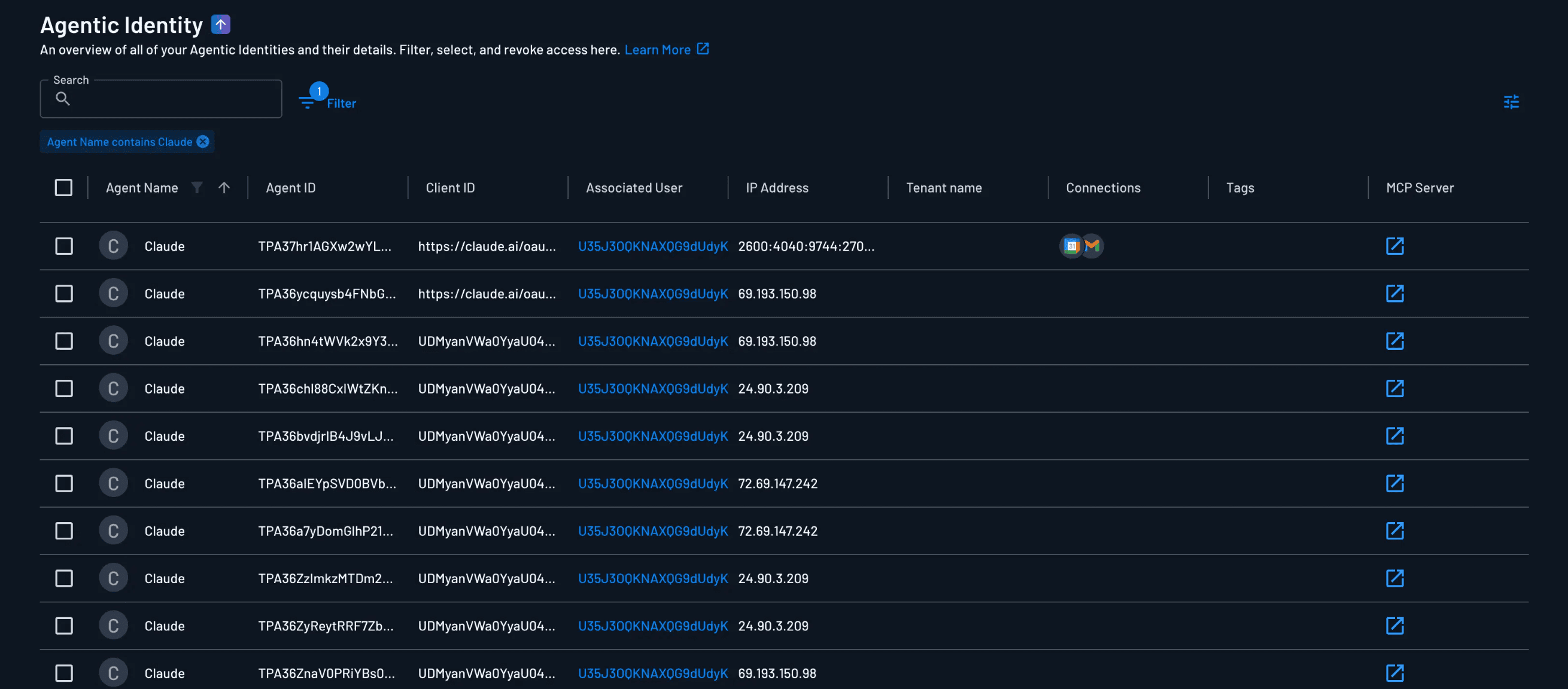
Descope is built around first-class agent identities, not service accounts layered on top of a human user record. Each authorization an agent receives creates its own agentic identity record, so agents can be discovered, governed, and revoked independently.
Creates a distinct agentic identity record for each authorization an agent receives
Maintains internal and external agents in a single agent directory
Supports filtering, tagging, and management of agents at scale
Revokes individual or multiple agentic identities without removing the underlying agent
Bulk-revokes filtered agent identities across multiple users at once
Descope treats every agent as a governable identity in its own right, making agent lifecycle management operationally predictable.
Auth0
Auth0's agent identity model is still developing. The Agent as Principal capability is available by invitation only, while agentic identities are offered separately from Okta for AI Agents.
Does not provide an agent-specific directory
Agentic identities exist alongside a broader, separately positioned Okta for AI Agents offering
Supports revoking individual or all grants for a given user
Has no equivalent to filtered, bulk revocation across many agents at once
Auth0 can support agent scenarios today, but its purpose-built agent identity model is not yet broadly available.
Bottom Line: Descope treats agents as identities that can be independently discovered, governed, and revoked throughout their lifecycle, while Auth0's agent-specific identity model is still in early access.
MCP server protection: First-class MCP resources vs standard APIs
Descope
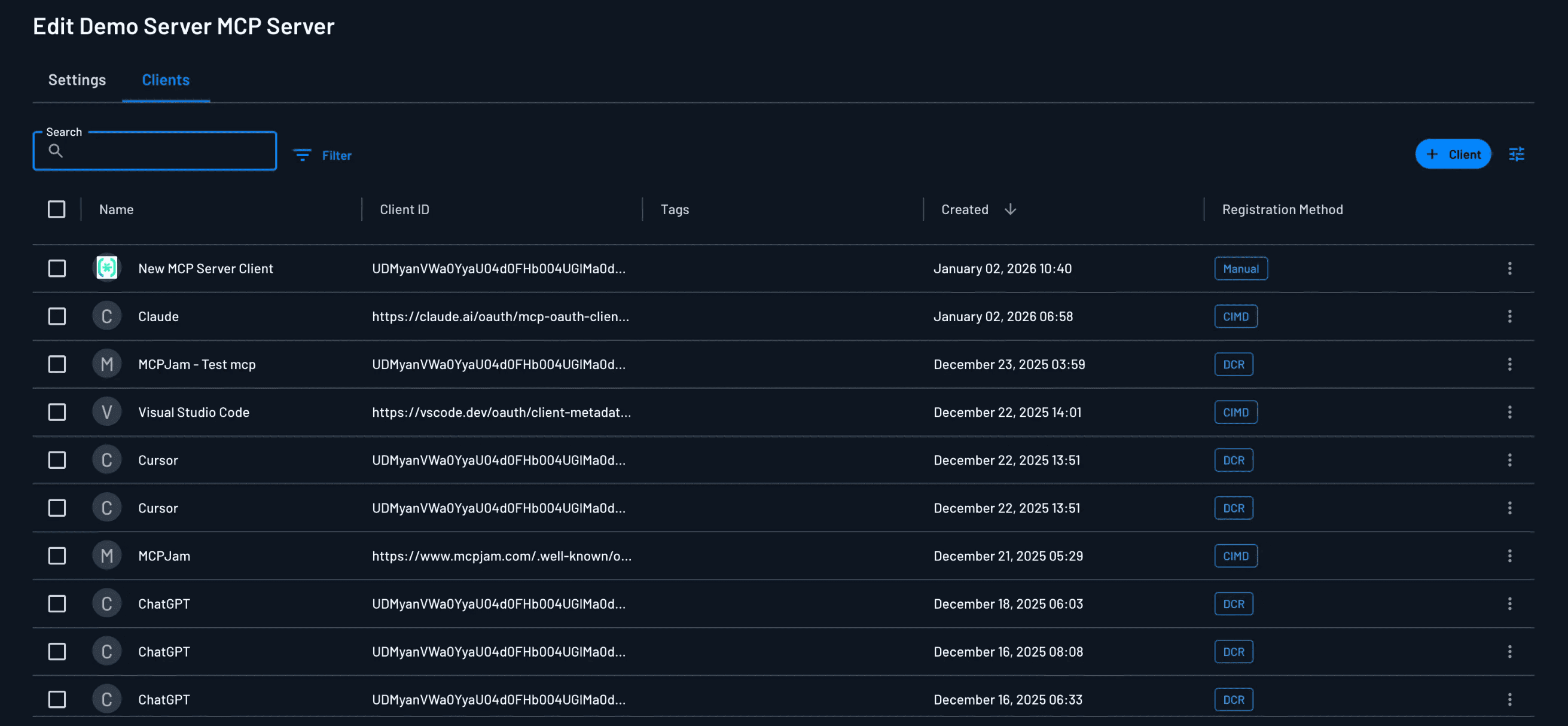
Descope models each MCP server as a first-class identity resource. Every server gets its own OAuth authorization server, so scopes, registered clients, and connection policies can be managed at the server level.
Gives each MCP server its own OAuth authorization server
Defines scopes and registered clients on a per-server basis
Controls which agents can connect to individual MCP servers
Uses wildcard domain allowlists to streamline client registration across many servers
Maps scopes declaratively to roles and connection tokens per server
Descope makes the MCP server itself a unique OAuth resource server with many MCP-specific features instead of another API sitting inside the tenant.
Auth0
Auth0 treats MCP servers as regular APIs within the tenant. Since there is no separate identity object for MCP servers, client registration, scopes, and roles are managed at the API or tenant level.
Registers MCP servers as standard APIs within the tenant
Configures client registration tenant-wide rather than per server
Defines scopes on the API object rather than the server itself
Keeps roles and permissions managed at the tenant level regardless of how many MCP servers you add
Auth0 can protect the traffic to an MCP server, but the server itself is not treated as its own identity resource.
Bottom Line: Descope makes the MCP server itself a governable identity resource rather than treating it as another API sitting inside the tenant.
Scopes and consent: Orchestrated authorization vs application-driven logic
Descope
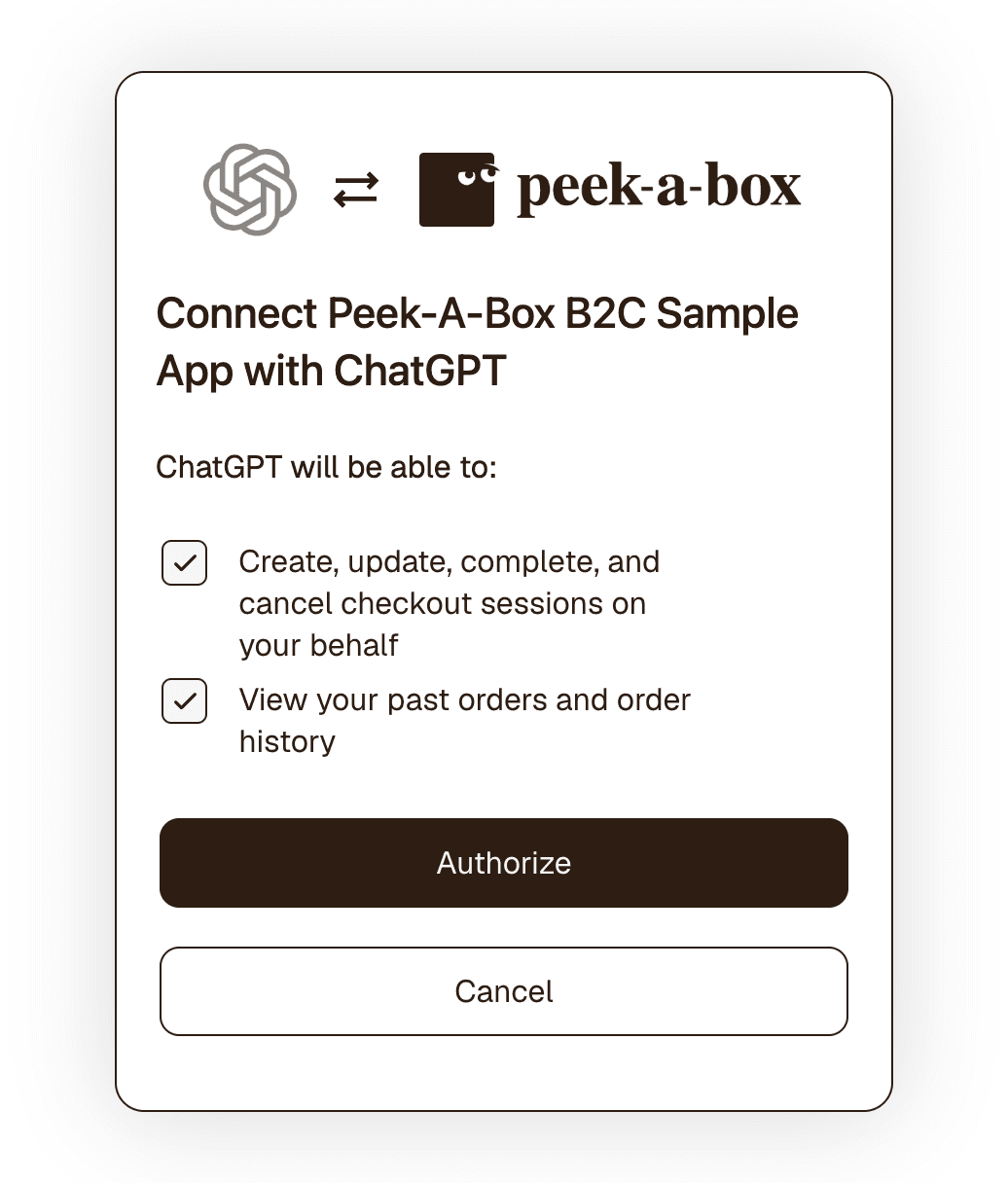
Descope maps MCP scopes to connection tokens, and then matches those tokens to the scopes needed by downstream providers. Authentication, MCP consent, and provider consent are all handled together in one configurable Flow.
Maps MCP scopes directly to connection tokens
Maps connection tokens to the downstream provider scopes they require
Collects consent before execution or dynamically at tool-call time
Adds MFA and step-up authentication into the same consent journey
Lets non-technical teams adjust consent logic without redeploying code
Descope brings authentication, delegated consent, and downstream authorization into one orchestrated identity journey.
Auth0
Auth0 sets scopes for API resources and manages provider-scope mappings within the application code. MCP consent is gathered at login, while advanced consent or step-up logic is handled using Actions code.
Defines scopes on API resources
Provider-scope mappings are handled in application code
MCP consent is collected during login
Advanced consent and step-up logic uses Actions code
Auth0 supports the same building blocks, but assembling them into one consent journey is left to application code.
Bottom Line: Descope brings authentication, delegated consent, and downstream authorization into a single orchestrated identity journey, while Auth0 assembles the same outcome from API scopes and application code.
Credential vaulting: Unified agent credentials vs OAuth token storage
Descope
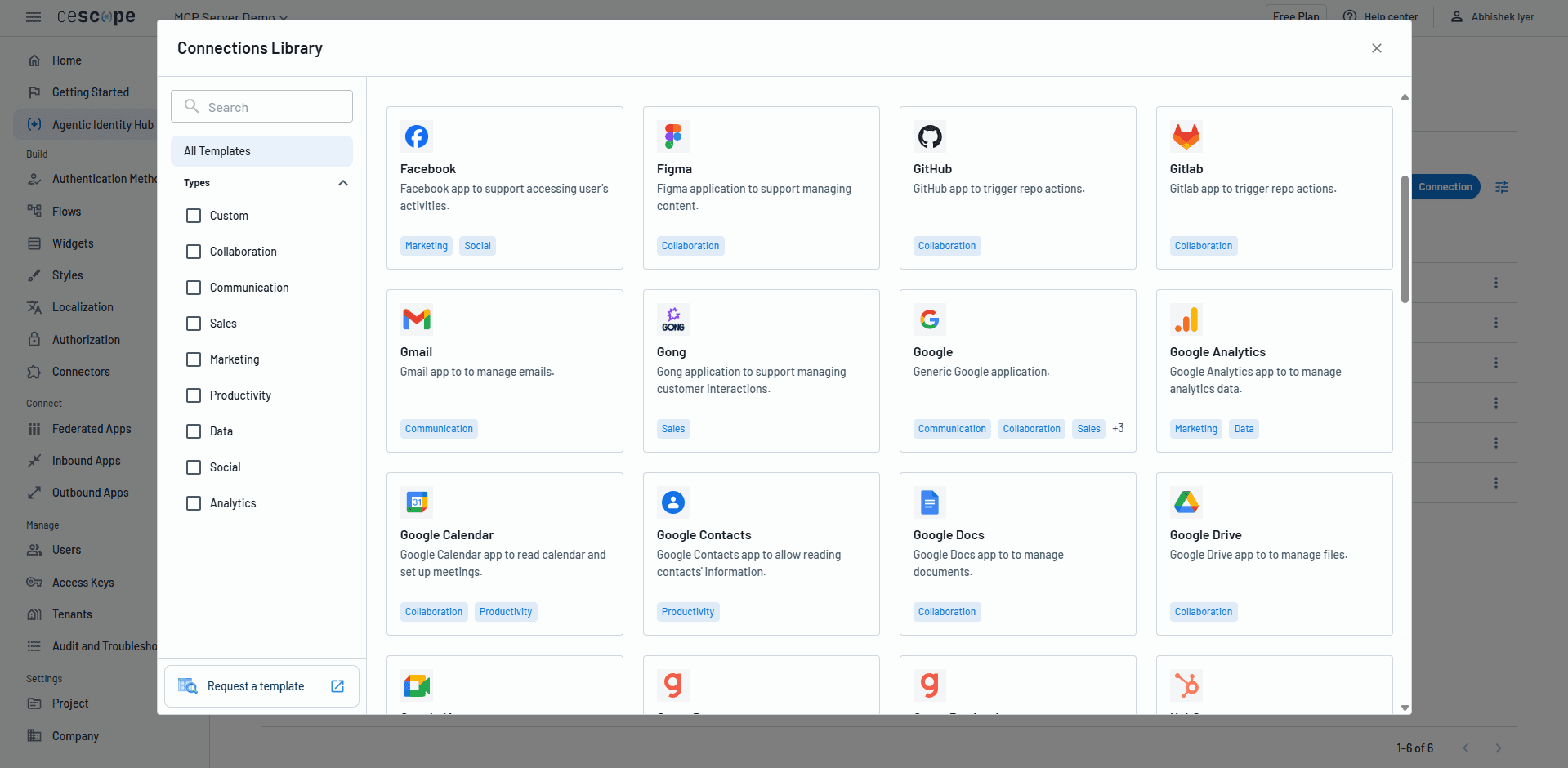
Agentic applications frequently need more than OAuth tokens. Descope vaults OAuth tokens and API keys together, scoping credentials to individual users or tenants and refreshing them automatically.
Scopes credentials to individual users or tenants
Automatically refreshes and rotates credentials
Connects to 50+ prebuilt providers out of the box
Extends to generic OAuth and custom OIDC providers for anything not prebuilt
Collects credentials through Flows, backend APIs, embeddable widgets, or hosted admin portal
Descope gives agents one place to retrieve any credential they need, instead of separate systems for tokens and keys.
Auth0
Auth0's vault stores OAuth tokens for individual users and refreshes them automatically, but API keys require separate credential management outside the vault.
Stores OAuth tokens for individual users
Automatically refreshes stored OAuth tokens
Supports 30+ prebuilt providers
Extends to additional providers through Custom OAuth2 connections
Auth0 covers OAuth token storage well, but teams still need a separate system for API keys and other credential types.
Bottom Line: Descope provides one unified vault for both OAuth credentials and API keys, while Auth0's vault is scoped to OAuth tokens.
Agent authorization: Context-aware policies vs scopes, roles, and Actions
Descope
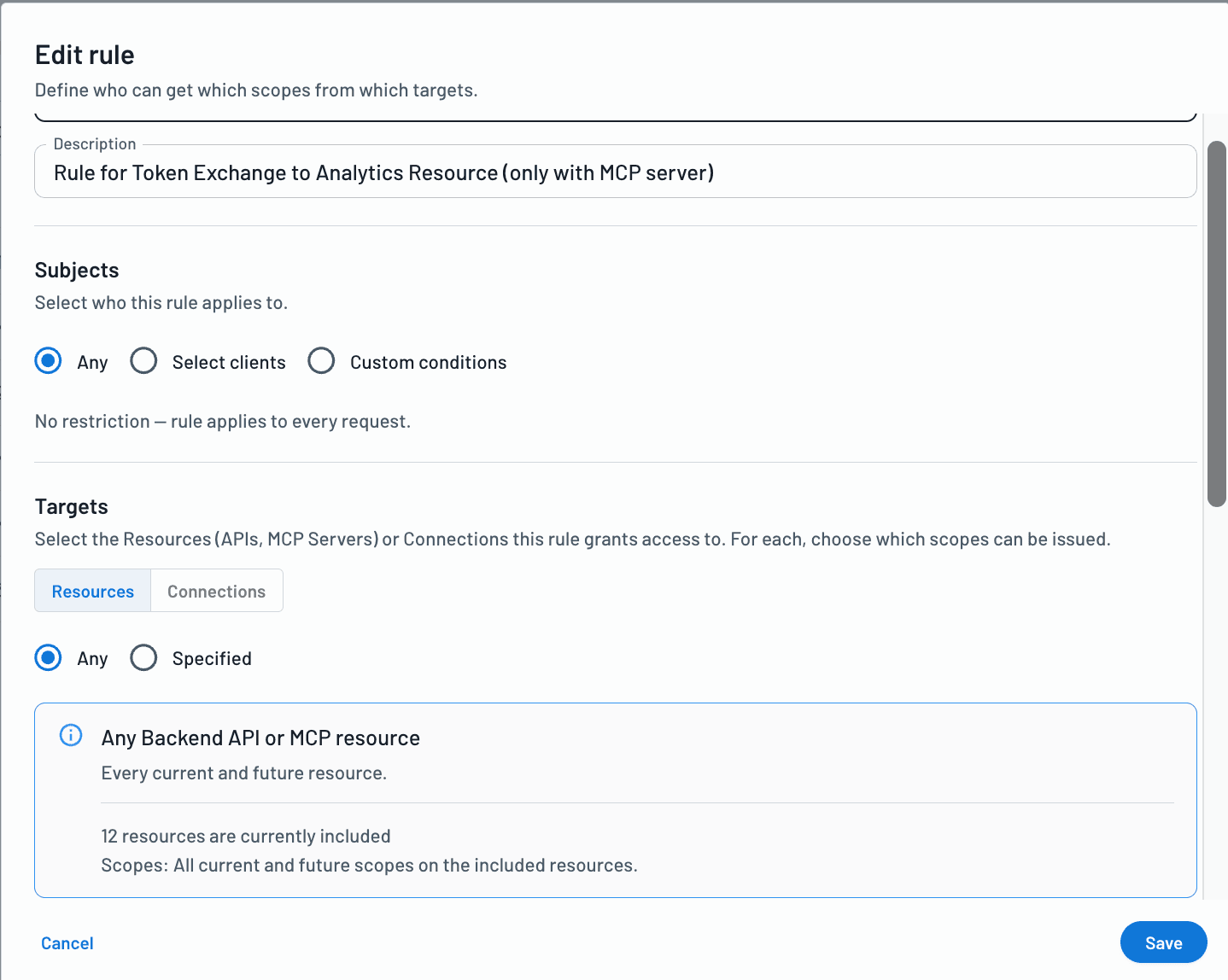
Descope enforces authorization policies at both token issuance and token exchange, applying least-privilege access by default. Policies can be built around users, tenants, permissions, claims, agent tags, and more.
Enforces policies during token issuance and token exchange
Uses least-privilege access as the default setting
Scopes authorization policies to individual MCP servers
Controls which agents can access certain stored credentials
Descope extends one policy model across MCP servers, tokens, and credentials instead of treating each as a separate concern.
Auth0
Auth0 builds authorization from API scopes, tenant roles, and Actions, applied at token issuance. There is no dedicated per-MCP-server policy engine or independent layer governing credential access.
Configures scope and role logic separately for each API and tenant
Provides no dedicated per-MCP-server policy engine
Provides no independent policy layer governing credential access
Auth0 can reach similar coverage, but it requires combining several separately configured and priced capabilities.
Bottom Line: Descope extends authorization across the agent's full chain of access, from MCP servers to tokens to downstream credentials, while Auth0 assembles equivalent coverage from several separately configured and priced pieces.
Human oversight: Flexible step-up vs CIBA-based approval
Descope
Descope supports human-in-the-loop approval through email, step-up authentication and CIBA, delivered through the Descope Agent Auth SDK. Teams can reuse MFA, passkeys, biometrics, SSO, or device checks to apply stronger verification before a sensitive agent action.
Human-in-the-loop approval through step-up authentication and CIBA
Both mechanisms are supported through the Descope Agent Auth SDK
Uses MFA, passkeys, biometrics, SSO, or device checks
Applies stronger verification before sensitive agent actions
Descope turns existing authentication methods into an approval step for agent workflows, without a separate approval channel.
Auth0
Auth0 lets you use human-in-the-loop approval with CIBA, sending approvals through Guardian push notifications. If you want to use email-based approvals, you will need a paid add-on.
Supports human-in-the-loop approval through CIBA
Approvals can be delivered through Guardian push
Email approvals require a paid add-on
Auth0 covers push-based approval well, but reaching email approval adds cost.
Bottom Line: Descope lets teams use the authentication methods they already have to add human approval to sensitive agent workflows, rather than standing up a separate approval channel.
Standards and interoperability: Building around the evolving agent identity ecosystem
Descope
Descope supports the standards agent and MCP identity depend on, including OAuth 2.1, PKCE, CIMD, and Dynamic Client Registration. In September 2026, Descope reached general availability for Cross App Access (XAA), becoming one of the first identity providers to both validate and issue ID-JAG assertions.
Supports OAuth 2.1 and PKCE for MCP authentication
Supports CIMD and Dynamic Client Registration
Supports protected resource metadata (PRM)
Validates and issues ID-JAG assertions on either side of an agent access request
Adds self-service Cross App Access setup to the SSO Setup Suite, so admins can configure it without engineering support
Descope reached general availability on both sides of cross-app access while most of the industry is still rolling it out in pieces.
Auth0
Auth0 supports the same core standards, and is building out Cross App Access across two complementary pieces: a Resource App side and a Client App side.
Supports OAuth 2.1, PKCE, CIMD, DCR, and protected resource metadata
Validates ID-JAG assertions through the Resource App side of Cross App Access
Added Client App capabilities in Early Access, letting apps request cross-app access under enterprise-managed authorization
Keeps full dual-sided support in Early Access rather than general availability
Auth0 is closing the gap on both sides of cross-app access, but as of this release, full support is not yet generally available.
Bottom Line: Both platforms support Cross App Access on the requesting and resource side. Descope reached general availability for dual-sided XAA support in September 2026, while Auth0's requesting-side (Client App) capability remains in Early Access.
Developer experience: Purpose-built Agent Auth SDK vs distributed agent tooling
Descope
Descope provides a dedicated Agent Auth SDK for Python and TypeScript, with integrations across major AI agent and MCP libraries. Authentication, consent, credentials, and human approval are managed together, using the same tooling as user and B2B identity.
Dedicated Agent Auth SDK for Python and TypeScript
Integrates with leading AI agent and MCP libraries
Handles authentication, consent, credential management, and human approval
Provides unified tools for user, B2B, MCP, and agentic identity management
Descope gives developers one SDK to reach across every layer of agentic identity.
Auth0
Auth0 provides SDKs and integrations that support agentic use cases, but agent capabilities are distributed across multiple libraries, and agent and MCP functionality can span separate Auth0 and Okta capabilities.
Offers SDKs and integrations designed for agent-based applications
Agent features are spread out over several libraries
Agent and MCP features may use different Auth0 and Okta tools
Auth0 developers often need to combine several libraries and products to cover the same ground.
Bottom Line: Descope provides a specialized Agent Auth SDK designed specifically around agent and MCP identity workflows.
Descope vs Auth0 for AI agents and MCP: At-a-glance
Capability | Descope | Auth0 |
|---|---|---|
Agent identity | First-class agent identities with centralized directory and granular revocation | Agent as Principal in invite-only early access |
MCP server identity | First-class MCP resources with per-server clients, scopes, and policies | MCP servers represented as standard APIs |
Scopes and consent | Declarative scope mapping with orchestrated consent and step-up | API scopes with provider mappings and advanced logic in application code |
Credential vault | OAuth tokens and API keys with user or tenant scoping | User-scoped OAuth tokens; API keys managed separately |
Authorization | RBAC, ABAC, ReBAC, agent policies, MCP policies, and credential policies | API scopes, roles, Actions, plus separately priced FGA |
Human oversight | CIBA and step-up with multiple verification methods | CIBA with Guardian push and paid email approval |
Standards | OAuth 2.1, PKCE, CIMD, DCR, protected resource metadata; Cross-App Access issuance and validation, generally available | OAuth 2.1, PKCE, CIMD, DCR, protected resource metadata; Cross App Access issuance and validation, in early access |
Developer experience | Dedicated Python and TypeScript Agent Auth SDK | Agent functionality distributed across multiple libraries |
Customer story: Cequence Security secures its AI Gateway with Descope
Enterprise identity requirements do not stop at human users, and Cequence Security is a clear example of why.
Cequence protects enterprise applications and data in the AI era, processing roughly 10 billion API transactions a day and safeguarding more than $10 trillion in digital assets across 4 billion user accounts. Cequence originally adopted Descope to solve for true multi-tenancy and self-service SSO, replacing custom claims and workarounds their previous provider required. The results were immediate: SSO-related support tickets dropped by more than 90%, new customer onboarding now takes minutes, and Cequence has fielded no SSO support calls in the last 18 months.
As Cequence extended its platform into agentic AI, that same identity foundation carried over. Descope now provides MCP authentication and authorization for the Cequence AI Gateway, giving Cequence a way to secure agent and MCP interactions without standing up a separate identity system for AI use cases.
Read more: Cequence Security: Flexible Auth & AI-Ready Infrastructure
Migrating or extending Auth0 for agentic applications
Adding agent and MCP support does not have to mean ripping out an existing Auth0 deployment or forcing a disruptive cutover. A well-planned transition focuses on securing new agentic surface area first, consolidation second.
Descope supports both full replacement and phased augmentation. You can migrate user authentication off Auth0 entirely, or introduce Descope specifically for agent identity, MCP protection, and credential vaulting while keeping your existing Auth0 integrations intact.
Replace Auth0 fully or augment selectively based on your roadmap
Use the dedicated Auth0 Migration Guide for full and hybrid migration walkthroughs
Use Session Migration to switch from Auth0 without disrupting logged-in users
Use the Auth0 AI agent migration skill to give your AI agent the expertise to plan a start-to-finsh migration that maps your current Auth0 setup to Descope equivalents.
Use Bring Your Own Auth to protect new MCP servers and agentic applications with Descope while existing user authentication stays on Auth0
By using standards-based federation and controlled cutovers, you can introduce agent and MCP identity without forcing changes on existing users or breaking current integrations.
Conclusion: Authentication for applications vs identity for agentic systems
Auth0 offers well-established authentication and authorization capabilities and is now extending them to applications involving AI agents. However, deploying production-grade agentic systems brings a broader identity challenge than simply adding a login screen for a bot.
Descope approaches these questions as a connected identity system with first-class agent identities, MCP server protection, credential vaulting, context-aware authorization, consent orchestration, and built-in human oversight.
When people are developing AI agents and MCP systems, the difference lies not so much in adding authentication to an agent as it does in setting up an identity and authorization layer that is designed from the beginning for autonomous software.
If you want to see how Descope's agentic identity layer fits into what you're building, meet with our auth experts. Or sign up for a Free Forever Account and start securing your AI agents and MCP servers today.