
Table of Contents
Don't have the time to read the entire post? Our human writers will be sad, but we understand. Summarize the post with your preferred LLM here instead.
Most B2B SaaS teams start shopping for an identity provider on the day a large customer asks for SSO. The search usually turns up two different categories of identity providers, which is part of why the shortlist takes so long to build.
This comparison covers seven IdP vendors that B2B SaaS teams evaluate most often: Descope, Auth0, WorkOS, Frontegg, Amazon Cognito, Microsoft Entra External ID, and Keycloak. It starts with what “identity provider” means when your users belong to customer organizations rather than to you, then sets out the criteria that separate these vendors in practice, and compares each one against these criteria.
At a glance
A B2B SaaS application is an identity provider to its own users and a service provider to each enterprise customer’s corporate IdP, and it has to do both jobs well.
Tenant model is the criterion to settle first, since a platform with native customer organizations handles SSO, roles, and provisioning very differently from one where you model tenancy yourself.
Self-service SSO setup decides whether enterprise onboarding is a task the customer completes or a standing cost on your engineering team.
Per-connection and per-MAU pricing produce very different bills for B2B products, so a few hundred enterprise tenants can cost more than the user count suggests.
Enterprise buyers are starting to ask how AI agents authenticate into B2B products, and agents need an identity model separate from the one built for human users.
What “identity provider” means for a B2B SaaS application
A B2B SaaS application sits on both sides of the identity federation relationship.
Your product is an identity provider to its own users. It holds the accounts, issues the tokens your APIs validate, carries the claims your authorization logic reads, and owns the login experience your customers see. Whichever IdP vendor you use plays this role for you.
Your product is also a service provider to each customer’s corporate IdP. An enterprise buyer that runs Okta, Entra, Ping, or Google Workspace expects your application to accept logins from them, honor the groups they send, and provision and deprovision users through SCIM when staff join or leave.
The vendors below all do the first job, but they differ considerably on the second, which can be the difference between winning or losing enterprise deals. A platform that treats customer organizations as a first-class concept behaves differently from one where you model tenancy yourself on top of a flat user list.
Type | What you get | Vendors here | Usually chosen when |
|---|---|---|---|
Full-stack CIAM | Authentication, the user store, tenancy, and enterprise federation in one platform | Descope, Auth0 | Identity is a continuing product concern rather than a one-time checkbox |
Enterprise feature layer | Enterprise SSO, SCIM, and admin tooling added onto an application, through APIs or drop-in components | Descope, WorkOS, Frontegg | Enterprise readiness is the gap and the rest of authentication is settled |
Cloud-ecosystem-native | Identity as a managed service inside a cloud platform the team already runs on | Amazon Cognito, Microsoft Entra External ID | The cloud standardization decision has already been made elsewhere |
Self-hosted open source | Source and deployment under your control, with operations as your responsibility | Keycloak | Control or data residency requirements outweigh operational cost |
What to look for in B2B SaaS IdP vendors
Tenant model: Check whether customer organizations are a native primitive within the IdP, or whether multi-tenancy is something you assemble from groups, metadata, and across separate user pools. This decision propagates into every other feature.
Per-tenant enterprise SSO: Support for SAML 2.0 and OIDC is the baseline. The more pertinent question is whether each tenant can have its own connection, its own IdP—and in some cases more than one—without a code change on your side.
Self-service SSO setup: Check whether the customer’s IT admin can configure their own SSO connection, or whether your engineers need to run setup calls for every enterprise onboarding. This is the difference between SSO as a feature and SSO as a recurring support cost.
User provisioning: Check support for SCIM 2.0, just-in-time provisioning, and whether group and role mappings arrive with the user.
Authorization scoped to the tenant: IdP vendors catering to B2B SaaS must have role-based access control that understands a user can hold different roles in different organizations, as well as fine-grained or relationship-based authorization for products where permissions attach to individual resources.
Delegated administration: Check for capabilities like a hosted admin portal or embeddable components that let tenant admins manage their own users, roles, and audit logs.
Compliance and deployment: Check whether the vendor provides multiple data residency regions, self-hosting options, and add-ons such as FedRAMP if your product needs to serve government organizations or regulated enterprises.
Agent access: Enterprise customers are starting to ask how AI agents authenticate into your product and what those agents are allowed to do on a user’s behalf. The identity models built for human users do not transfer to agents, which need their own treatment around delegated access, scoped permissions, and credentials that expire. This is new enough that vendor capabilities vary widely and change quickly, so it is worth checking current state rather than relying on a comparison table.
IdP vendors for B2B SaaS at a glance
Vendor | Type | Tenant model | Self-service SSO setup | Ideal for |
|---|---|---|---|---|
Descope | Full-stack CIAM with visual orchestration | Native tenants with per-tenant config | Yes, via SSO Setup Suite | B2B SaaS teams that need enterprise readiness and consumer-grade auth from one platform |
Auth0 | Established full-stack CIAM | Organizations layered on a core built for B2C | Partial, varies by tier | Teams prioritizing SDK breadth and ecosystem maturity |
WorkOS | Enterprise feature layer | Organizations as a core primitive | Yes, via admin portal | Teams adding enterprise SSO and SCIM to existing auth |
Frontegg | Embedded B2B identity components | Native multi-tenancy | Yes, via embedded admin portal | Teams wanting prebuilt B2B UI quickly |
Amazon Cognito | Cloud-ecosystem-native | User pools, tenancy modeled by the team | No | AWS-standardized teams with straightforward requirements |
Microsoft Entra External ID | Cloud-ecosystem-native | Directory-first | No | Organizations standardized on Microsoft |
Keycloak | Open source, self-hosted | Realms or groups, depending on approach | No | Teams with infrastructure capacity and strict control requirements |
Descope
Descope is a full-stack customer and agentic identity platform built with multi-tenancy as a first-class primitive that meets B2B requirements and consumer authentication needs from the same product.
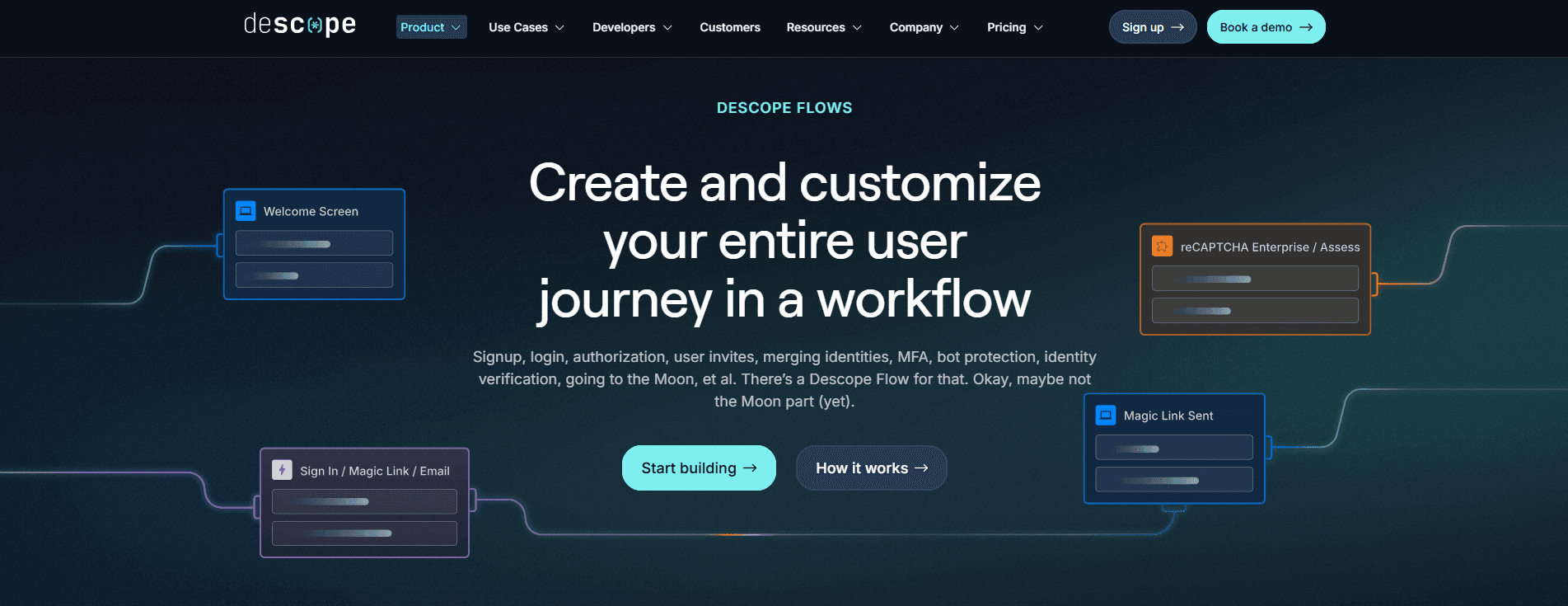
Tenants represent each customer organization and carry their own SSO connections, roles, permissions, and branding, with a single user able to belong to several tenants under different roles in each. Authentication journeys are built in Descope Flows, a visual workflow builder, which means changes to login logic, step-up conditions, or onboarding sequences generally do not require a release.
Key capabilities
Native tenant management with independent SSO, role, and identity provider configuration per customer organization.
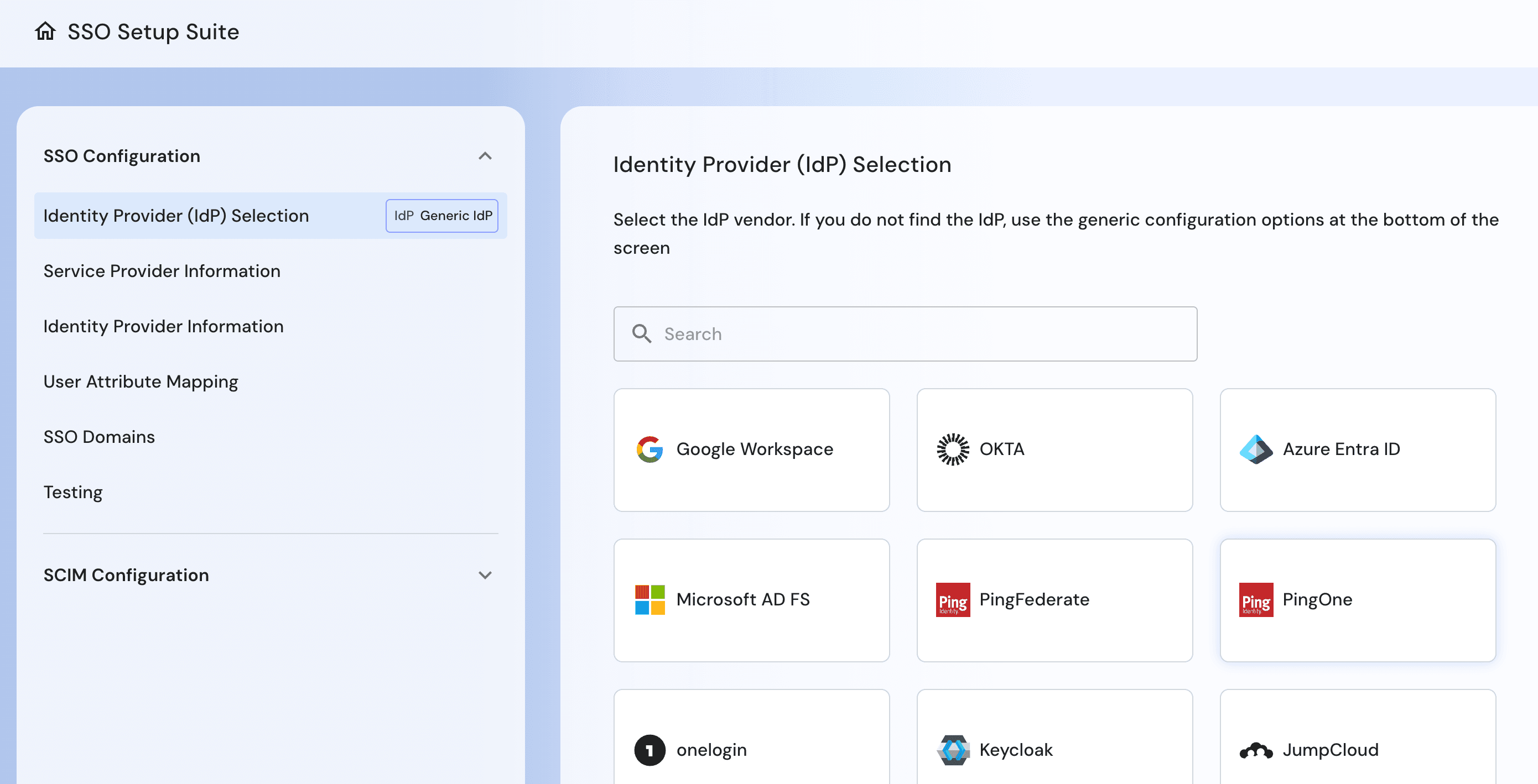
The SSO Setup Suite, which lets a customer’s own IT admin configure SAML or OIDC connections and SCIM provisioning without involving your engineering team.
RBAC at project and tenant level, plus relationship-based access control for resource-level permissions.
Delegated administration through a hosted admin portal and embeddable widgets that run inside your own application.
Descope Flows for building and changing authentication journeys visually, covering passkeys, MFA, step-up, and risk-based conditions
The Agentic Identity Hub, a separate identity model for AI agents built on delegated access, scoped permissions, and short-lived credentials
Multi-region data residency across seven regions, with SOC 2 Type 2, ISO 27001, GDPR, and FedRAMP High authorization
Strengths
Enterprise onboarding moves off the engineering backlog, since tenant admins configure their own SSO and SCIM.
One platform covers both the B2B requirements and consumer-grade authentication methods, so teams selling to businesses and individuals do not run two stacks.
Authentication logic lives in a visual flow rather than application code, which shortens the loop when a customer’s security review asks for a policy change
Ideal for
B2B SaaS teams moving upmarket who need enterprise identity features without dedicating engineers to identity infrastructure. It also suits companies selling to both businesses and individual users, since one platform covers tenant-aware B2B requirements and consumer authentication methods rather than two stacks running in parallel. Pricing starts with a Free Forever plan covering 7,500 monthly active users and 3 SSO connections, with paid tiers from $249 per month.
Auth0
Auth0, also known as Okta Customer Identity Cloud, is a long-established CIAM platform that lands on most B2B shortlists by default.
Its SDK coverage, documentation, and extensibility model through Actions are mature, and most engineering teams will find a published integration path for their stack. However, the platform’s core was designed around individual consumer users, with the Organizations feature added later to serve B2B, so multi-tenant requirements tend to sit on higher tiers and need more configuration than on platforms built as tenant-first. Monthly active user pricing can climb sharply as a B2B product’s seat count grows across its customer base.
Key capabilities
Organizations for modeling business customers, with per-organization connections and membership.
Broad SAML and OIDC federation support with a large catalog of social and enterprise connections.
Actions for injecting custom logic at points in the login pipeline.
Extensive SDK and quickstart coverage across languages and frameworks.
Strengths
Extensive documentation and a large community knowledge base, which shortens troubleshooting.
Familiarity with security reviewers and procurement teams, which can smooth enterprise evaluations.
A mature extensibility model for teams comfortable writing and maintaining custom pipeline logic.
Ideal for
Teams that value ecosystem maturity and SDK breadth above tenant-model fit, and that have engineering capacity to configure and maintain B2B structures on top of the platform.
WorkOS
WorkOS is an enterprise feature layer for B2B SaaS, centered on the specific capabilities that enterprise buyers demand.
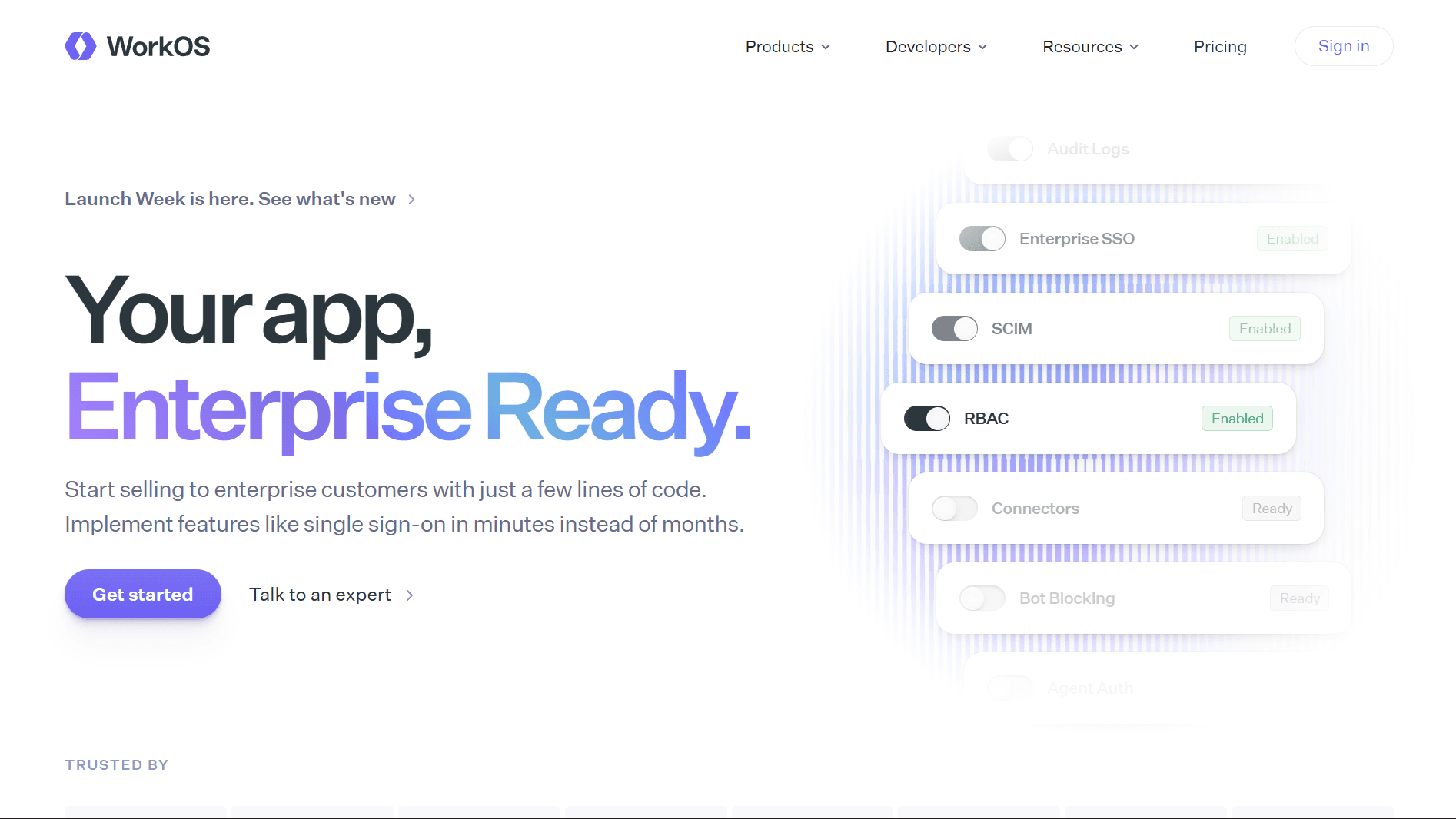
Enterprise SSO, Directory Sync for SCIM provisioning, and audit logs are the core products, with AuthKit extending into user authentication and prebuilt UI. The admin portal is a strong piece of the offering, giving customer IT admins a self-service path to configure their own connections. The commercial model prices enterprise SSO per connection, which is predictable at low tenant counts but becomes a meaningful line item for products with many enterprise customers. Teams looking for a single platform to cover consumer-grade authentication methods, visual journey orchestration, and fine-grained authorization will generally need to assemble those pieces around WorkOS.
Key capabilities
Enterprise SSO across SAML and OIDC with a hosted admin portal for customer-led setup.
Directory Sync for SCIM provisioning from the customer’s identity provider.
Audit logs formatted for enterprise compliance requirements.
AuthKit for user authentication and prebuilt login components.
Strengths
A short path to a working enterprise SSO integration, which is part of its appeal to early-stage B2B SaaS teams.
The admin portal removes engineering from most enterprise onboarding conversations.
Clear, narrow product scope that is easy to evaluate and easy to explain internally.
Ideal for
B2B SaaS teams that already have authentication they are happy with and need to add enterprise federation and provisioning on top of it, particularly earlier-stage companies with a small number of enterprise tenants.
Frontegg
Frontegg provides embedded identity components aimed specifically at B2B SaaS, with prebuilt login widgets, an admin portal, and multi-tenancy included.
The appeal is speed. A team can drop in login, user management, SSO, MFA, and role assignment as components rather than building those surfaces. The tradeoff is that the components are opinionated, and teams that need authentication logic to diverge from the supplied patterns have fewer levers than a visual orchestration model provides. Teams with requirements around fraud prevention or account takeover protection will typically look to add a separate layer.
Key capabilities
Embedded admin portal and login components designed for B2B tenancy.
Multi-tenancy with per-tenant SSO, MFA, and role configuration.
Self-service user and role management for customer admins.
RBAC for tenant-scoped permissions.
Strengths
A quick route to a complete B2B identity surface, including the admin experience.
Multi-tenancy is native rather than modeled on top of a flat user store.
Reduces the amount of identity UI a product team has to design and maintain.
Ideal for
B2B SaaS product teams that want a complete, prebuilt identity experience quickly and are comfortable working within the patterns the components provide.
Amazon Cognito
Amazon Cognito is AWS’s customer identity service, usually adopted because a team has standardized on AWS rather than because of an identity-led evaluation.
It handles core authentication at low cost and integrates cleanly with the rest of the AWS stack. For B2B, the structural question is user pools. Separating customer organizations means either many pools or modeling tenancy in attributes, with both approaches pushing complexity into application code. Customizing journeys relies on Lambda triggers, so changes to login logic are engineering work, and there is no built-in self-service path for a customer’s IT admin to configure their own SSO connection.
Key capabilities
User pools and identity pools with SAML and OIDC federation.
Native integration with AWS IAM and the broader AWS service set.
Lambda triggers for customizing points in the authentication lifecycle.
Low per-user cost at high volumes.
Strengths
Predictable cost at scale for teams already operating in AWS.
Infrastructure and billing stay inside an existing vendor relationship.
Adequate for straightforward authentication requirements without heavy B2B structure.
Ideal for
Teams deeply standardized on AWS with simple tenancy requirements and engineering capacity to build the B2B layer themselves.
Microsoft Entra External ID
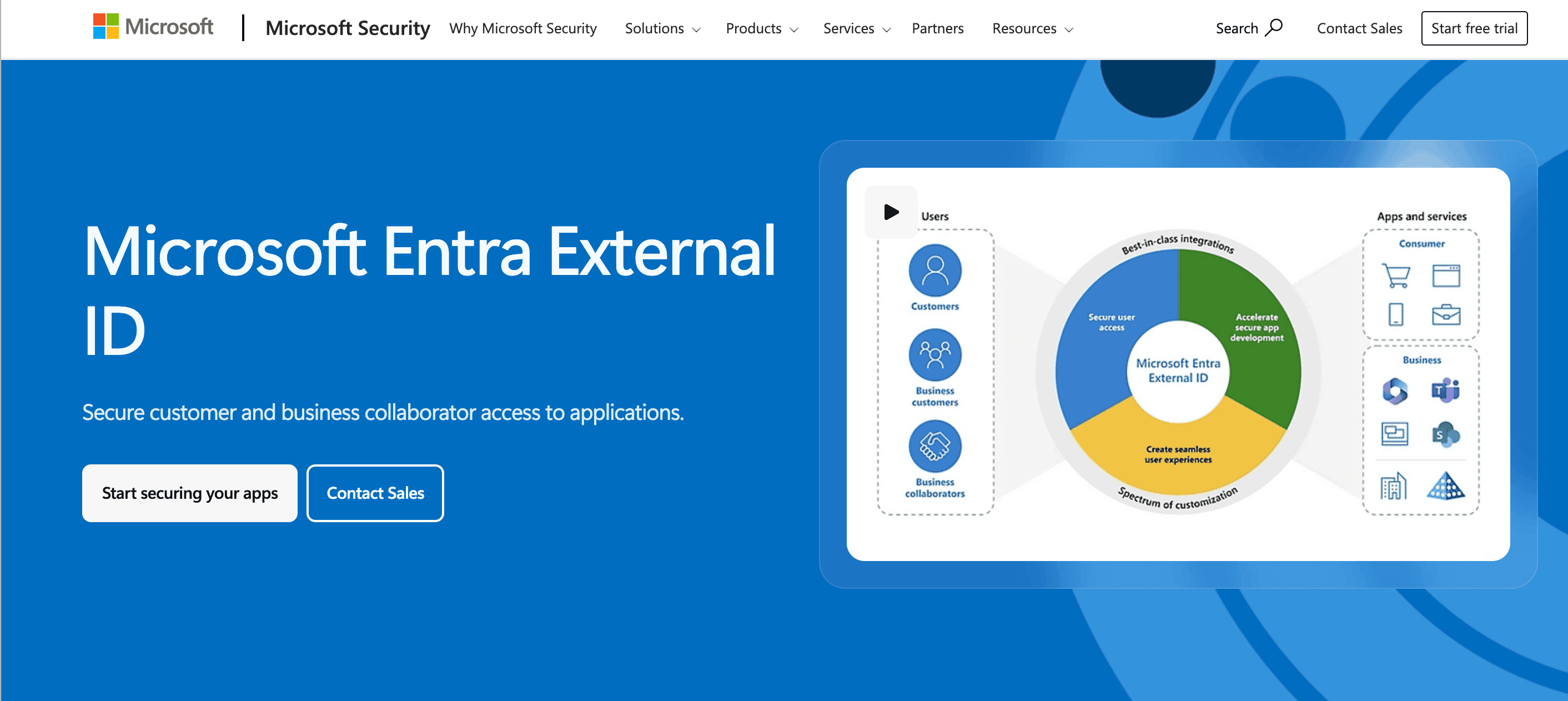
Entra External ID is Microsoft’s customer identity offering and the successor path for teams on Azure AD B2C.
Organizations already running Microsoft across their stack will find procurement and security review straightforward, and federation with Entra tenants on the customer side is well-trodden. However, the architecture is directory-first and built originally for workforce identity, which adds friction to several common CIAM requirements. Per-tenant branding, journey customization, and the developer experience around custom policies are the challenging areas teams most often cite during evaluation.
Key capabilities
Federation across SAML and OIDC, with strong alignment to Microsoft identity sources.
Custom policies for extending authentication journeys.
Conditional access concepts carried over from the workforce product.
Integration with the wider Entra and Azure administrative tooling.
Strengths
Minimal friction when the buyer and the customer base are both Microsoft-standardized.
Backed by Microsoft’s compliance and regional infrastructure footprint.
Consolidates vendor relationships for organizations already licensing Entra.
Ideal for
Organizations committed to the Microsoft ecosystem whose customer identity requirements stay close to what the directory model handles natively.
Keycloak
Keycloak is an open-source identity and access management project maintained by Red Hat, and teams run it on their own infrastructure.
It implements auth standards thoroughly, supports SAML and OIDC federation, and gives a team complete control over where identity data lives and how the system behaves. There is no license cost, which is usually what puts it on the list. The cost moves to engineering instead. Teams running Keycloak in production report meaningful effort around scaling, upgrades, and the admin experience. Realms are the closest fit for modeling tenants, and they get harder to manage as the number of customer organizations grows.
Key capabilities
Full SAML 2.0 and OIDC support, including identity brokering to external providers.
Realms for isolating configuration, commonly used to model tenants.
Extension points through service provider interfaces and custom authenticators.
Complete control over deployment location and data handling.
Strengths
No license cost and no vendor dependency on the identity layer.
Deployment anywhere, which satisfies strict residency or air-gapped requirements.
Standards coverage that is thorough enough to handle unusual federation requirements.
Ideal for
Teams with infrastructure engineering capacity, strict control or residency requirements, and tolerance for owning upgrades and operations.
Choosing between IdP vendors for B2B SaaS
Most shortlists get shorter once your requirements are clear.
If enterprise SSO and SCIM are the gap and your existing authentication works, augmentation-friendly layers like Descope or WorkOS address that directly.
If you need B2B structure and consumer-grade authentication methods in one platform, a full-stack CIAM like Descope or Auth0 is a closer fit.
If prebuilt B2B UI is the priority and the supplied patterns match your product, Frontegg and Descope get you there quickly.
If your main constraint is ecosystem standardization, Cognito or Entra External ID will be easier to get approved internally, though you will do more work to adapt them to B2B requirements.
If control over infrastructure matters more than operational cost, Keycloak is the option.
Run the pricing model against your actual tenant count before deciding on an IdP vendor. A product with many enterprise customers and moderate user volumes is affected far more by per-connection SSO pricing than by MAU tiers.
Conclusion
The IdP comparison that matters for B2B SaaS comes down to a few structural questions. Are customer organizations a native concept or something you build? Can a customer’s IT admin configure their own SSO connection? Does authorization understand that a user holds different roles in different tenants? Does the pricing model match the shape of your customer base?
Descope was built to answer these questions for B2B SaaS applications. Tenants carry their own SSO, roles, and branding, the SSO Setup Suite hands enterprise onboarding to the customer’s own admins, RBAC and relationship-based access control operate at tenant scope, and Descope Flows keeps authentication logic out of application code. For teams whose customers are asking about AI agent access, the Agentic Identity Hub provides a separate identity model for agents.
Sign up for a Free Forever account to build a tenant-aware login flow, read the B2B use case documentation, or book a demo with our auth experts to walk through your tenant model.