
Table of Contents
Don't have the time to read the entire post? Our human writers will be sad, but we understand. Summarize the post with your preferred LLM here instead.
Most Transport Layer Security (TLS) connections authenticate only one side. A browser checks a website's certificate, but the website learns nothing about the client from the handshake and relies on a password, session cookie, or token sent afterward. For traffic between services, application programming interfaces (APIs), and AI agents, that leaves the client's identity resting on a secret that can be copied.
Mutual TLS (mTLS) adds a certificate on the client side as well. OAuth uses it in two ways: to authenticate clients without a shared secret, and to bind access tokens to the client that received them.
At a glance
mTLS is a form of TLS in which both the client and the server authenticate with X.509 certificates during the handshake.
In ordinary TLS, only the server presents a certificate, and the client proves its identity afterward with a password, cookie, API key, or token.
OAuth uses mTLS for two separate jobs: authenticating a client to the authorization server without a shared secret, and binding access tokens to the client's certificate.
A certificate-bound access token carries a thumbprint of the client's certificate, so a copied token fails unless the presenter also holds the certificate's private key.
mTLS suits service-to-service traffic, workloads with managed identities, and AI agents running on infrastructure that can be issued certificates. It's harder to use with browsers, mobile apps, and anything behind a TLS-terminating proxy that doesn't forward the client certificate.
What is mTLS?
mTLS is TLS with client certificate authentication turned on. Both the server and the client present an X.509 certificate during the handshake, and each proves it holds the private key that matches its certificate.
On both sides, a certificate binds a public key to a subject, such as a hostname, a service name, or a Uniform Resource Identifier (URI), and is typically signed by a certificate authority (CA) the other party trusts. Proving possession of the private key is a form of public key authentication: the key never crosses the network, so there's no shared secret to intercept or replay.
How mTLS differs from TLS
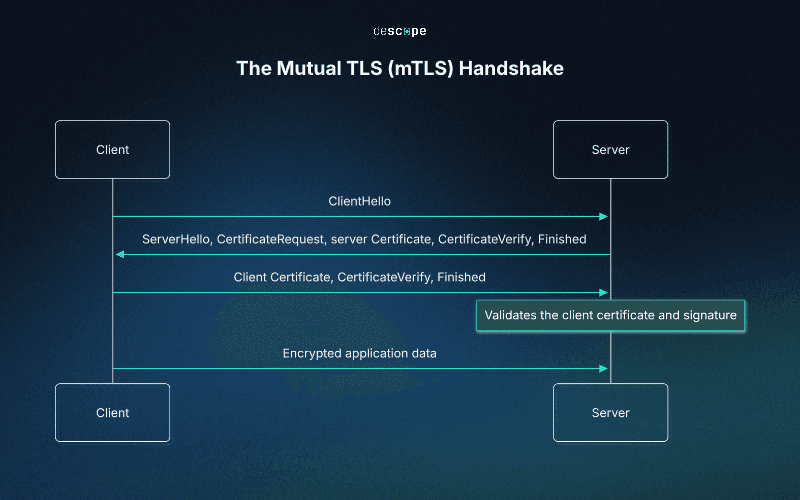
TLS 1.3 always authenticates the server and treats client authentication as optional. mTLS adds one request from the server and one response from the client:
The client opens the connection, as in any TLS handshake.
The server sends its own certificate and, for mTLS, asks the client for one.
The client sends its certificate, along with a signature over the handshake made with its private key.
The server validates the certificate, checks the signature, and completes the handshake.
TLS | mTLS | |
|---|---|---|
Server authenticated | Yes, with a certificate | Yes, with a certificate |
Client authenticated | Not by TLS; the application handles it afterward | Yes, with a certificate during the handshake |
Client credential | A password, cookie, API key, or token sent after the handshake | A certificate plus a private key that never leaves the client |
A server can require a client certificate or treat it as optional, so the same server can enforce mTLS for some clients and not others.
How OAuth uses mTLS
OAuth's baseline client credential is a shared secret, and its baseline access token is a bearer token that works for whoever presents it. RFC 8705, the OAuth mTLS specification, defines mTLS-based alternatives to both. The two are separate mechanisms: a deployment can use either one alone or both together.
mTLS client authentication
When a confidential client calls an authorization server's token endpoint, it normally proves its identity with a client secret or a signed assertion (private_key_jwt). With mTLS client authentication, the proof is the TLS connection itself. The client connects with its certificate and sends its client ID as usual, and the server checks the certificate against what that client registered.
The spec defines two ways to register a certificate:
Public key infrastructure (PKI) method (
tls_client_auth): A CA the server trusts issues the certificate, and the server matches it to the client by the certificate's subject. The client can renew the certificate without re-registering.Self-signed method (
self_signed_tls_client_auth): The client registers its own certificate, for example through a JSON Web Key Set (JWKS), and the server checks for an exact match.
mTLS client authentication works with the client credentials flow, where a service requests a token for itself with no user involved. For example, Descope's Agentic Identity Hub supports mTLS client authentication and certificate-bound tokens alongside private_key_jwt, Secure Production Identity Framework for Everyone (SPIFFE), and workload identity federation, with the method chosen per agent based on how and where it runs.
Certificate-bound access tokens
Certificate binding ties an access token to the client that received it. When a client gets a token over an mTLS connection, the authorization server records a thumbprint of the client's certificate in the token. The resource server compares that thumbprint with the certificate on the incoming mTLS connection. If they don't match, the request is rejected, so a token captured through a man-in-the-middle attack (MITM) or leaked from a log can't be used without the certificate's private key.
Demonstrating Proof of Possession (DPoP) reaches the same outcome at a different layer. A DPoP client generates its own key pair and signs a proof for every HTTP request, and the token is bound to that public key instead of a certificate. mTLS binding needs no per-request proof, because the handshake already showed possession of the key, but the certificate has to reach whatever checks the token.
Bearer token | DPoP-bound token | Certificate-bound token | |
|---|---|---|---|
Bound to | Nothing | A public key the client generates | The client's X.509 certificate |
Proof of possession | None | A signed proof in each HTTP request | The mTLS handshake |
Copied token | Usable until it expires | Fails without the private key | Fails without the certificate's private key |
Needs a certificate | No | No | Yes |
Behind a TLS-terminating proxy | Unaffected | Unaffected | Works only if the proxy forwards the certificate |
Binding doesn't depend on mTLS client authentication. A public client with no credentials of its own can generate a self-signed certificate per installation, so its tokens and refresh tokens are bound to that one instance.
When to use (and not use) mTLS
mTLS works best where both ends of a connection are software that can be issued certificates, and the TLS connection carries the certificate all the way to the party that checks it.
Scenario | How well mTLS fits |
|---|---|
Service-to-service traffic | Good fit. Both sides can hold certificates, and each authenticates the other on every connection. |
SPIFFE workloads | Good fit. X.509-SVIDs are certificates built for mTLS and rotate automatically. |
AI agents on managed infrastructure | Good fit. A certificate replaces a stored secret, and bound tokens limit the value of a leaked token. |
Behind a TLS-terminating proxy | Possible fit. Works if the proxy forwards the client certificate and the backend trusts the proxy. |
Browsers and mobile apps | Poor fit. Certificates are hard to issue and manage on user devices, and DPoP covers the same goal. |
Service-to-service traffic
Microservices, partner APIs, and back-office integrations are all connections between software run by organizations that can issue certificates. Each side authenticates the other on every connection, and when OAuth tokens are involved, binding keeps a token from being replayed by any service other than the one it was issued to. Every service in that setup is a non-human identity with its own certificate.
SPIFFE workloads
SPIFFE gives workloads verifiable identities issued at runtime. Its X.509 SPIFFE Verifiable Identity Document (X.509-SVID) is a certificate designed for mTLS, so a workload can present it directly as its client certificate. Because SPIFFE deployments issue and rotate these certificates automatically, they remove much of the management work mTLS otherwise requires. SPIFFE also defines a JSON Web Token (JWT) version, the JWT-SVID, which Descope accepts for client authentication through workload identity federation.
TLS-terminating proxies and load balancers
mTLS proves identity on a single TLS connection. When TLS ends at a load balancer, reverse proxy, or API gateway, the application behind it never sees the client's handshake. The proxy has to pass the certificate along, for example in the Client-Cert header standardized by RFC 9440, and the backend has to accept that header only from the proxy. Certificate binding then holds only as far as the trust between proxy and backend. DPoP doesn't have this dependency, because its proof travels in an HTTP header and passes through the proxy intact.
Browsers and mobile apps
Requesting a client certificate can cause problems for browsers and other clients that don't use mTLS, so OAuth authorization servers can list separate mTLS endpoints in their metadata. Resource servers can advertise that they expect certificate-bound tokens the same way, through Protected Resource Metadata. On user devices, issuing certificates and replacing them before they expire is the harder problem, and replacing a certificate also invalidates the tokens bound to it. DPoP needs no certificate authority, which makes it a fit for these clients.
AI agents and MCP servers
AI agents that run on managed infrastructure, such as a backend service calling a Model Context Protocol (MCP) server or an internal API, can authenticate like any other workload. mTLS client authentication replaces the API key or client secret an agent would otherwise hold, and certificate-bound tokens keep a leaked token from working without the agent's certificate. Agents running where certificates are hard to issue can get the same protection from DPoP.
Moving client identity into the handshake
mTLS moves a client's identity from a secret sent with each request to a certificate checked during the TLS handshake, and certificate binding extends that check to every token the client uses. Where certificates can be issued and reach the party that verifies them, both replace credentials that work for anyone who copies them with credentials that require a private key. Where they can't, DPoP binds tokens at the application layer instead. Descope's Agentic Identity Hub supports both, so each agent or workload can use the method that fits where it runs.
To try mTLS client authentication and certificate-bound tokens with Descope, sign up for a Free Forever account, join AuthTown, our open user community for developers, or book time with our auth experts.