


Table of Contents
Don't have the time to read the entire post? Our human writers will be sad, but we understand. Summarize the post with your preferred LLM here instead.
Your healthtech service may have started with a simple identity need — giving patients or members a secure way to sign up and log in. As you move upmarket, that login experience quickly becomes more complex.
Hospitals expect enterprise SSO and automated provisioning. Different users require different access levels. Security teams need stronger authentication and auditable controls for protected health information (PHI). EHR integrations introduce SMART on FHIR requirements. AI agents bring their own identity and permission needs. Identity stakes are especially high in healthcare, which has had the most expensive data breaches for 14 consecutive years, averaging $7.42 million per breach in 2025.
For healthtech companies moving toward a multi-tenant enterprise platform, the challenge is preparing for these identity requirements before each new customer onboarding becomes another engineering project. These tips can help you build for what comes next for your healthcare technology application.
At a glance
Healthtech identity becomes more complex as products scale from a single patient portal to a multi-tenant enterprise platform serving providers, payers, employers, partners, and AI agents.
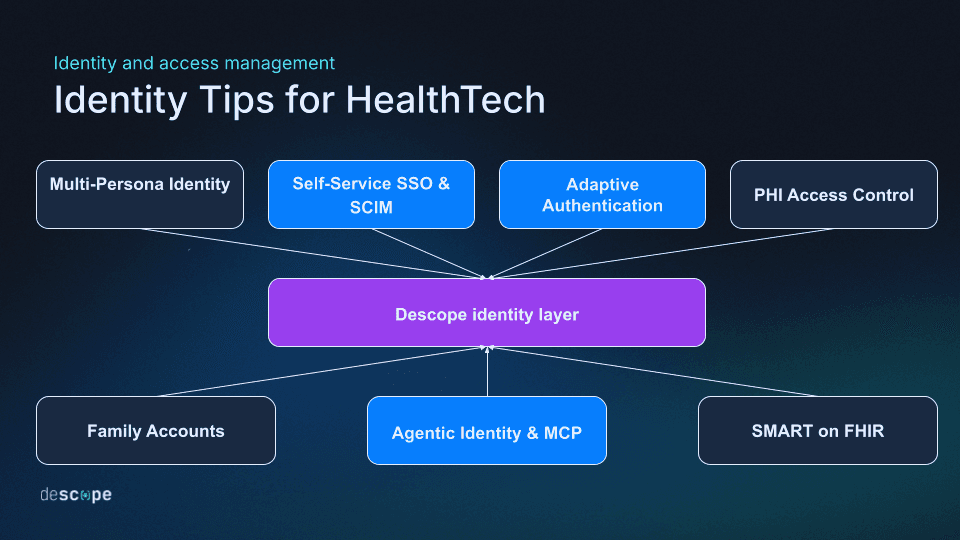
The tips covered here are planning for multi-persona identity, setting up self-service SSO and SCIM, moving beyond passwords and SMS OTP, building access control for PHI, making SMART on FHIR a configurable flow, establishing agent identity early, and modeling guardian and dependent relationships.
Each tip pairs a challenge healthtech teams commonly face while scaling with a practical solution so identity is fixed with purpose rather than patched deal by deal or launch by launch.
Descope brings these capabilities together in one platform with capabilities such as enterprise SSO and SCIM, adaptive authentication, fine-grained access control, SMART on FHIR support, agentic identity for MCP, and Family Accounts.
Plan for multi-persona identity in advance
Challenge
Most healthtech apps don’t stay single-persona for long. A patient or member portal may expand to clinicians, caregivers, administrators, employers, and other users, each with different authentication and access needs.
For instance, a patient signing in from a phone might use a passkey or magic link, while a clinician may require enterprise SSO and MFA. Caregivers, in turn, may need permission to act for dependents, and administrators may need broader organizational access.
If your identity architecture supports only one user type, each new persona becomes another engineering project. Users may have multiple accounts, and teams struggle to maintain consistent access controls.
Solution
Plan for different user types early so your identity architecture grows with your product. Consider who needs access today and how those needs could change as you add customers and services.
Map your user types: Identify current and future authentication and access requirements.
Create a shared identity layer: Keep identity consistent across applications and portals.
Adapt each experience: Apply authentication, branding, and permissions based on context.
Model user relationships: Connect caregivers, patients, clinicians, and organizations appropriately.
With these foundations in place, you can add new personas without creating separate identity systems or rebuilding your application.
Also read: Descope Per-Tenant Identity Isolation for B2B Platforms
Set up self-service SSO and SCIM
Challenge
Onboarding a hospital, health system, PBM, or large employer can introduce identity requirements your product has not faced before. Enterprise IT teams may expect SAML or OIDC SSO, SCIM provisioning, tenant-level roles, delegated administration, and audit logs.
If developers must configure identity for every new customer, onboarding can quickly become a bottleneck. Deployments take longer, engineers get pulled from product work, and support demands increase as customer requirements change.
Solution
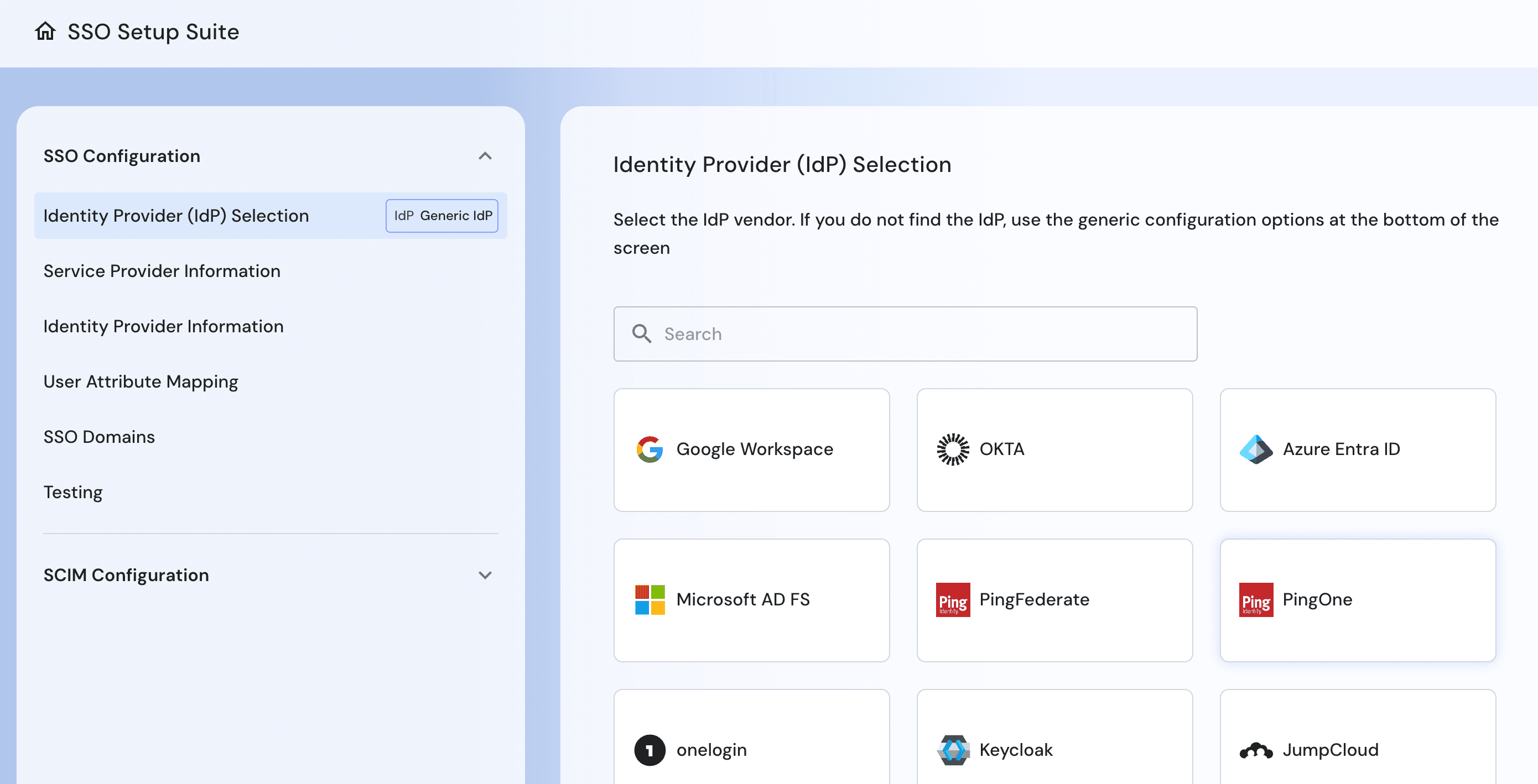
Make enterprise identity onboarding self-service so customer IT teams can configure and manage their environment through a guided, repeatable experience.
Guide SSO setup: Walk admins through configuring SAML or OIDC connections.
Automate SCIM provisioning: Provision and deprovision users as access changes.
Validate configurations: Test and identify setup issues before connections go live.
Delegate administration: Let customers manage users, roles, access, and identity settings.
Self-service helps enterprise customers manage their identity needs while keeping your engineering workload from growing with every new account.
Also read: Descope SSO Setup Suite and Descope Admin Portal
Move beyond passwords and SMS OTP
Challenge
Healthtech apps must protect sensitive data and accounts while keeping access simple for patients and clinicians. Passwords complicate this balance because they can be phished, reused, or exposed in attacks. Adding SMS OTP to every login creates friction and does not always protect against modern threats.
More authentication steps can frustrate patients trying to access care and interrupt clinicians during routine work. Too much friction may even encourage users to find workarounds that introduce new security risks.
Solution
Adjust authentication based on risk. Modern methods simplify everyday access, while adaptive controls add stronger verification when needed.
Reduce password reliance: Use passkeys and magic links for simpler, more secure authentication.
Evaluate risk signals: Consider device, behavior, network context, and fraud indicators.
Use adaptive MFA: Trigger additional verification for unusual or higher-risk activity.
Protect sensitive actions: Apply step-up authentication when users access PHI or perform higher-risk actions.
For example, a clinician logging in from a trusted device can work without MFA, or accessing health records triggers an additional authentication step. This strengthens security and keeps routine access simple.
Build access control for protected health information
Challenge
In healthcare, a user's role often does not determine all the information they should access. For example, a clinician may need records for patients on their care team, while a billing specialist may only need information tied to a specific facility. Access depends on both the user's role and their relationship to the patient or organization.
As a result, traditional role-based access control (RBAC) struggles with this complexity. Teams often use custom permissions, making access harder to manage and audit and increasing the risk of inappropriate access to protected health information (PHI).
Solution
Design authorization around the context of each request. Combining RBAC with attribute-based access control (ABAC) and relationship-based access control (ReBAC) lets teams account for roles, attributes, and healthcare relationships.
Define access by role: Use RBAC to establish baseline permissions.
Next, add contextual attributes: Use ABAC to consider factors such as facility or organization.
Model healthcare relationships: Use ReBAC to define relationships among patients, authorized providers, care teams, and data resources.
Keep permissions current: Adjust access as patient, provider, or organizational relationships change.
This approach helps teams apply least-privilege access to PHI and manage authorization more easily as the application grows.
Also read: Healthcare Identity and Access Management Best Practices
Make SMART on FHIR a configurable identity flow
Challenge
Connecting a healthtech app to an electronic health record (EHR) introduces specialized identity requirements. SMART on FHIR builds on standards like OAuth 2.0 and OIDC, while adding healthcare-specific requirements for scopes, authorization, and consent.
Teams without deep OAuth or SMART on FHIR expertise will need to build redirects, token validation, consent flows, and authorization logic themselves. This adds code to maintain and can cause issues during EHR certification or customer rollout.
Solution
Create a consistent identity foundation for SMART on FHIR and configure flows for individual EHR and customer requirements.
Standardize core protocols: Use a consistent OAuth 2.0 and OIDC foundation.
Configure healthcare requirements: Add PKCE, granular scopes, consent, and identity claims.
Adapt each integration: Configure flows for different EHR and customer requirements.
Simplify ongoing changes: Update flows as interoperability requirements evolve.
This approach reduces custom authentication code and provides security teams a consistent implementation to review. Teams can reuse the same foundation as they add EHR integrations and enterprise customers.
Also read: How to Build SMART on FHIR-Compatible Apps With Descope
Establish agent identity foundations early
Challenge
Agentic AI is becoming a core part of healthtech products, including clinical copilots, scheduling assistants, and agents connecting with healthcare systems through the Model Context Protocol (MCP). During development, teams may rely on service accounts, long-lived API keys, or shared tokens. These identity anti-patterns can create security and governance issues as agents move into production.
Without clearly defined agent identities, teams may struggle to determine which agent took an action, who authorized it, and what it can access. These issues can arise during enterprise security reviews and delay AI features that are otherwise ready for production.
Solution
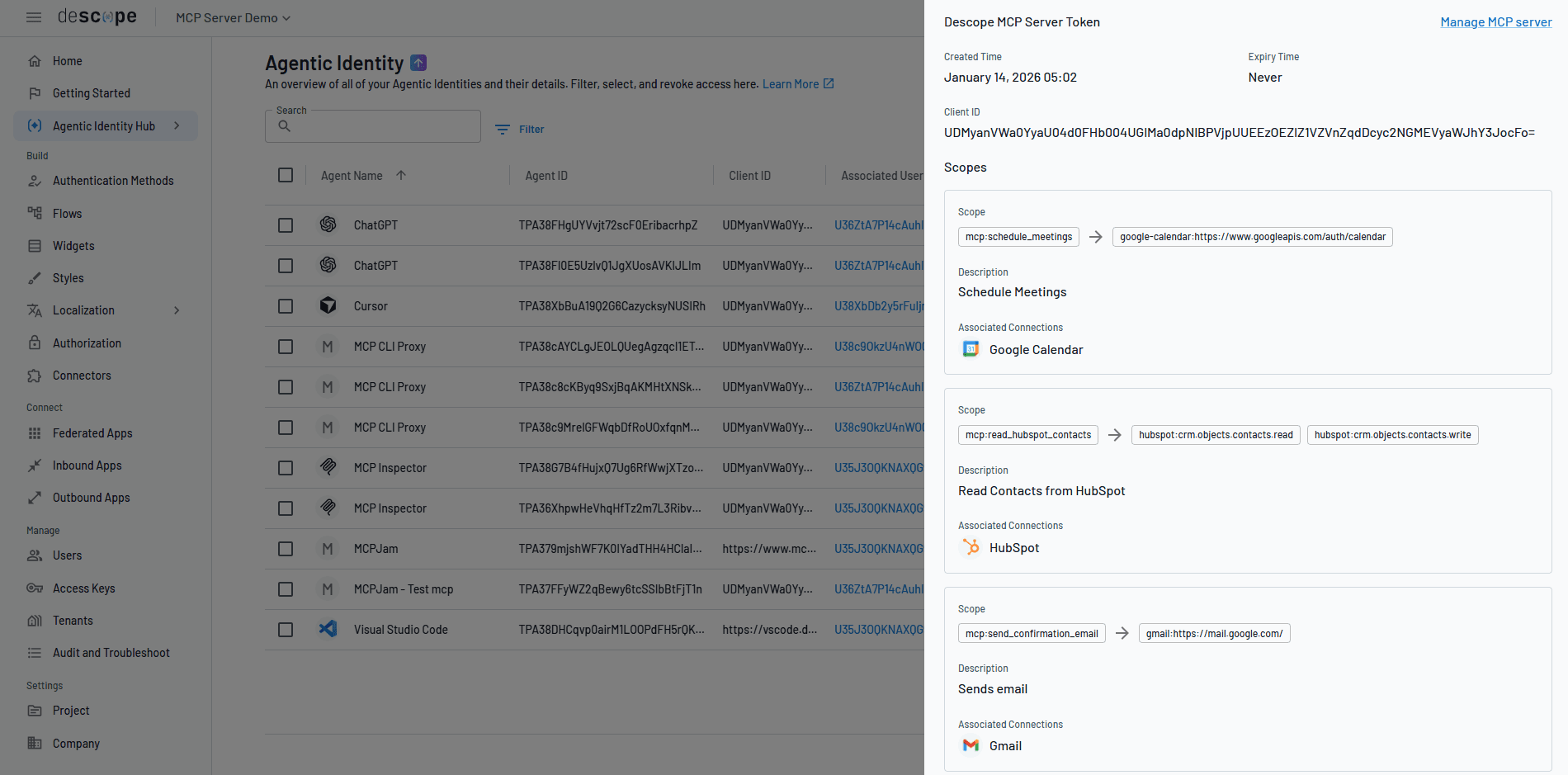
Give AI agents their own identities as they move toward production. Define what each agent can access, record its activity, and link delegated actions to the appropriate user.
Establish agent identities: Give each agent a distinct identity, owner / delegating user information, clearly defined scopes and access permissions, and an audit history.
Scope MCP access: Limit agents to the tools and resources they need when accessing MCP servers.
Govern delegated actions: Control actions performed on a user's behalf through authorization and consent.
Support enterprise agents: Use agent SSO to securely connect customer agents.
These controls help teams monitor agent activity, modify or revoke access, and give security teams greater visibility into how AI interacts with healthcare systems.
Also read: MCP Server Security Best Practices to Prevent Risk
Model guardian and dependent relationships
Challenge
Healthcare often involves someone acting on another person's behalf. Parents may manage care for children, multiple guardians may need access to the same dependent, and adults may help elderly parents with their healthcare.
Many healthtech applications assume one account belongs to one individual. Shared family accounts weaken accountability because it is hard to determine who viewed information or took an action. Custom guardian logic can preserve separate accounts but adds engineering work and makes permissions harder to manage as family relationships change.
Solution
Build guardian and dependent relationships into your identity model so both caregivers and dependent users have distinct identities and appropriate access.
Define dependent profiles: Give dependents their own identity profiles even when they don't authenticate themselves.
Separate guardian identities: Give each guardian their own account and audit history.
Define relationship-based permissions: Set access based on each guardian's relationship to the dependent.
Add approval workflows: Require guardian approval for sensitive actions when appropriate.
This approach supports multiple guardians with different permissions while keeping actions attributable to the person who performed them. It also provides clearer access controls and audit trails as caregiving relationships evolve.
Identity tips for healthtech: at a glance
Tip | Challenge | Solution |
|---|---|---|
Plan for multi-persona identity in advance | New user types get bolted onto a single-persona identity architecture as products grow. Each addition becomes its own engineering project and leaves users with fragmented accounts. | Map every current and future persona early and build a shared identity layer that adapts authentication, branding, and permissions by context. |
Set up self-service SSO and SCIM | Enterprise IT expects to configure SAML/OIDC SSO and SCIM themselves, but manual onboarding turns every deal into an engineering project. | Give customer IT teams guided, self-service SSO and SCIM setup with built-in validation and delegated administration. |
Move beyond passwords and SMS OTP | Passwords and SMS OTP are easy to steal, and high-friction MFA at every login frustrates patients and clinicians. | Default to passkeys and magic links, then apply adaptive, risk-based step-up only when a login looks unusual. |
Build access control for protected health information | Roles alone don't capture who should see PHI, and homegrown fixes turn into brittle, hard-to-audit permission code. | Combine RBAC, ABAC, and ReBAC so access follows a person's real relationship to the patient, facility, or care team. |
Make SMART on FHIR a configurable identity flow | EHR integrations add healthcare-specific OAuth requirements that catch teams without deep OAuth expertise off guard. | Deliver SMART on FHIR as a configurable flow on a standard OAuth 2.0/OIDC base instead of custom-building it per integration. |
Establish agent identity early | AI agents using long-lived API keys or shared tokens won’t pass an enterprise customer’s security review and risk the company falling out of compliance. | Give every agent its own identity with scoped access to MCP servers and APIs, delegated consent, and agent SSO for enterprise customers. |
Model guardian and dependent relationships | Shared family logins erase the audit trail, and custom guardian workarounds add to technical debt and engineering workload. | Give dependents and guardians their own identities, with support for delegated impersonation and approval flows. |
Descope for healthtech identity
Making a healthtech application enterprise-ready introduces new identity requirements across the product. Descope unifies these capabilities in one platform, providing healthtech developers with abstraction layers like visual workflows, SDKs, and an MCP server to easily build and modify identity journeys.
Enterprise-ready identity (CIAM): Support different user populations through a shared identity layer. Descope provides SAML and OIDC SSO, SCIM provisioning, delegated administration via embeddable widgets and a hosted Admin Portal, identity orchestration, and audit trails to support enterprise onboarding and security requirements.
Self-service SSO and tenant management: Descope’s tenant-aware architecture supports complex B2B2X identity relationships that healthtech apps often grow into. Self-service SSO and SCIM let customer IT teams configure connections, while delegated administration gives control over users and access within their organization.
Authentication and account security: Passwordless methods like passkeys and magic links simplify authentication. Adaptive controls use contextual signals to trigger extra verification when risk rises, protecting accounts while limiting friction.
Access control for healthtech: Descope combines RBAC, ABAC, and ReBAC to provide fine-grained authorization. Healthtech teams can define access based on roles, attributes, and relationships, helping apply least-privilege principles to PHI.
SMART on FHIR and healthcare interoperability: Descope supports OAuth 2.0, OIDC, PKCE, granular scopes, and consent through configurable identity flows. This provides a consistent foundation for SMART on FHIR integrations and reduces specialized authentication work for EHR connectivity.
Agentic identity and MCP: Descope’s Agentic Identity Hub gives AI agents distinct identities with controlled access and auditable activity. Teams can delegate agent access to their product APIs and MCP servers, secure downstream credentials, and support enterprise agents through Cross-App Access (XAA).
Family Accounts: Descope’s relational identity framework supports dependent profiles alongside separate identities for parents, caregivers, and guardians. Family-scoped roles and attributes define individual permissions, helping applications support complex caregiving relationships while maintaining accountability and clear audit trails.
Descope healthtech customer stories
Collabrios Health
Formed by merging three companies (RTZ Systems, PeerPlace Networks, and Tabula Rasa's PACE EMR division), Collabrios Health inherited a patchwork of legacy identity deployments that slowed customer onboarding and drained engineering time. They chose Descope for tenant-aware authentication, deep SSO support, and self-service SSO and SCIM that lets customer admins configure their own connections. The result is a "single front door" identity layer serving tens of thousands of EHR users across multiple government and healthcare tenants.
b.well Connected Health
b.well needed a scalable identity system for external apps, partners, and services, with multi-region reliability and support for up to 1,500 requests per second. They migrated from Amazon Cognito to Descope in phases, starting with machine-to-machine authentication and then adding user authentication with Descope Flows. This gave b.well a flexible identity foundation for partners, services, and users, without needing a disruptive one-time migration.
Build identity for where your healthtech business is going
Identity requirements tend to grow as a healthtech business grows. What begins as a straightforward login experience can become much more complex as you add enterprise customers, support new healthcare use cases, and adopt AI agents and MCP servers. Planning for that evolution early can keep identity from becoming a recurring engineering bottleneck.
Descope gives healthtech teams an identity foundation they can expand as those requirements change. Self-service SSO can simplify enterprise onboarding, while fine-grained authorization helps protect access to PHI. Family Accounts supports guardians and dependents, while its Agentic Identity Hub assigns AI agents distinct identities and controls access to backend systems.
Want to see how it works? Sign up for a free Descope account or request a demo to see how Descope can support your healthtech identity strategy.